
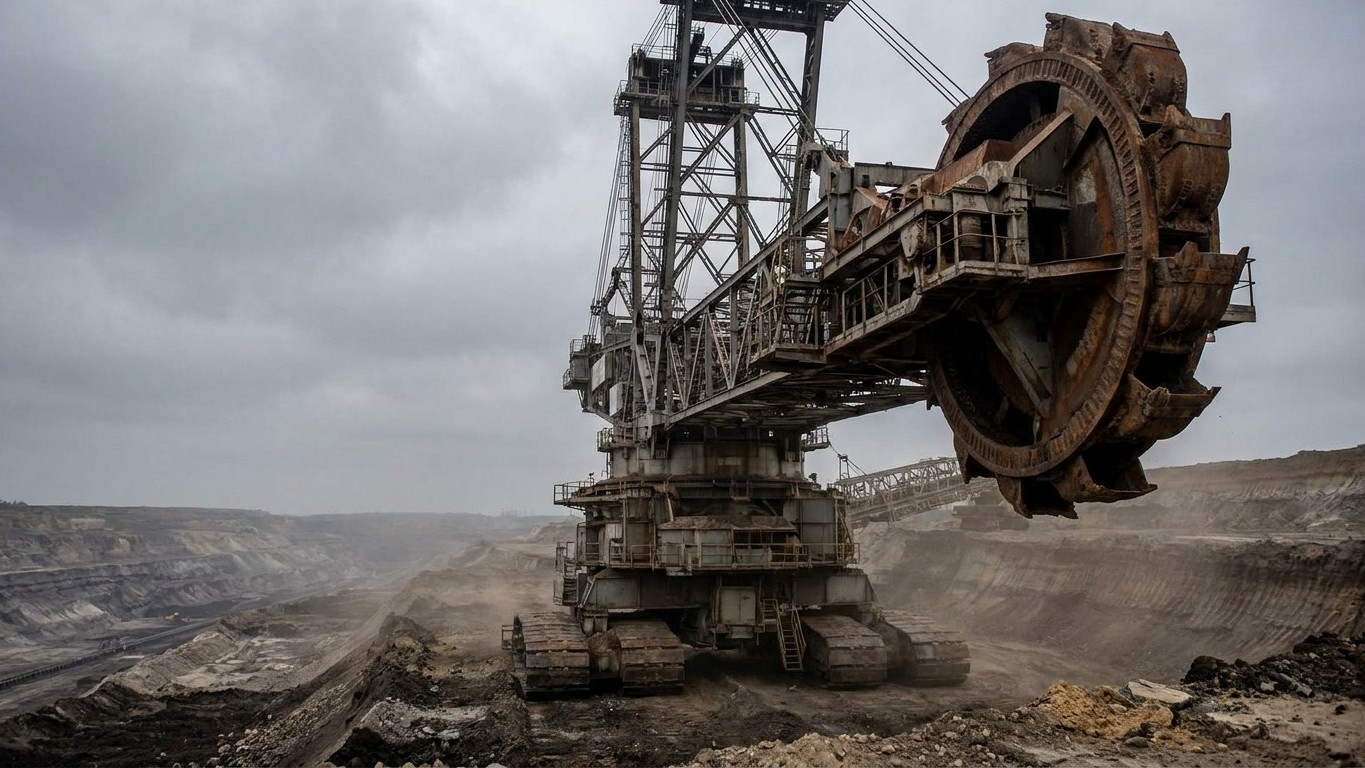
Fourteen thousand two hundred tonnes. That is the weight the ground at Hambach mine, in North Rhine-Westphalia, bears every time the Bagger 293 advances by one meter. No truck could have laid it there, no rail could have borne its load. On that day, what moved this 96-meter-tall machine for the first time were twelve steel tracks, each 3.8 meters wide, capable of distributing an enormous weight across a surface large enough to prevent sinking.
The Bagger 293 isn’t transported. It moves on its own supports, at a pace closer to crawling than to driving. The machine doesn’t roll, it walks, advancing by pressing its own weight into the ground, at a maximum speed of 0.6 km/h, i.e., one-tenth of the pace of human walking. A steel snail, but a snail that redraws entire landscapes.
Key takeaways
- A machine weighing 14,200 tonnes with every step: how does it avoid sinking?
- Why did engineers reject rails and trucks for this colossal machine?
- An industry that shapes the landscape at 0.6 km/h, but whose days are numbered
A Giant Assembled Piece by Piece, On Site
You do not build a machine of this size in a factory and then ship it. It cannot travel along a road, nor be loaded onto a cargo ship. The Bagger 293 is built directly at the mining site, a process that can take 18 months to 3 years. Each beam, each cable, each electrical module is carried separately to the edge of the pit, then assembled on site like a gigantic industrial Meccano set.
Its official name is MAN TAKRAF RB293, conceived and assembled by TAKRAF, a company with deep roots in Germany’s industrial history. Construction began in the early 1990s and was completed around 1995, after nearly a decade of planning, engineering, and assembly. All of this for a bill that, at the time, was phenomenal: about 100 million dollars, a figure that testifies to the effort required to make every piece robust enough.
Neither Truck nor Rail: The Secret of the Twelve Caterpillar Tracks
This is the true tour de force of the machine. A weight like that should, in theory, turn any ground into a moving trap. Here lies the real technical feat of the Bagger 293: its ability to distribute its mass over a vast surface rather than concentrate it. Twelve tracks, spread in a fan beneath the structure, act like giant snowshoes on the ground: they prevent the machine from sinking into its own terrain.
Why not rails, then, as with some extreme mining machines? Because the pit is constantly evolving. The mine face retreats daily, and laying new rails with every movement wouldn’t be viable, so the machine advances by pressing its own weight into the ground. Building fixed infrastructure for a site that continually changes shape didn’t make sense. The solution chosen by TAKRAF engineers was to render the machine completely autonomous in its movements, even if that meant sacrificing speed.
This slowness hides a ruthless logic. As Space Group notes, its 96-meter height earns it, along with its cousin the Bagger 288, a Guinness World Record for the tallest land vehicle, the equivalent of two Statue of Liberty statues set on tracks. Such mass cannot afford haste: every move is measured to the millimeter to avoid tipping.
A Small Mobile Factory Operated by Five People
The paradox is almost comic. The bigger the machine gets, the fewer human arms it needs. Here is the most striking paradox of this machine: the larger it is, the less human labor it requires. Like its sister machines, the Bagger 293 is run by a surprisingly small crew, only five people. Five operators, in a cab perched tens of meters above the ground, to operate the equivalent of a small mobile factory.
Its bucket wheel, however, does not share the same slowness as its tracks. It measures more than 21.3 meters in diameter with 18 buckets, each capable of holding more than 15 cubic meters of material, and it can move up to 240,000 cubic meters per day. In plain language: the equivalent of about a hundred Olympic-sized pools ripped from the earth in 24 hours. This tonnage cleared allows access to the seams of lignite, the brown coal that still fuels part of Germany’s electrical grid.
A Giant in an Industry Under Threat
The Bagger 293 operates at Hambach mine, one of Europe’s largest open-pit operations. Its mission may not look spectacular from afar, but it is vital to German mining: removing the layers of earth and rock that cover coal seams. In short, without it, lignite extraction would not be economically viable at this scale.
Yet the future of these giants hangs on a political timetable. With Germany planning to phase out coal use entirely by 2038, it is hard to predict what will happen to machines like this in the future. Paradoxically, the machine that defies gravity by simply distributing its weight could end up immobilized not by a mechanical fault, but by a decision to exit coal. In the meantime, its tracks continue to move forward, patiently, one meter at a time, on ground it shapes with each step.
Sources: media24.fr | records-du-monde.fr
