
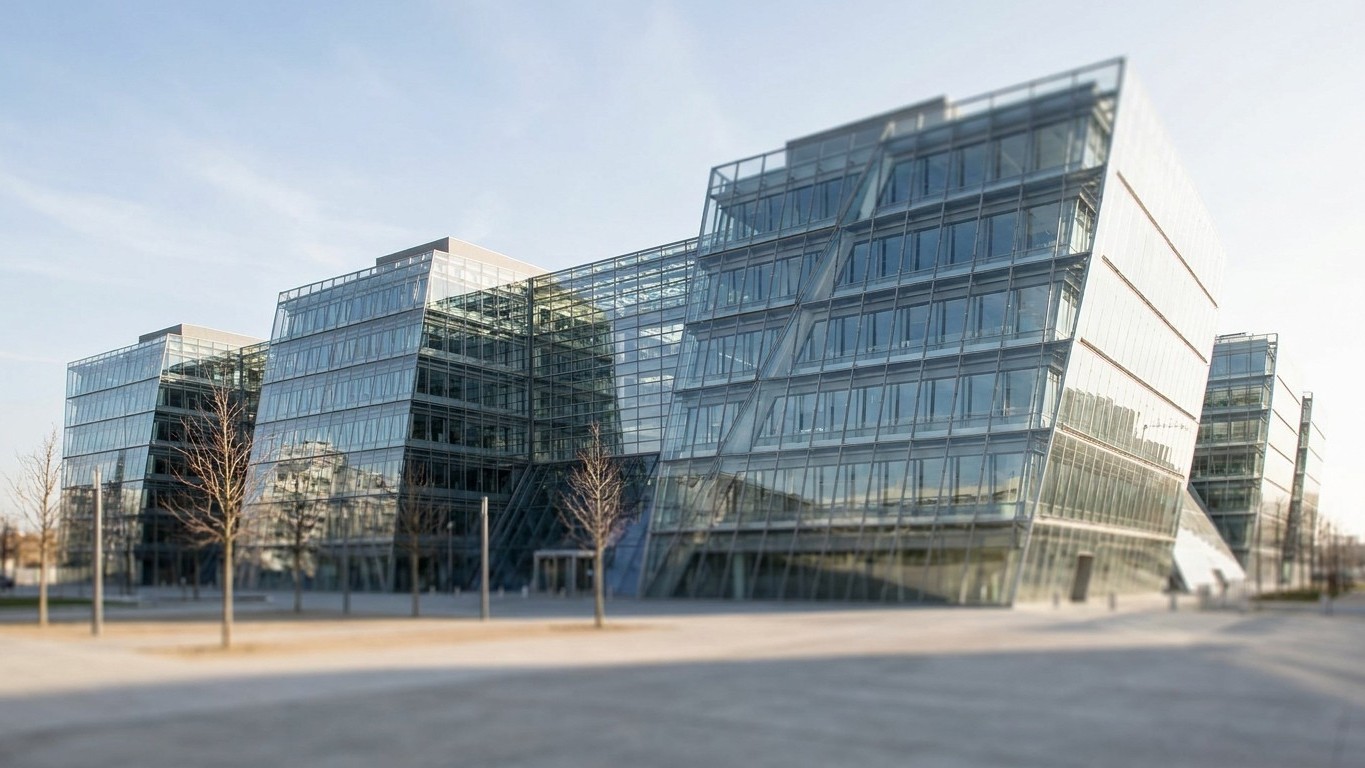
Five point eight billion euros. That is the total bill estimated by the Court of Accounts for the Ministry of the Armed Forces’ headquarters at Balard, in Paris’s 15th arrondissement, a sum that bears little relation to the price displayed at the contract signing in 2011. The building has been delivered, inaugurated, and occupied for eleven years. Yet the State will continue paying the price into the 2040s, at an annual rent that exceeds one hundred million euros each year.
Key takeaways
- Why will a building delivered 11 years ago still cost the State 25 more years in rent?
- How did the initial cost of 600 million escalate to 5.8 billion?
- What revenue promises disappeared and were never kept?
A French Pentagon Financed by the Private Sector
The idea germinated in the mid-2000s: to bring under one site all the headquarters and central bodies of the ministry, which had been scattered across the capital. This grand project, decided in 2007 and completed in 2016-2017, made it possible to bring together on a single site 9,500 personnel from the Ministry of the Armed Forces, previously spread across 12 locations. On paper, the logic was irrefutable: no more commuting between twelve addresses, replaced by a single, secure, functional “Balardgone.”
To finance this colossal undertaking without immediately weighing on the State’s coffers, the ministry chose the route of a public-private partnership. The operation, under a 30-year PPP, was properly prepared and conducted in such a way that the definition of needs, the selection of the contractor, the financial negotiations, and the management of the construction works provided grounds for satisfaction, notes the Court, even though the process was not devoid of malfunctions. The contract was won by a consortium led by Bouygues, partnered with Thales and Sodexo, brought together under the Opale Défense banner. Exprimm would be responsible for the operation and maintenance of the buildings for 27 years from the delivery date. Concretely: the private sector builds, maintains, heats, and cleans; the State rents, while the title to ownership remains suspended for nearly three decades.
A Rent That Weighs Heavier Than the Construction Itself
Here is where the matter becomes telling for the taxpayer. It falls to the constructor to shoulder the cost of the investment, estimated at 600 million euros, and to ensure the maintenance of the buildings, in exchange for an annual rent of 132 million euros over 27 years, at the end of which the State would own the entire complex. Other assessments, covering a slightly different scope, put the annual rent at 154 million euros. In barely five years of cumulative rent, the State has already repaid the construction cost. The remaining twenty-some years are pure service, margin, and financing.
The overall value of the partnership contract is dizzying: the announced investment stood at 3.5 billion euros before tax. A figure already substantially higher than the raw construction cost, which is the very essence of a PPP: you pay more, spread over time, in exchange for the private partner assuming the risk. But the risk, in this case, has not completely shifted sides.
The Overruns that the Court of Accounts Did Not Fail to Highlight
The Court of Accounts’ report, published in February 2018, is clear: the project is an operational success, but a partial budgetary fiasco. In total, the project’s overall cost is estimated at 5.8 billion euros, and the main risk today lies in the future management of the PPP contract by the Ministry of the Armed Forces. Between the initial announcement and the full accounting of expenditures, the gap arises from several precise lines. Notably, the 990 million euro overrun due to in-house support, and 355 million euros corresponding to additional investments. Add to that personnel savings that never reached the targets: the shortfall in funding for payroll savings amounted to 32 million euros, or 24% of the resources expected.
The initial arrangement rested on a simple principle: the ministry would finance the operation thanks to the savings generated by the consolidation, and would, in passing, sell off the freed-up plots in Paris. The problem is that this promise did not hold. Two of its Paris sites, Îlot Saint‑Germain and the Hôtel de la Marine, for which sale was contemplated at several hundred million euros, were ultimately not sold. Consequently, to balance a financing plan that looked solid on paper but not in reality, the ministry had to draw on additional resources to shore up the project’s funding. That much public money injected, which was not supposed to exist in the first place.
Although the building has long since been inaugurated, Balard’s financial story is far from over. The official inauguration took place on 5 November 2015, but the contract runs to roughly 2042. Each passing year adds a line to the ledger, and each renegotiation of contract management recalls one certainty: a public-private partnership transforms a single, visible bill—the construction cost—into a continuous and far less scrutinized stream—the rent. The real test has not been architectural for a long time. It is financial, and it plays out every year in the ministry’s budgetary decisions.
Sources: batiactu.com | opex360.com
