
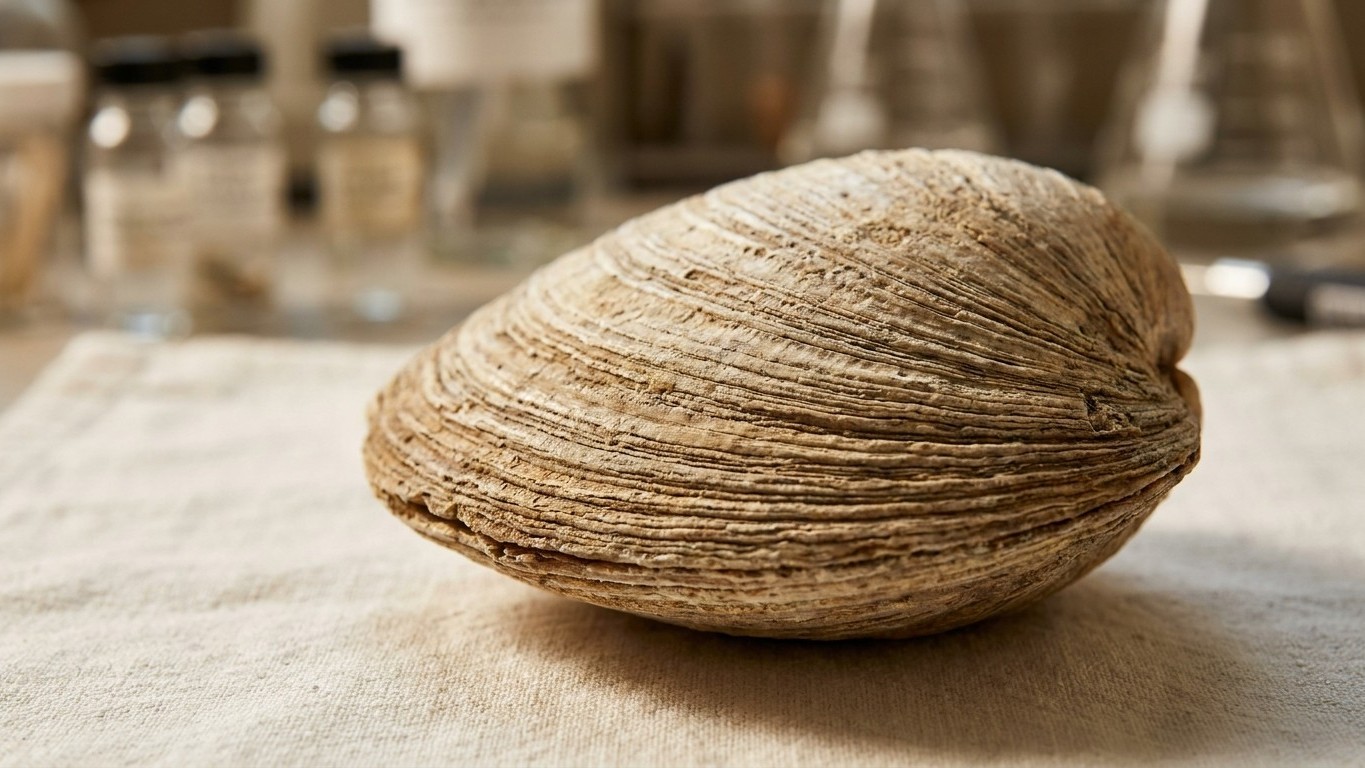
Her name was Ming, and she had already surpassed five centuries of existence when researchers unknowingly pulled her from the water. The quahog, a species of Arctica islandica, lay quietly on the seabed off Iceland since the year 1499. Dredged in 2006 by a team from Bangor University, in Wales, she would become, almost by accident, the oldest non-colonial animal ever recorded on Earth.
The paradox is cruel: it is by trying to unlock her secret that the scientists killed her. The scientists who made the discovery inadvertently killed the very aged bivalve while attempting to determine its age. To count the annual growth rings imprinted on the shell, much like reading the rings of a tree, one must open it. And an opened clam does not survive.
Key takeaways
- A clam discovered in Iceland turned out to have lived more than five centuries
- Researchers determined its true age in two analyses, with a hundred-year gap between estimates
- Its shell holds a climate archive dating back over 500 years
A clam born under the Ming dynasty
The name Ming is far from arbitrary. She was nicknamed “Ming” in reference to the Chinese dynasty reigning at the time of her birth. At the moment this mollusk began its slow life on the cold floors of the North Atlantic, Christopher Columbus had just set foot on American soil, and Leonardo da Vinci was working on a portrait that would become the Mona Lisa.
The year Ming was born, Leonardo was at work on the “Mona Lisa,” and the Ming Dynasty ruled China. It puts into perspective what we mean by “old age.” By comparison, a common clam usually lives only a few decades. Ming, by contrast, lived through the Renaissance, the Napoleonic Wars, and two world wars, hidden in the Icelandic sands.
The calculation of its age was not instantaneous. In 2006, scientists from the School of Ocean Sciences at Bangor dredged the quahog off the north coast of Iceland, and the following year the team first estimated its age to be between 405 and 410 years by examining the shell’s annual growth rings. An already remarkable age. But not the correct one.
A second analysis, six years later, that changes everything
That is where the story takes a more dramatic turn. In 2013, another Bangor research team reported that the clam’s age could be precisely determined at 507 years at the time of its death. A hundred years of discrepancy between the two estimates is not a trivial detail. It is equivalent to adding the entire duration of the French Revolution to the animal’s life.
This revision is explained by more sophisticated measurement techniques, allowing researchers to detect growth rings that the first analysis had missed, notably near the edge of the shell where the growth layers tighten with age. In November 2013, thanks to these more advanced measurement methods, the figure was raised to 507 years.
Professor James Scourse, who led the Bangor work, found himself at the center of an unexpected controversy. “We received emails accusing us of being clam murderers,” he told the BBC. The public, shocked to learn that the oldest documented animal had died for science, did not hold back. Some messages even labeled the team as “clam murderers.”
Yet Ming’s death was not the result of negligence. It is the method itself, the only reliable way to date this type of shell, that requires opening the shell and thus ending the animal.
What the growth rings of a shell reveal
Ming was not an isolated anomaly in Icelandic waters. Other clams analyzed in this study were found to be over 300 years old. This longevity across individuals intrigues researchers for a reason far larger than the mere record: each growth ring records the environmental conditions of the year in which it formed—the water temperature, available food, and marine chemistry.
The Ming shell functions as a living climate archive, reaching back to the 15th century. Ming’s sacrifice should help the research of Scourse and Butler on long-term climatic impacts, the 507-year sample sitting at the top of the series and enabling annual records of marine climate change, never available before for the North Atlantic.
A study published in the journal Palaeogeography, Palaeoclimatology, Palaeoecology used these data to reconstruct more than 1,300 years of climate variability in northern Iceland, drawn from the growth increments of several Arctica islandica specimens.
Today, Ming’s shell valves are preserved as a scientific and educational artifact. The record she holds has, to date, never been surpassed among non-colonial animals; only some corals (colonial organisms made up of thousands of polyps) display even longer lifespans. The next time researchers dredge the icy depths of the North Atlantic, one question deserves asking: how many other Ming-like beings lie there, unseen, until they are counted?
Sources: ilesdelamadeleine.com | snopes.com
