
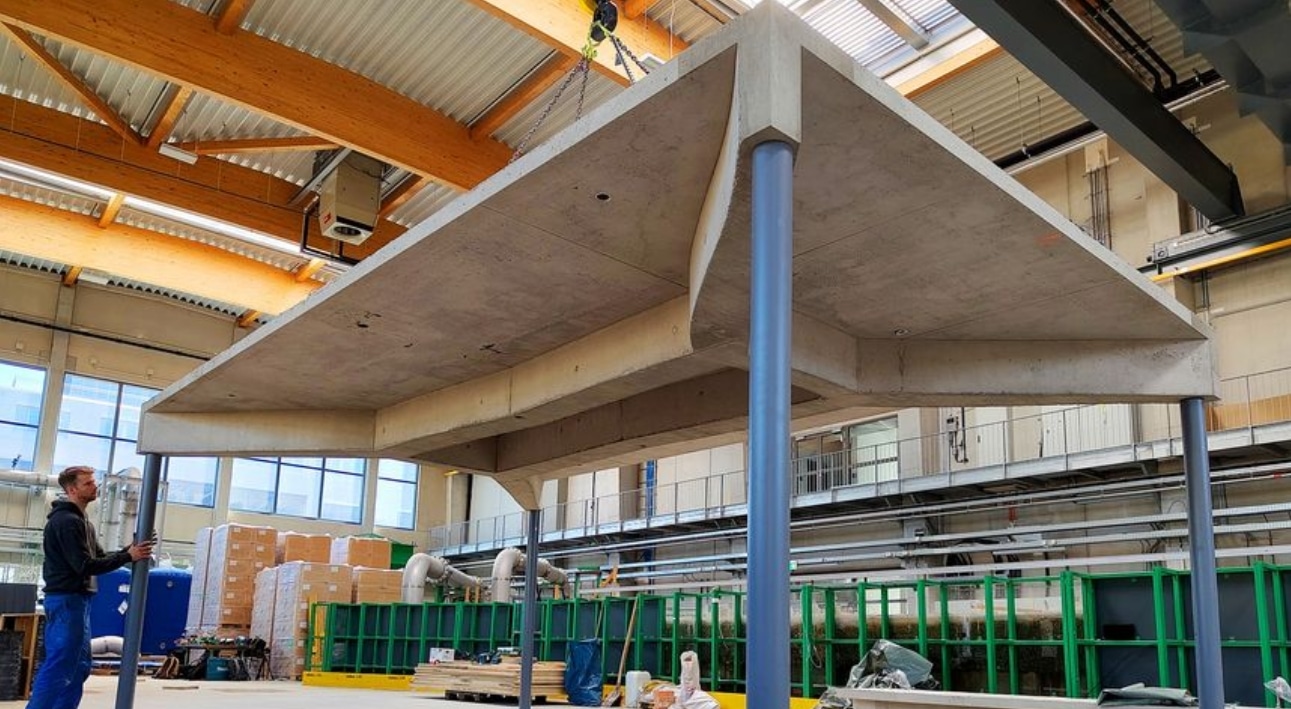
Recently, Austrian researchers unveiled a major technological breakthrough, namely a new generation of reinforced concrete slabs. According to the scientists, this product could deliver substantial savings without compromising the strength of the structures. Could it revolutionize the construction industry? Perhaps.
50% less material, for identical strength
In recent years, concrete production has become a highly important environmental issue. It is worth recalling that cement manufacture—through calcination of limestone—accounts for about 8% of global greenhouse gas emissions. Moreover, this production requires astronomical volumes of construction sand, a sign of plunder and destruction of numerous marine ecosystems.
Naturally, many scientists and other industry players are trying to find credible alternatives to avoid or at least reduce the drift mentioned above. This brings us to the Vienna University of Technology (Austria) and its project Topology-Optimized reinforced concrete Slabs with digital formwork and reinforcement (TOPS), whose details appear in an official publication dated July 21, 2026.
Concretely, it concerns a new generation of reinforced concrete slabs capable of reducing material usage by half. Yet this feat comes with the same strength as traditional structures. But how can such a promise be possible?
Hollow slabs embracing the lines of force perfectly
In the case of a conventional construction, reinforced concrete slabs appear as solid, heavy panels. However, much of this concrete does not directly contribute to the load-bearing capacity of the work. The Austrian researchers used topology-optimization algorithms to calculate precisely the zones where material is indispensable given the mechanical constraints. This makes it possible to remove the unnecessary parts, resulting in much lighter structures characterized by ribs that perfectly follow the lines of force.
It must be noted that prior to these studies, the manufacturing of complex ribbed floors often failed, or was very expensive. The TOPS project helps to overcome these problems through automation. Initially, the data from the computer model are sent directly to the factory machines. The formwork molding the concrete and the tension-resistant reinforcement are entirely the subject of digital design and automated production.
A method whose effectiveness has already been demonstrated
Undoubtedly, the revolution under discussion here is first and foremost ecological, as it aims to reduce material quantities and decarbonize the sector. It should be noted that floors represent up to 60% of the total concrete volume of a multi-story building. Thus, cutting them in half can markedly lower the overall carbon footprint. Obviously, reducing material quantities naturally goes hand in hand with a drop in CO2 emissions.
Furthermore, since the goal is to lighten structures without lowering their solidity, the TOPS slabs could play a role in the mass of cities. Recall that today several cities are gradually sinking into the ground on which they rest. This is notably the case for Venice (Italy), Bangkok (Thailand), Tehran (Iran) or the Indonesian capital Jakarta. In fact, Indonesia is moving its capital.
For the time being, the researchers have unveiled two large-scale demonstrators, which allowed validating the physical viability of the structures and the effectiveness of the method on real constructions. The scientists have indeed built real building segments at full scale, notably for office buildings and shopping centers.
