
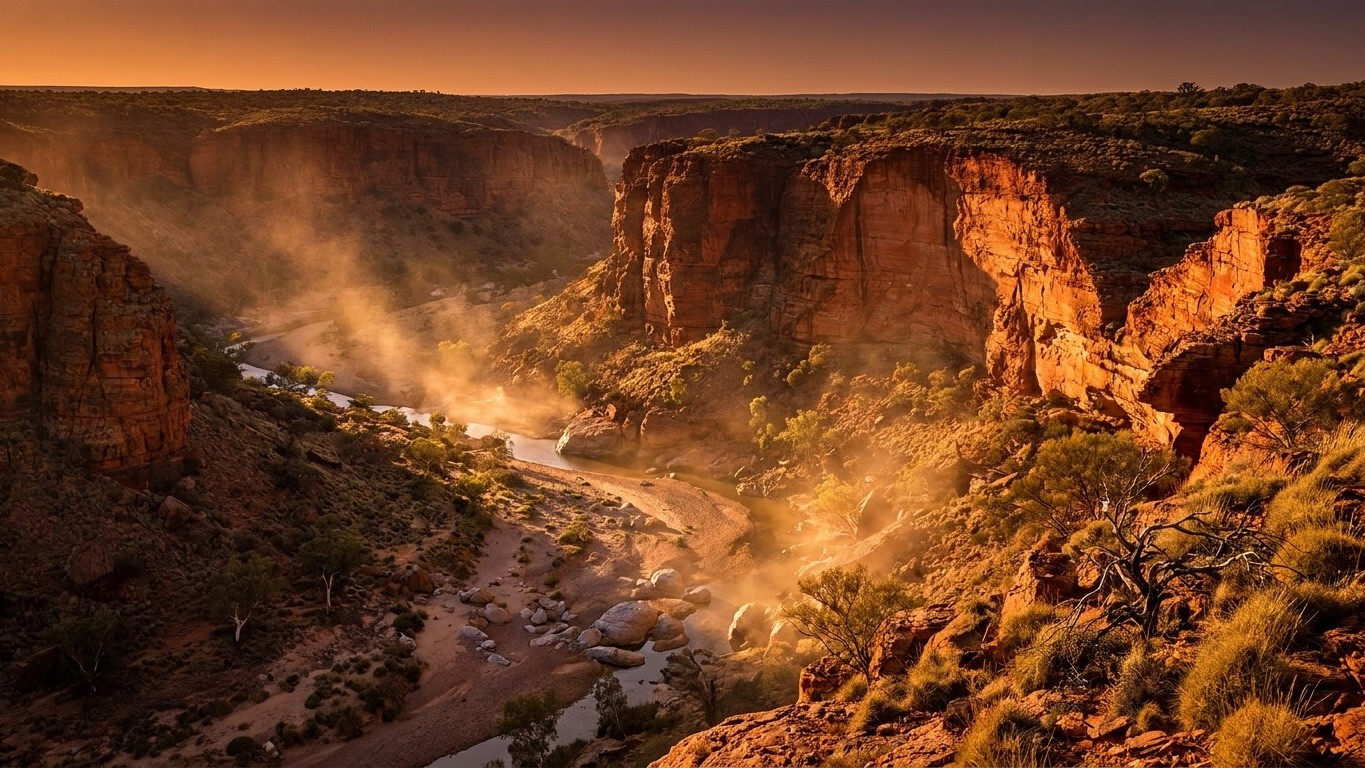
Western Australia has not had a point on the map since 2007. Wittenoom, the former Pilbara mining town, was officially erased from the administrative territory that year, removed from road signs, wiped from official maps. The government aimed to deter visitors. But the rock did not forget: according to Western Australian government data published in 2019, roughly three million tonnes of blue asbestos-contaminated mining tailings remain piled up in the gorges surrounding the site.
This figure is dizzying when viewed in perspective. Three million tonnes is about the weight of eight Eiffel Towers multiplied by a thousand. And these residues are not sealed away in a secure bunker: they blanket the bottoms of the gorges, seep into riverbeds, and are blown aloft at the slightest gust in a region where dust storms are commonplace.
À retenir
- Une ville entière a été gommée des cartes officielles pour dissimuler un problème qui n’a jamais vraiment disparu
- Les résidus toxiques continuent de se disperser au vent et à travers les cours d’eau sans plan de nettoyage en vue
- Des milliers de personnes, dont des migrants italiens, ont grandi en ignorant qu’elles jouaient littéralement dans des tas de poison
A city designed to disappear from collective memory
The story of Wittenoom began in the 1930s, when crocidolite deposits, blue asbestos, were discovered in the gorge that bears its name. During the 1950s and early 1960s, Wittenoom was the sole supplier of blue asbestos in Australia. The mine closed in 1966, due to unprofitable operations and rising health concerns linked to asbestos extraction in the region. In the 1950s, the town looked like a mining utopia: Wittenoom was then the largest town in Western Australia north of the Tropic of Capricorn, promoted as a model mining town equipped with modern facilities, set in a landscape of spectacular beauty.
What stands out most is the organized blindness. There is no doubt that the mining company knew that asbestosis and cancer were highly probable consequences of the working conditions imposed at Wittenoom, and more than 20,000 men, women and children lived in the town during the mining period. Among them were Italian migrants who came seeking a better life: during the 1950s and 1960s, 1,100 Italian migrants worked in the isolated Wittenoom mining town, unaware of health risks, and many brought their families. Children grew up playing literally in piles of toxic residues.
The administrative closure did not come quickly or easily. After decades of such threats, the Western Australian government eventually closed the town in 2006, declaring it a contaminated site and withdrawing all public services, before it was officially delisted and removed from maps in June 2007. A legal and human struggle then continued for nearly a decade, as legislation was introduced in 2015 to forcibly remove the last three residents still clinging to their homes.
Three million tonnes that continue to contaminate air and water
The site today bears a name that says it all: the Wittenoom Asbestos Management Area, a zone listed under the Contaminated Sites Act of 2003. This area covers nearly 47,000 hectares, stretching from the town to the Wittenoom Gorge and the Joffre floodplain. Inside this boundary, contamination is not limited to a distant pile of debris: it is active, mobile, and dangerous.
Wind and water erosion have dispersed blue asbestos fibers over a wide area, inside the gorges as well as beyond, such that loose blue asbestos fibers are now present throughout the management area. Every sandstorm, every seasonal flood, redistributes a little more poison across the landscape.
A engineering firm, GHD, had been commissioned in 2006 to assess the situation for the authorities. The study looked at five zones around Wittenoom, including Yampire Gorge, the Colonial Mine, the Wittenoom Mine and Gorge, the airstrip, and the floodplain, recording 175 sites now classified as contaminated and requiring remediation within the city’s parameter. The options considered at the time—covering the residues, diverting watercourses, demolishing built structures—give an idea of the scale of the undertaking. A project that largely remained virtual: according to the British specialist firm HASAG, there is still no plan to clean up the residues nearly eighty years after their first deposition, and the downstream river water could remain contaminated for more than a century to come.
An “Australian Chernobyl” still open to tourists
What makes the Wittenoom matter almost absurd is its immediate proximity to one of the country’s natural jewels. The site borders Karijini National Park, a heavily visited tourist destination, and the area is regarded as the largest asbestos-contaminated site in the southern hemisphere, sometimes dubbed the “Australian Chernobyl.” Despite warning signs planted all around, despite the name disappearing from maps, tourists continue to ignore warnings and expose themselves to asbestos dust and debris, an exposure that, even at very low levels, can trigger mesothelioma years later.
The human toll, however, does not fade with time. In Western Australia, 1,500 people have been diagnosed with this cancer since the first case in the early 1960s, including around 300 from Wittenoom. A cruel disease since the average life expectancy from diagnosis to death is only nine months.
Since 2022 and 2023, authorities have finally begun the physical demolition of remaining structures, rather than merely erasing them from maps. Yet the three million tonnes of residues remain at the bottom of the gorges, carried by the wind with each dry season. Some Aboriginal communities of the Banjima people, whose traditional lands include the site, continue to demand a genuine cleanup rather than a mere access ban, a reminder that depolluting a territory cannot be decreed with a stroke of an administrative pen.
Sources: ashburton.wa.gov.au | mindat.org
