
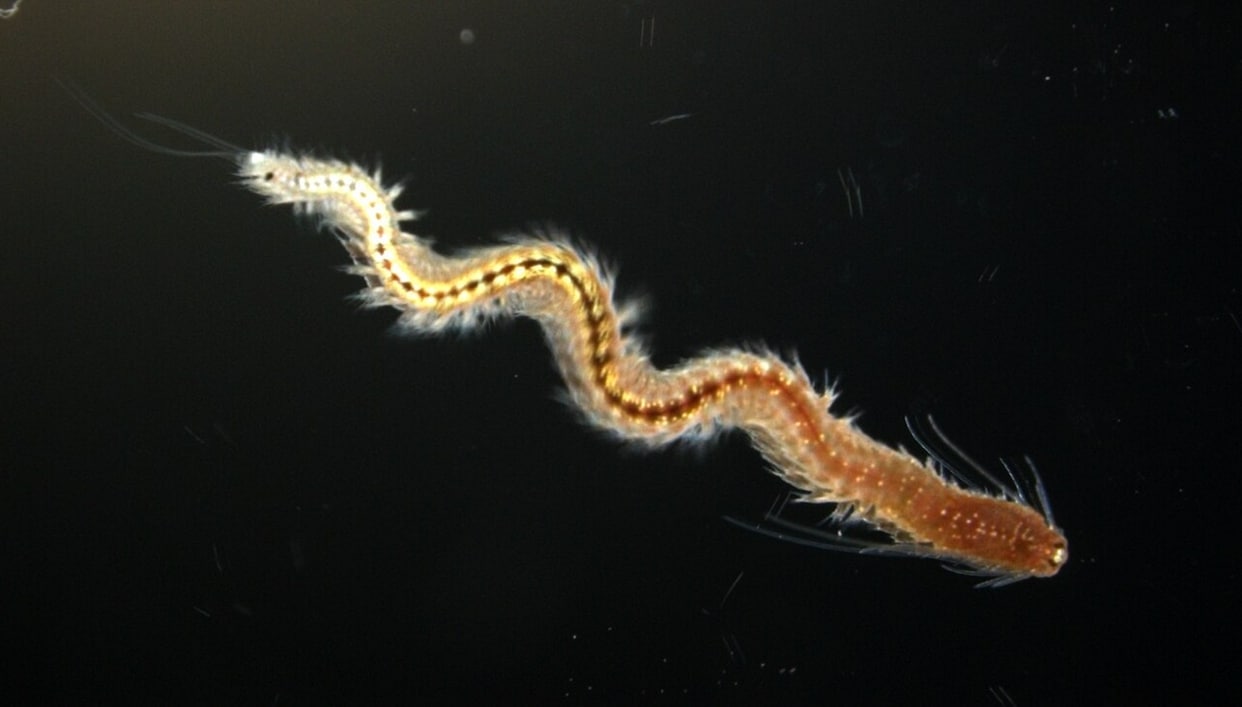
Around the world, there are animals with cells whose protrusions operate in a way that is quite similar to a 3D printer. These are the polychaetes, a group of annelid worms comprising a vast number of species.
Something Very Curious at the Molecular Level
All polychaete worms are aquatic. The vast majority of them are marine, with some living in the estuaries of rivers. Others, however, have taken up residence in freshwater zones but account for barely 200 species among the 13,000 that make up the group. Importantly, polychaetes possess parapodia, lateral appendages in the shape of a limb (or paddle) that enable them to swim, crawl along the seabed, or even dig tunnels. Moreover, these organs are notable for being equipped with “chaetae”, resembling long bristles.
It should be noted that science studies polychaete worms extensively, for the simple and good reason that they are fascinating models for regeneration biology. Indeed, they can regenerate most of their bodies, and do so with greater efficiency than some other organisms with similar capabilities.
Florian Raible works as a molecular biologist at the Max Perutz Laboratories of the University of Vienna (Austria). He and his team published a study on polychaete worms in Nature Communications in 2026. According to the publication, the scientists discovered something very intriguing at the molecular level after employing electron microscopy and tomography.
A Double Discovery!
By examining specimens of the species Platynereis dumerilii, biologists found that the bristles covering the parapodia are accompanied by special cells: blasts. Moreover, these cells themselves bear outgrowths capable of extending and retracting at will. Their function? To deposit chitine—a natural molecule—during the formation of each bristle. According to the researchers, it is possible to compare the outgrowths of the blasts to 3D printers. Yet, beyond this striking and intriguing trait, another surprising discovery was made. There is indeed a very close resemblance between the geometry of the blasts and that of sensory cells found in the inner ear of many vertebrates, including humans.
For Florian Raible, the blasts would not only be interesting for understanding the regeneration process. These outgrowths could in the future become a new model allowing better study of certain similar cells. In other words, it could be possible to better understand conditions such as deafness, which can arise after damage to these sensory cells.
