
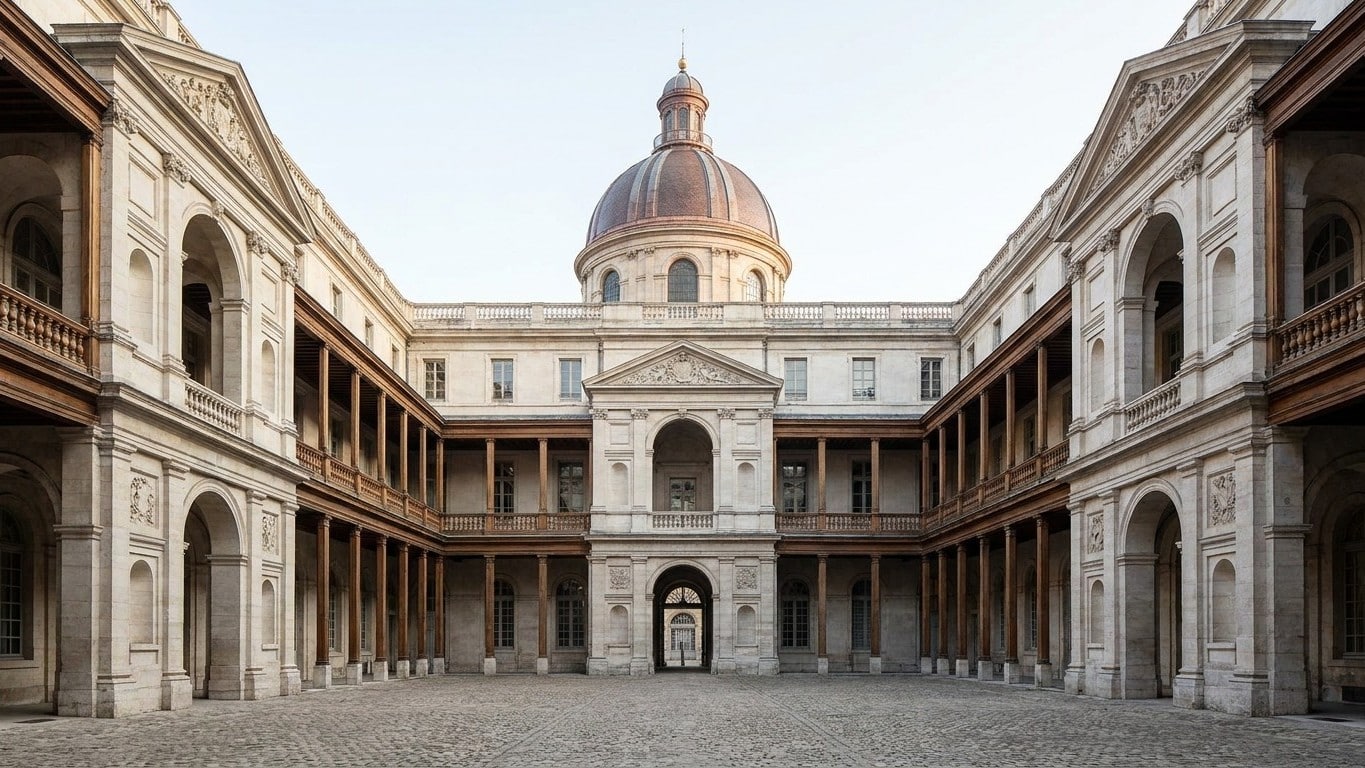
One in three. That was the share of visitors who actually stepped through the doors of the Lyon International City of Gastronomy during its first year, compared to the ambitions announced at its opening. In nine months, only 45,000 people had visited the site, a figure that effectively condemned the project. That number should be read against the 150,000 visitors hoped for in that first full year, which itself was a downscaled version of the initial target. The venue still exists, in one of the Presqu’île’s most photographed monuments. But it lived in its original form for barely nine months.
À retenir
- A €20 million project bets on Lyon’s prestige to draw 300,000 visitors annually
- Only a third of the expected visitors turned up in nine months, despite a €24 ticket
- Flawed scenography and excessive pricing: the real reasons for the fiasco, according to experts
A bet of 300,000 visitors per year
The project was not short of ambition. The stated goal was a high attendance of 300,000 visitors per year across the 3,930 m² that the City was to occupy. This figure was, in municipal communications, compared to the attendance of the Museum of Fine Arts of Lyon. To achieve it, the community and its partners spared no expense: led by the city and the metropolitan area, with 2 million euros each, and by sponsorship totaling 10.5 million euros, the City hoped to welcome 300,000 visitors per year. Eleven private sponsors, including the Groupe Seb, Crédit Agricole Centre-Est, and the Institut Paul Bocuse, opened their wallets to close a budget that, according to estimates, ended up around 20 million euros.
Management had been awarded through a call for tenders to the Spanish group MagmaCultura, selected over rivals such as GL Events. The ticketing was not half-measured: twelve euros per person for the visit, with the obligation to add twelve euros more for the tasting deemed essential to conclude the visit. Twenty-four euros in total for a route announced across four levels and 4,000 m². The bet rested on a simple premise: Lyon’s name, self-proclaimed capital of French gastronomy, would be enough to fill the rooms. The Gastronomic Meal of the French had just been inscribed on UNESCO’s intangible heritage list, and the Grand Hôtel-Dieu’s newly renovated surroundings added prestige. On paper, everything seemed in place.
What visitors actually found
Opened on October 19, 2019, the City quickly revealed a gap between promise and experience. The three-star chef Régis Marcon, who had chaired the project’s steering committee, did not mince his words after the closure: “the launch did not go well; the scenography was lacking. There was a lack of readability; the exhibition didn’t align with popular interests and lacked a clear through-line, even though there were successful elements like the children’s space.” He would add that there wasn’t “enough cuisine, not enough experience and public engagement,” calling the space, in his view, too pretentious and blurred.
The pricing, deemed misaligned for a venue of this size, finished off deterring part of the public. The local business press summarized the causes of the fiasco this way: “the City of Gastronomy’s scenography, very basic, proved uninspiring despite the highly valorized setting of the Grand Hôtel-Dieu.” Five months later, barely, the Covid-19 pandemic delivered the coup de grâce to a model already fragile. The City had closed for the first time on June 6, 2020, due to a lack of visitors and the Covid-19 crisis. The official statement spoke politely of “heavy impacts generated by the coronavirus health crisis,” without mentioning that attendance had already been disappointing before the first lockdown. MagmaCultura pulled out and, in passing, claimed €1.7 million in termination fees from the authority that had hired it. A costly outcome that added to the initial bill.
A vacant site, then reintroduced
A long period followed during which the monument remained closed to the public, owned by a local authority that no longer quite knew what to do with it. It would take until October 21, 2022, more than two years later, to see the City reopen in a completely revamped form by a local expert committee named the Rabelais Committee, with management now directly under the Metropolis rather than a public service delegation. The ambitions, however, were scaled back: for this first season, the City aimed to welcome 100,000 to 150,000 visitors, a figure far from the initial ambitions of the CIG and the goal of 250,000 to 300,000 visitors annually announced at the first opening. Caution also shaped the pricing: entry was free for the entire first month to attract the public.
The second act did not produce a tidal wave either. Between its reopening and mid-December 2023, only 61,000 visitors had visited, a pace again far below the revised objectives. The Metropolis eventually tightened the purse strings: the 2025 budget removes one million euros from the City of Gastronomy, in a context of restrictions affecting several Lyon cultural facilities. Since the first quarter of 2025, the ax fell definitively for the general public: it is no longer visitable nor accessible to the general public, now reserved for private event privatizations only.
What stands out in hindsight is the speed with which a showcase project, financed equally by public funds and private sponsorship, shifted from straightforward operation of a permanent exhibit to renting out rooms for corporate seminars. The building, for its part, retains its splendor: the carved woods of the former pharmacy, the dome’s Four Rows cupola, and the grand inner courtyard continue to draw passersby, for free, with no €12 or €24 ticket required to admire them. A paradox that speaks volumes about what truly drew people to the Grand Hôtel-Dieu: not the paid museum designed to showcase Lyon’s gastronomy, but the architecture itself, which can still be contemplated free of charge.
Sources: lyoncapitale.fr | lyon-entreprises.com
