
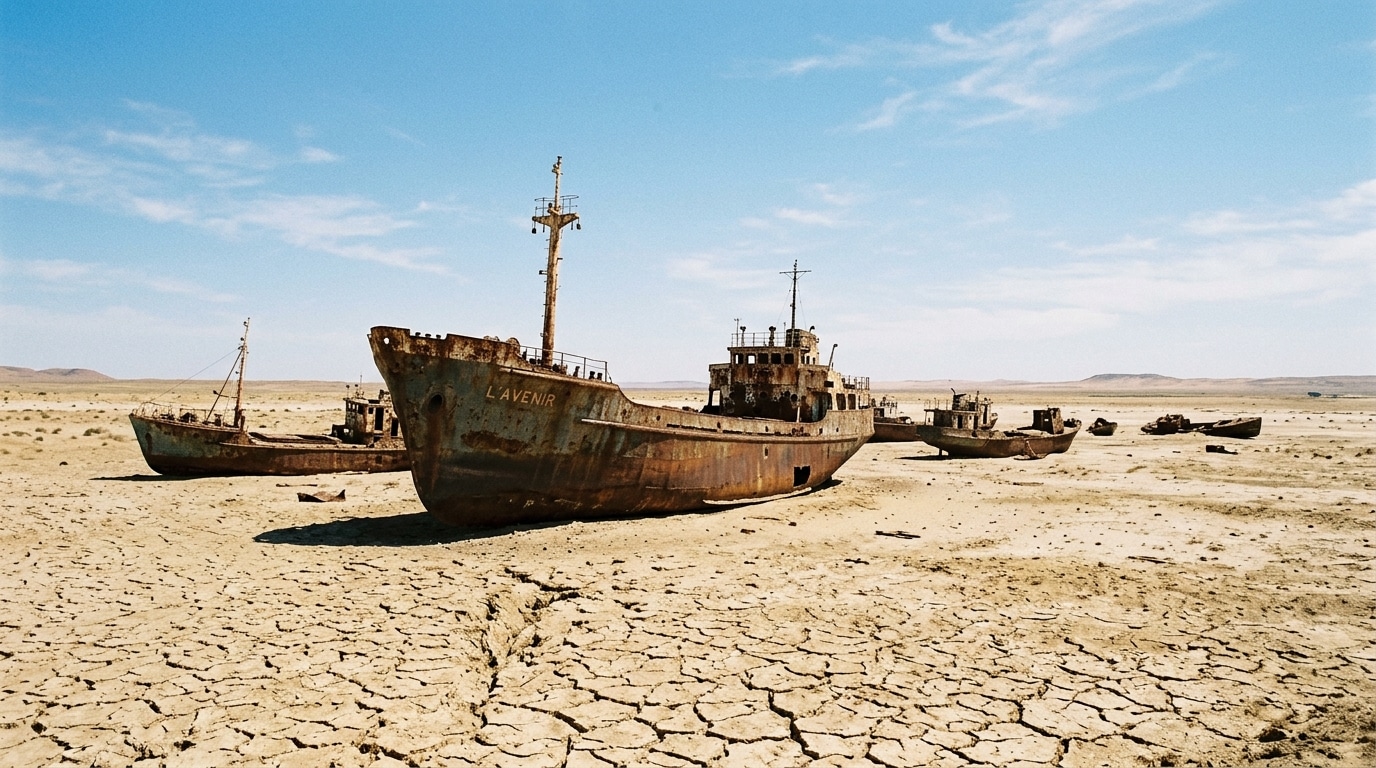
Imagine a multi‑ton trawler, the hull corroded by rust, stranded on a sweltering stretch of sand. Around it, not a single drop of water on the horizon: the nearest wave lies 150 kilometers away. This image, fit for an absurd dream or a surreal painting, is in fact real. It unfolds in Central Asia, on the ruins of the Aral Sea. In 1960, this inland sea stretched over nearly 68 000 km², the area of the Czech Republic. It was then the fourth largest lake in the world. Today, it has almost entirely vanished, leaving behind a salt desert and a ghost fleet. Between these two realities there was no natural cataclysm, nor a meteorite. Just a political decision made several decades ago, whose consequences continue to shape the region.
Cotton Against the Sea: the Soviet Calculation That Started It All
At the end of the 1950s, the Aral Sea relied on two mighty rivers that fed it: the Syr-Darya to the north and the Amu-Darya to the south. These two freshwater arteries flowed down from the mountains to feed this vast saline expanse straddling Kazakhstan and Uzbekistan. But the Soviet Union harbored another ambition: to transform the arid steppes of Central Asia into immense fields of cotton and rice. For that, water was needed—lots of water.
So the Soviet planners decided to divert the two rivers to irrigate millions of hectares of crops. The calculation seemed simple: favor the white gold of cotton over a sea deemed less profitable. Except that deprived of its tributaries, the Aral Sea began to evaporate and never to replenish. In just a few decades, one trillion tonnes of water vanished into the atmosphere. A short‑term economic choice transformed into one of the largest human‑made ecological disasters in history.
150 kilometers of horizon in a generation: when the sea fled the towns
The retreat of the Aral Sea was vertiginous. Since 1960, it has lost 14 meters in depth, 75% of its surface and 90% of its volume. In 1989, the sea split into two distinct bodies: a small northern sea and a large southern sea. The latter gradually dried up almost completely, leaving behind a vast basin of dust.
For the inhabitants of the port towns, the scene was heartrending. Fishermen watched the horizon recede by 150 kilometers in a single generation. Where nets were once thrown, there stretches now a desert. The water’s salinity rose so high that aquatic life collapsed: the number of fish species fell from 32 to only 6. The ports, once bustling with trawlers, emptied out. Fishing activity disappeared, triggering the economic collapse of entire communities and a massive rural exodus. Only these rusted ships remain, stranded on the sand like the skeletons of a world sunk upside down.
The salt that poisons the air: the toxic legacy of a bare seabed
The tragedy does not stop at the water’s retreat. As the basin dried, the former seabed revealed layers filled with toxic salts and pesticides accumulated during decades of intensive farming. Today, winds sweep these exposed plains and raise vast dust storms loaded with chemical residues. These particles travel **hundreds of kilometers**, contaminating nearby agricultural soils and seeping into the lungs of residents.
Health consequences are heavy: respiratory diseases, cancers and other pathologies strike local populations hard. The Aral landscape offers a chilling lesson: an ecological catastrophe does not simply erase a backdrop; it poisons air, water and soil for generations. What was once a nourishing sea has become a silent source of poison.
What the Aral Desert Teaches Us About Seas We Believe to Be Eternal
The most fascinating, and most worrying, is that the water’s disappearance even disturbed the Earth’s interior. Before drying, the lake’s enormous weight pressed the earth’s crust beneath the sea. Since that mass evaporated, the former lake bed has risen slowly, at an average rate of about 7 millimeters per year, over a zone stretching up to 500 kilometers from the original center. Humanity, unwittingly, disrupted the planet’s deep mechanics simply to grow more cotton.
All is not lost, however. In the mid‑2000s, the construction of the Kokaral Dam allowed the isolation of the small northern sea in Kazakhstan. Since then, this Little Aral has begun to come back to life: its level rises, its salinity falls, and fish are slowly returning. A hopeful glimmer in a sea of sand, proof that nature can rebuild when given a chance.
The Aral Sea will remain one of the most striking warnings of our era. It reminds us that no body of water, however vast, is truly eternal in the face of human decisions. Those rusted trawlers stranded in the desert are not mere tourist curiosities: they are keepers of a memory. So, at a moment when other great lakes around the world see their levels drop dangerously, the question must be asked: will we learn the lessons of the Aral before another horizon recedes forever?
