
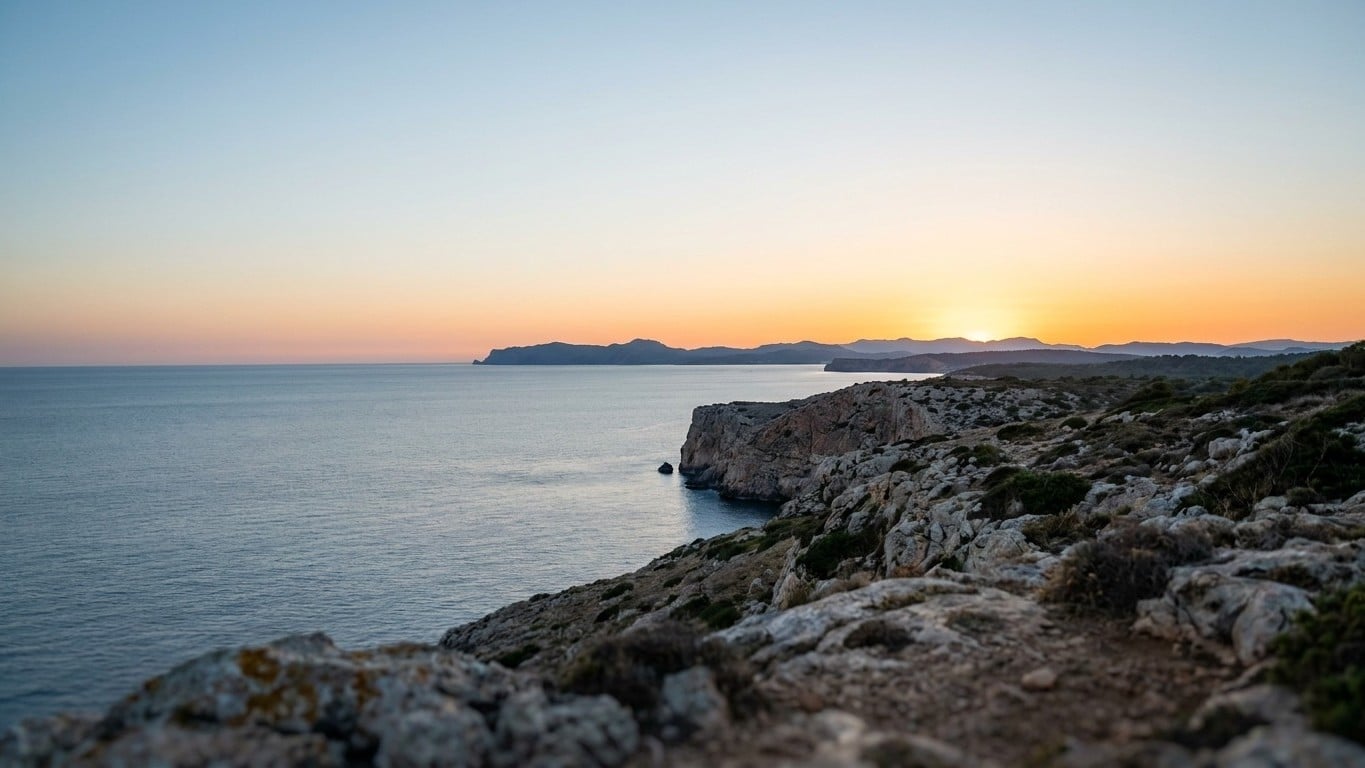
Two degrees. That is the height the Sun will reach above the horizon when the Moon completely covers it over Palma de Mallorca, on August 12, 2026, around 8:32 p.m. local time. The eclipse will begin in Palma at 7:38 p.m. and will peak at 8:32 p.m., a few minutes before sunset, with the star at an altitude of 2 degrees, according to data from Spain’s National Geographic Institute (IGN). In other words, a simple block of buildings to the west will be enough to turn what could be the decade’s most remarkable astronomical event into a total non-event.
This figure is not inconsequential. It places the Balearic Islands in a distinct category among all the territories crossed by the path of totality on that day. In Spain, the Sun will sit much lower: only about +10° on the northern coast, and barely +2.8° when the shadow reaches Mallorca, making the choice of observation site a critical factor. Between Galicia and the Balearic archipelago, the difference in solar altitude is thus almost fivefold. A nuance that radically alters how the event is approached depending on where you stand.
Key takeaways
- A Sun skimming the horizon at the moment of totality: what surreal aesthetics will this rare phenomenon offer?
- Only two degrees separate observers between a clear view and total darkness: how much does the site choice matter?
- No new total solar eclipse in Spain before 2027: how many will miss the spectacle because of a single building?
A Sun that grazes the waves before disappearing
August 12, 2026 will mark the first total solar eclipse visible on continental Europe since 1999. The totality belt, about 200 km wide, will cross the Arctic, descend onto the Iberian Peninsula, brush the Balearic Islands, and traverse the Maghreb. The Moon’s shadow enters Spain through Galicia, sweeps the country from northwest to southeast, then heads toward the Mediterranean, leaving the European continent precisely above Mallorca and Ibiza.
This trajectory directly affects the geometry of the phenomenon. As the shadow advances eastward, the day draws toward its end and the Sun sinks lower toward the horizon. The visibility of the eclipse in Spain is hampered by the Sun’s low height: only about 10 degrees of elevation along the northern coast, and barely 4 degrees above the horizon over the Balearic Sea at totality. Practically speaking, observers in Galicia will enjoy a Sun still relatively free of ground-level obstacles, while those in the Balearics will have to contend with a Sun that literally brushes the waterline.
The duration of the event, on the other hand, tilts in favor of the archipelago. Palma offers a substantial 1 minute 36 seconds of totality, one of the longest durations along the entire Spanish route. An interesting paradox: it is precisely because Mallorca lies near the central line of the shadow path that totality lasts so long there, even though the Sun will be at its lowest.
Why two degrees change absolutely everything
At this elevation, the margin for error is zero. Totality will occur with the Sun less than 3° above the horizon, meaning that the slightest foreground obstacle would block the view. A multi-story building, a row of Aleppo pines, or simply a slightly elevated hill to the west, and the entire spectacle vanishes behind a wall of concrete or foliage. There is no second chance: unlike a high-soaring eclipse, there is no tolerance for a fallback here.
The phenomenon, in contrast, offers an aesthetic rarely seen in Europe. Few eclipse chasers have felt the incomparable thrill of watching totality with a Sun so low that its disk appears oval-shaped due to atmospheric refraction. The dark body, surrounded by its corona, will assume an almost unreal look, flattened by the dense layers of the atmosphere just before it drops below the horizon. A sight that even the most documented eclipses of recent decades have not presented in this form.
Choosing your observation post: the sea, nothing but the sea
The consensus among astronomers converges on a single imperative: favor a completely unobstructed marine horizon facing west or west-northwest. In the final stages of the shadow’s path, care must be taken to avoid hills on the horizon or a forest accidentally placed in the line of sight. The western coasts of Mallorca and Ibiza, with cliffs looking out to sea, thus offer prime vantage points. Some hotels have already recognized this: a five-star hotel perched on a 250-foot-high cliff, with an unobstructed view of the Balearic Sea separating Mallorca from the mainland, has made this site a selling point for the event.
Three criteria are worth checking before selecting a precise spot:
- An western horizon free of any construction, trees, or terrain features, even modest
- Direct access to the sea or to an open coastal plain
- A slightly elevated viewpoint relative to sea level, to push back the horizon line
The question of clear skies remains, and it is far from a given in mid-August. The odds of clear skies are reasonably favorable, about 75%, with August evenings in the Balearics typically supportive, giving roughly three chances in four to observe the totality from a good western coastal site. A prudent bet, though it still leaves one observer out of four facing a veiled sky at the crucial moment.
This meeting will not happen again anytime soon. It will not be possible to observe another total solar eclipse from Spain before 2053. In other words, for many curious observers stationed along Mallorca’s or Ibiza’s coastline that evening, the mere sight of a crane sticking up on the horizon will remain a bitter memory for decades to come.
Sources: telescopes-et-accessoires.fr | generationvoyage.fr
