
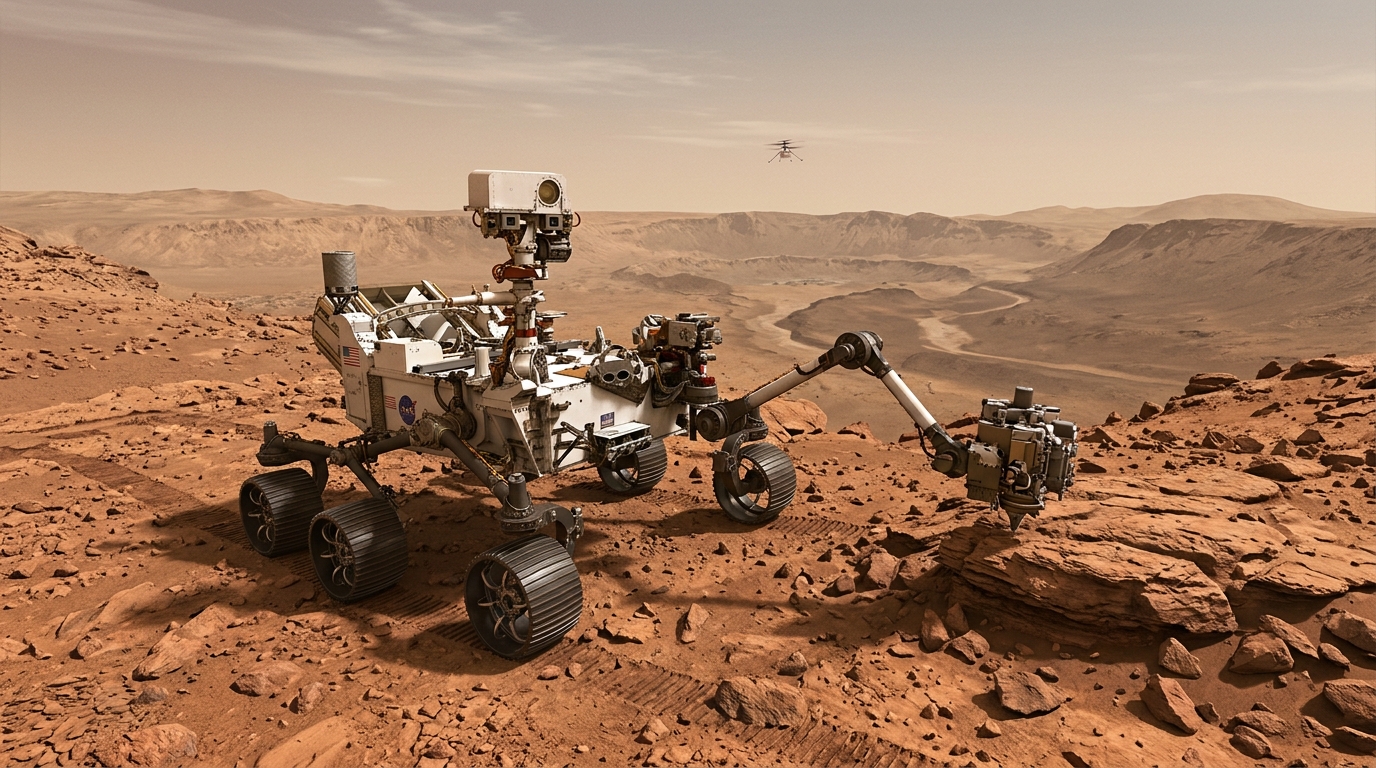
There are numbers that speak for themselves. 42,195 kilometers: the legendary marathon distance, the one that the most seasoned runners complete in a few hours, between sweat and self-transcendence. But now imagine that marathon unfolding on another planet, on a hostile surface swept by red dust, hundreds of millions of kilometers from any resupply. That is precisely the feat NASA’s Perseverance rover has achieved. Except that here, the clock does not read hours, but five years and four months. A performance that, at first glance, might seem maddeningly slow, yet hides one of the most beautiful demonstrations of engineering and patient perseverance in modern space exploration. Here’s why this Martian marathon deserves attention.
A Martian Marathon: When Every Meter Becomes a Victory
Perseverance crossed the symbolic marathon distance, exactly 42,195 kilometers, at the end of its 1,890th Martian day — what scientists call a sol. At the moment of this achievement, the robotic explorer was west of Jezero Crater, in a region the mission team nicknamed “Arbot”. To immortalize the moment, NASA achieved a neat feat: capturing the rover from Martian orbit. In an image taken the day before crossing the symbolic line, Perseverance appears as a tiny green dot lost in the ochre vastness of the landscape, photographed by the HiRISE camera aboard the Mars Reconnaissance Orbiter.
What strikes most about this shot are the faint lines winding across the terrain: the tracks left by the rover along its journey. A true signature etched in Martian dust, a silent witness to a patient and methodical voyage.
Five Years and Four Months: The Slowness That Hides a Feat
At first glance, taking more than five years to cover a marathon distance might provoke a smile. Yet that figure is anything but a poor showing. To truly grasp the scale of the feat, one must compare it to its predecessor. NASA’s other renowned rover Opportunity required eleven years and two months to cover the same distance. In other words, Perseverance completed its marathon twice as fast as its elder.
This acceleration is far from accidental. It testifies to major advances in design and navigation. On Mars, every meter traveled represents a carefully weighed decision, a balance between boldness and caution. The rover continues to operate at full capacity, and at its current pace scientists estimate it could become the first rover to complete an ultramarathon on Mars. A goal that, just a few years ago, would have sounded like pure science fiction.
Driving on Mars: the Challenges of a Relentless Terrain
Driving on the Red Planet has absolutely nothing to do with a Sunday drive along our provincial roads. Martian terrain is a genuine minefield: loose sand where one can get stuck, steep slopes, sharp rocks likely to damage the wheels, and a multitude of other traps. Each route must therefore be planned with the meticulousness of a master craftsman by the ground teams.
But there is an additional, and substantial, constraint: time. Signals take many minutes to travel between Earth and Mars, making real-time piloting impossible. To overcome this obstacle, Perseverance relies on onboard navigation systems capable of making certain decisions autonomously. The mission even marked history by moving along routes entirely planned by artificial intelligence, rather than by human operators. A quiet revolution that foreshadows the exploration of space to come.
Much More Than Miles: What Perseverance Really Achieved
Reducing this mission to a simple mileage counter would be a mistake. If Perseverance was sent to Mars, it is not to set speed records, but to study the planet’s ancient environments and search for possible traces of past microbial life. Each kilometer traveled is an opportunity to traverse rocky plains, climb slopes, examine fascinating geological formations, and collect precious samples.
These samples may well be the most important treasure of the entire venture. They could someday reveal whether the Red Planet truly hosted life billions of years ago. So this marathon is not an end in itself, but the guiding thread of a scientific investigation of unprecedented scope.
By completing this symbolic marathon in record time, Perseverance reminds us of a fundamental truth: in space exploration, patience is not a weakness but a virtue. Each meter gained on this hostile ground is a victory wrested from difficulty, another brick in our understanding of the cosmos. As the rover continues its journey toward a hypothetical ultramarathon, one question remains: how many kilometers still separate us from the answer to humanity’s oldest inquiry — are we really alone in the Universe?
