
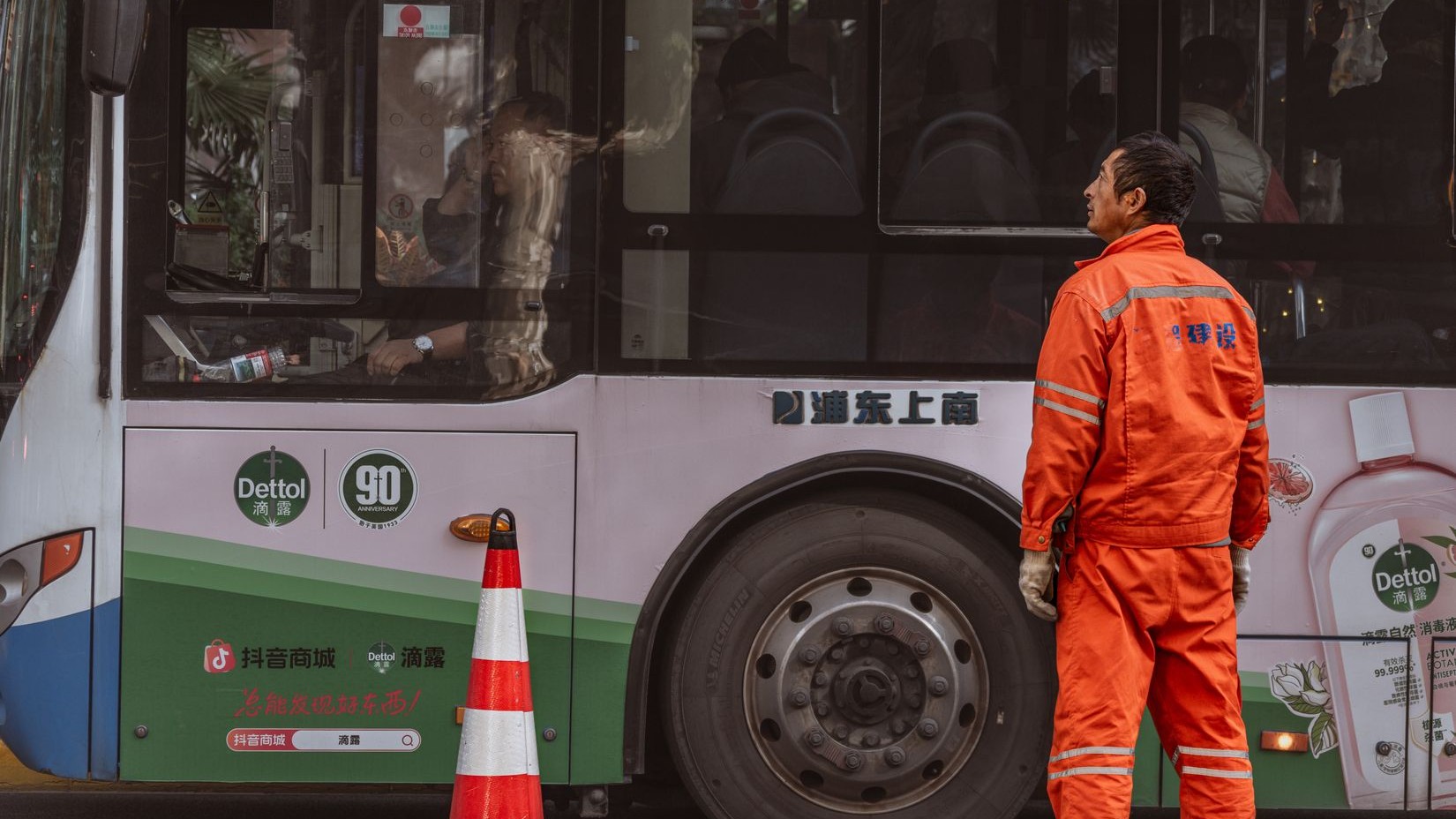
An orange cone rolls out by itself from a truck’s bed, travels to its position on the roadway, and stops within millimeter precision. It takes only about ten seconds. In China, rescue teams are currently testing these autonomous signaling cones that can deploy without human intervention on roads where traffic has not even been stopped. Each cone houses centimeter-accurate GPS/RTK positioning, obstacle-avoidance sensors to detect nearby movements, and most importantly, a swarm coordination algorithm that tells it where to stop relative to the other cones, not relative to a fixed map.
The technical detail matters. A cone that follows a pre-established GPS plan is fragile: beneath a bridge, in a tunnel, or simply due to a parasitic signal reflection, its position can drift by several meters. University researchers working on comparable platforms have also measured this issue up close: their autonomous cones equipped with GPS RTK achieved an accuracy of around two centimeters in the best-case position error, but quickly lost reliability when the satellite signal degraded, with a maximum error of nearly two meters over fifty meters traveled under low or absent GPS signal conditions. The solution adopted by the Chinese teams reverses the logic: each cone positions itself first relative to its neighbors, with the GPS map serving as a rough reference rather than an absolute one. This is exactly the principle that allows a flock of birds to maintain formation without any individual knowing the global trajectory.
À retenir
- An orange cone rolls by itself and stops to the millimeter in about ten seconds — but how does it do it without a pre-programmed map?
- 54 road workers die each year placing cones: this machine absorbs the most dangerous gesture of the job
- This decentralized swarm technology has already piloted 158 km of highway without direct human presence — what secret does this cone truly reveal?
A robot replacing humans where they die
Placing cones on a road open to traffic remains one of the most dangerous tasks of the job. American statistics, often used as international reference due to a lack of comparable data elsewhere, are unequivocal: an average of 54 pedestrian workers are killed each year after being struck by vehicles in work zones. More broadly, a recent synthesis on road-work safety recalls that 63% of transport-related accidents in work zones between 2011 and 2020 involved workers struck by vehicles, causing 577 deaths. The most routine act, running to place a cone in front of a still-moving line of cars, is among the deadliest tasks in the sector.
That is exactly the moment the machine absorbs. The cone operates either remotely or in fully autonomous mode, day or night, in the rain, while the worker stays out of harm’s way. The gain is not only about comfort: it is a transfer of risk from human to machine on the most exposed portion of the job. It is far from a trivial development when road accidents remain, in almost all industrialized countries, the leading cause of professional mortality related to travel.
A technical cousin on the Beijing-Hong Kong-Macao highway
It’s not a one-off. China has carried out, on another project, a demonstration of the same philosophy applied at a larger scale. On the highway connecting Beijing, Hong Kong and Macao, a 158-kilometer stretch was fully resurfaced without direct human presence on site, according to the specialized site highwaysindustry.com, which mentions a record project of 157.79 km completed entirely without a human operator, establishing new standards of safety, efficiency, and quality. Drones flew over the roadway to map the areas to repair, while autonomous earth-moving machines and road rollers carried out the work, coordinated by a centralized control system.
The link with robot cones is not incidental: the two projects rely on the same architecture at heart, namely a fleet of machines that communicate with each other to adjust their positions in real time, rather than a succession of isolated machines following each a fixed program. The Chinese manufacturer Sany, already involved with this highway project, has developed for its drones a high-precision positioning system based on sensor fusion, developed in-house, coupled with trajectory-tracking algorithms. At another scale, we see the same decentralized coordination logic as with the orange cones: each unit knows where its neighbors are and adjusts its trajectory accordingly, without depending on an advance-fixed plan.
What this orange cone really reveals
The scientific interest goes far beyond the viral gadget circulating on social networks in recent weeks. What is at stake here is a swarm robotics test in real-world hostile conditions, far from the laboratory halls where this research field has long been confined. A university team that designed a comparable system of robotized cones in coordinated formation describes this challenge precisely: their prototypes rely on a mobile robot equipped with a Raspberry Pi controller and RTK GPS sensors, with a central computer ensuring supervision via WiFi, an architecture designed to maintain formation despite terrain uncertainties. The same paper notes that China, the United States, and other European countries have begun automating the loading and unloading procedures of signaling cones, vehicles being designed to place cones automatically to minimize human intervention and accidents on worksites.
This decentralized coordination, where each agent adjusts its position relative to the others rather than to a central instruction, is exactly the same type of calculation used by military drone swarms or rovers sent to explore extraterrestrial terrain. The fact that it is now embodied in something as banal as a traffic cone says something striking about the trajectory of this technology: it has left research papers to quietly settle into the most ordinary urban furniture there is.
One question that viral videos never show: what happens when a cone fails in the middle of the formation, or when a truck runs into the swarm before it finishes deploying? Safety protocols for partial failures remain, for the moment, the blind spot in the official communication surrounding these demonstrations.
Sources: tiktok.com | sciencedirect.com
