
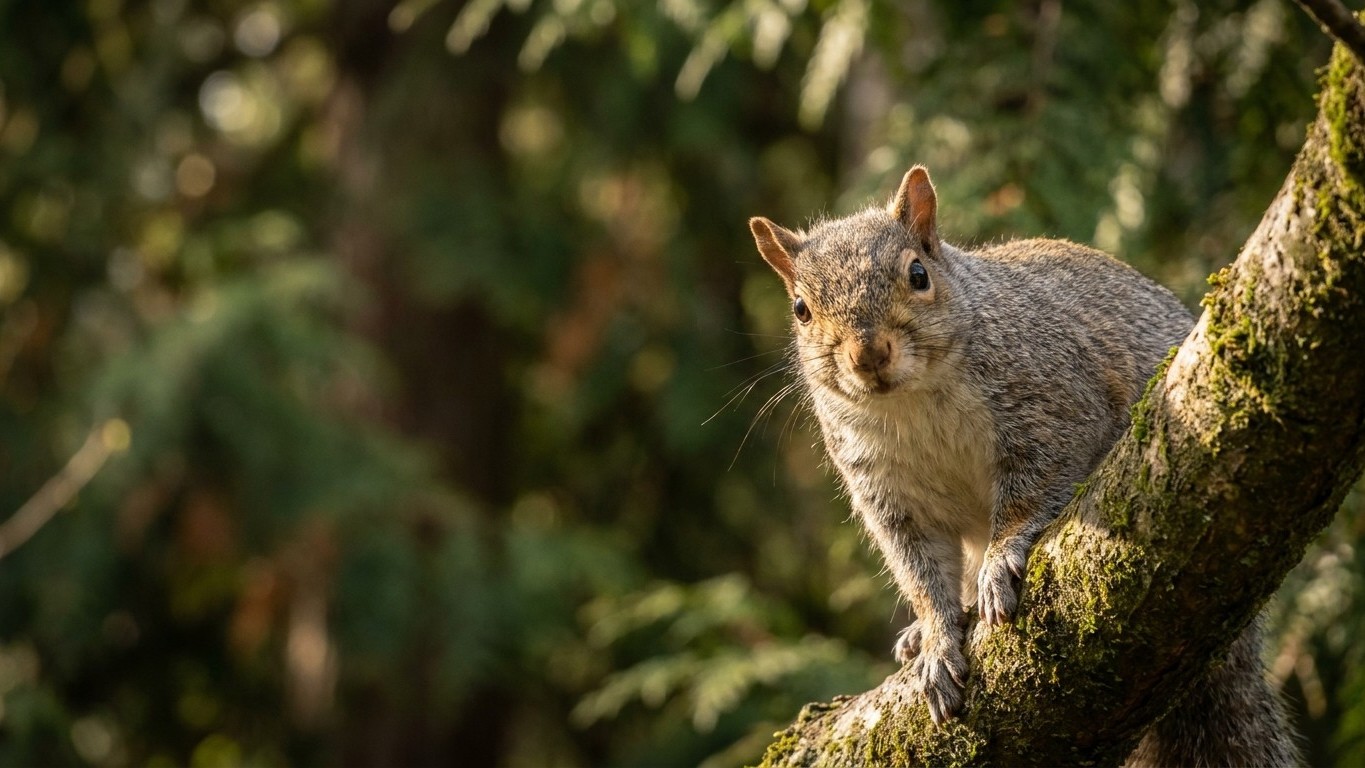
Four American gray squirrels. That was all it took to permanently disrupt the forest ecosystem of northern Italy. In 1948, these rodents from Washington, D.C. were released in Candiolo, near the Stupinigi forests south of Turin, in Piedmont. The gray squirrels had been introduced into North America from Europe starting in 1948, with the first release involving four individuals from Washington, D.C., released in Candiolo, near the Stupinigi forests just south of Turin. No one at the time could imagine that this seemingly harmless gesture would trigger one of the most studied biological invasions in Europe.
À retenir
- A forgotten diplomatic gift from 1948 triggered a major biological invasion in Europe
- The gray squirrel virus: harmless to it, devastating to the red
- A window of opportunity remains before the threat crosses the Alps
A diplomatic gift with unsuspected consequences
The anecdote has enough to astonish: according to a chronicle in Scientific American, the Italian invasion dates back to 1948, when an American ambassador offered four of these adorable creatures as a gift. A diplomatic present, a park in Piedmont to embellish it, and voilà how a North American species set foot on the European mainland for the first time. The animals escaped and have continued to expand their territory exponentially ever since.
Other releases followed, less known but just as decisive. In 1966, five individuals were released in Villa Groppallo Park in Genoa, Liguria, while an introduction in Trecate, Lombardy, in 1994 seems to correspond to an illegal translocation of gray squirrels from Piedmont. Three foci, three starting points for a colonization that never stopped. Today, these gray squirrels introduced in Northern Italy in 1948 have caused damage to commercial poplar plantations and have replaced the native red squirrel across most of the 350 km² of the Po Plain Piedmontese that they now occupy. A surface as large as the Lyon metropolitan area, entirely emptied of its indigenous species.
The parapoxvirus, a silent weapon
The real danger did not lie solely in the size or appetite of these newcomers. The gray squirrel can carry, without being affected, a pathogen, a parapoxvirus, and transmit it to the red squirrel, for whom the infection proves lethal: a healthy carrier on one side, near-certain mortality on the other. A biological imbalance that echoes, within proportional limits, what is observed with certain diseases spread by invasive species around the world.
The mechanism has been particularly well documented in Britain. Gray squirrels act as reservoirs of a squirrelpox virus, potentially fatal to the red squirrel, while it does not seem to be pathogenic for the gray itself. In Britain, this virus accelerated the decline of red squirrel populations dramatically, turning a competition that was already hostile into a local massacre.
The Piedmont, indeed the cradle of continental invasion, presents here a peculiarity worth noting. Recent research notes that the populations of gray squirrels present on continental Europe occur only in Italy, which is somewhat good news for the conservation of the red squirrel at the continental scale, partly because the pathogen appears absent in Italy, where it is more the food factor that seems to explain the progressive elimination of the red by the gray. The virus that decimates British populations has not, for the moment, crossed the Alps with the same virulence. A significant nuance, often forgotten when recounting this story.
A competition capable of wiping out the red squirrel
Even without the viral accelerator, the simple balance of power does its work. The gray squirrel is larger, with an average adult weight of 550 grams versus 350 grams for the red. This size difference, coupled with a better ability to store reserves for winter, changes everything. The greater body mass of the gray ensures better winter survival and a stronger start to reproduction, while the presence of the American competitor causes the red to slow its growth in juveniles and subadults and reduces the condition of breeding females, leading to lower fertility and fewer litters per year.
Result on the ground? No surprise. A study conducted on the Piedmontese colony showed that the red squirrel disappears from areas colonized by the gray, and that bark-stripping and feeding damage are considerable. Foresters are also worried for another reason: the gray squirrels strip the bark from broadleaf trees to reach sap, which can weaken or kill certain trees, posing a direct threat to the poplar plantations of the Po Plain.
Progress, however, remains slower than in Britain, precisely because the parapoxvirus has not (yet) taken root on the Italian side. The growth of populations and their expansion since the 1948 introduction have been slower than in Great Britain, a relative grace period that affords scientists and land managers a window to act before the species permanently crosses the Alps toward France and Switzerland. A gift from 1948 continues, almost eighty years later, to redraw the forest map of an entire continent.
Sources: notre-planete.info | sosecureuilroux.fr
