
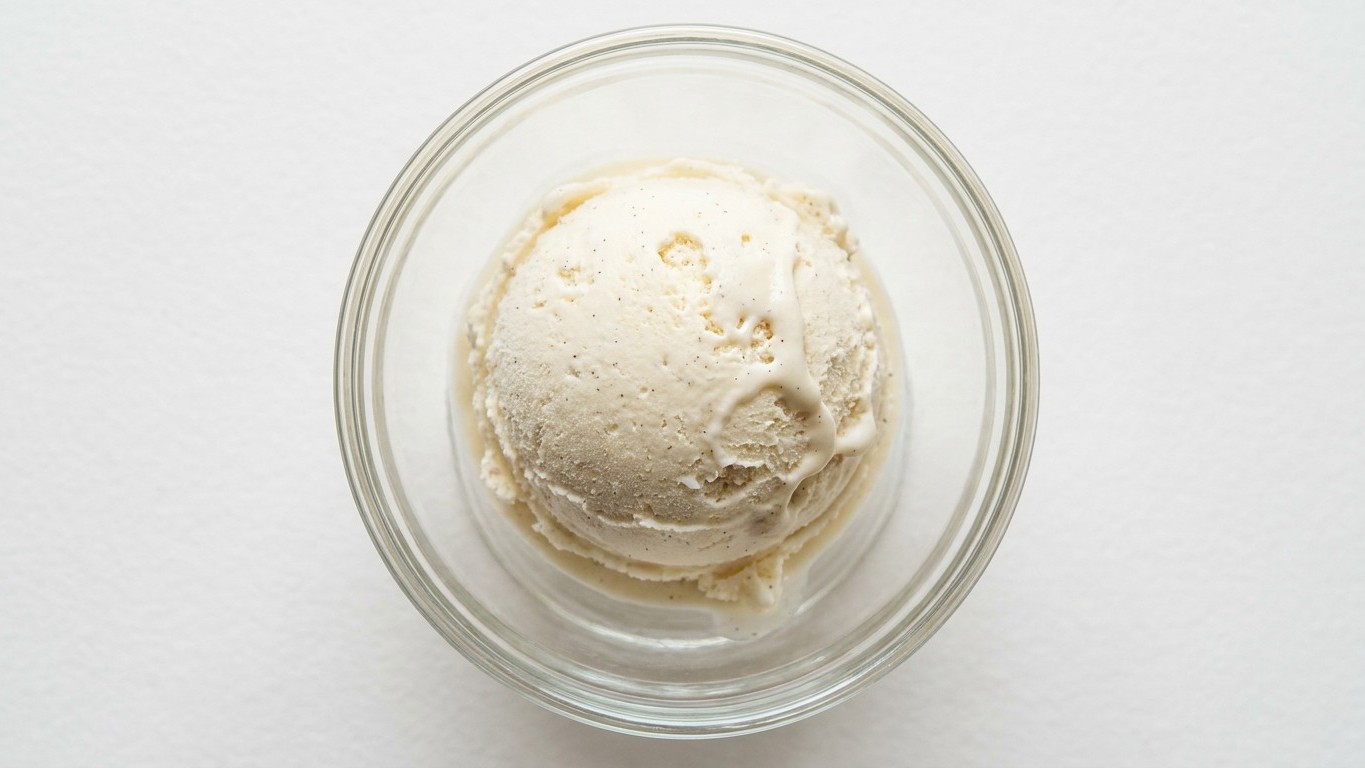
Less than 1% of the vanilla you consume each year actually comes from a vanilla bean. The rest, the one that flavors your yogurts, your ice creams, your biscuits and most mass-produced cakes, comes from a chemical plant, derived from oil or wood by‑products. The natural vanillin extracted from beans does not cover 1% of global demand; less than 1% of vanillin consumed worldwide originates from natural beans. The rest? Synthesized, manufactured, industrial, whatever poetic label appears on the packaging.
The figure deserves to be stated in plain terms. Global production of industrial vanillin is estimated at 12,000 to 15,000 tonnes per year, while all the natural vanillin that could be extracted from the world’s commercial vanilla production represents fewer than 50 tonnes annually. Even if every vanilla bean grown on Earth were turned into pure vanillin, we would still fall far short of 1% of what the agri-food industry consumes each year. Demand has, for decades, exceeded what nature can provide.
Takeaways
- Your industrial vanilla hides an unpalatable secret about its origin
- Global demand for vanillin would exceed 12,000 tonnes annually, versus less than 50 tonnes natural
- Two chemical processes dominate the market: one petroleum-based, the other derived from paper-recycling
Petroleum and Wood in Your Ice Cream Jar
The molecule responsible for vanilla flavor is vanillin. It exists naturally in the pod, but its industrial version never touched an orchid. The guaiacol intended for vanillin production is mainly produced by petrochemistry, and the rest of the world market depends on crude oil. A study reported by Swiss television RTS already noted that more than 85% of global production of this aroma comes from oil, a figure that confirms the scale of the phenomenon.
There is a second route, less known but just as far removed from the vanilla bean: lignin. This polymer is found in wood and is a by-product of the paper industry used as a raw material. Fifteen percent of global vanillin production comes from lignosulfonates, by-products of cellulose production via the sulfite process. In concrete terms, part of the vanilla flavor in your desserts literally comes from wood chips chemically transformed. The molecule obtained is identical, atom for atom, to the one from the pod. But it has never had a botanical link to the originating plant, which explains why it can legally be called “vanillin” without ever having touched an orchid.
Vanillin was isolated for the first time in 1858 by the French chemist Théodore Nicolas Gobley, who obtained it by evaporating a vanilla extract to crystallization. This discovery later enabled the molecule to be synthesized without using the plant. The industry finally had a stable, cheap, and unlimitedly available solution. It could transform a luxury scent reserved for royal courts into a daily flavor, present in the most ordinary pot of yogurt at the supermarket.
Why the Real Vanillin Bean Remains Out of Reach for Mass Industry
The vanilla bean itself is an orchid climbing plant native to Mexico, one of the most labor-intensive spices in the world: manual pollination, nine months of maturation, four months of post-harvest processing. Each flower opens only for a single day and must be fertilized by hand, flower by flower, due to the lack of an efficient natural pollinator outside its native region. It is back-breaking work, literally, on plantations of enormous scale.
Madagascar has dominated this niche market for decades. It is the world’s leading producer, regularly supplying between 70% and 80% of global supply. But the preparation doesn’t end with harvest: green pods must be steamed, dried, and cured for months before they develop their complex fragrance. The pods are placed in large crates lined with wool blankets to “sweat” for 24 to 48 hours, followed by a slow drying process, first under the sun for a few hours a day, then in the shade for weeks. This process explains why an authentic bean costs so much and why its aroma cannot be equated with the linear scent of pure vanillin. The molecule in question is a phenolic aldehyde that provides the spice with its unmistakable smell, yet it never acts alone in a true bean: the natural aroma derives its subtleties from the interaction of vanillin with more than 200 other volatile compounds present in the pod. The synthetic version, by contrast, contains only this single molecule. Hence the often-flat nose of the flavor, which seems almost harsh before fading away too quickly.
What the Label Really Says
European regulation draws a strict boundary between the two realms. Only the pure vanilla extract may be declared as “natural vanilla flavor” under Regulation (EC) 1334/2008, while the essence must be labeled as “vanilla flavor” or “vanilla flavoring” without any natural qualifier. On a package of cookies, the claim “vanilla flavor” by itself, without the word “natural,” is therefore a discreet confession: the molecule comes from guaiacol or lignin, not from a Malagasy pod.
Faced with this paradox (a rare spice yet a ubiquitous aroma), some manufacturers seek alternatives deemed more virtuous than petroleum. The Norwegian group Borregaard, for instance, produces vanillin from softwood rather than crude oil: Borregaard’s vegetable vanillin relies on 100% renewable carbon and offers a 90% reduction in CO2 emissions compared with vanillin derived from guaiacol synthesized from crude oil. The nuance does not change the taste—the molecule is the same as the petrochemical version—but it shifts the debate toward carbon footprint rather than authenticity. The next time you read “vanilla aroma” on a package, one thing is certain: the molecule you taste has probably passed through a refinery or a paper mill before reaching your plate, long before it ever touched a Madagascar orchid vine.
Sources: lagourmandine.org | abacai.fr
