
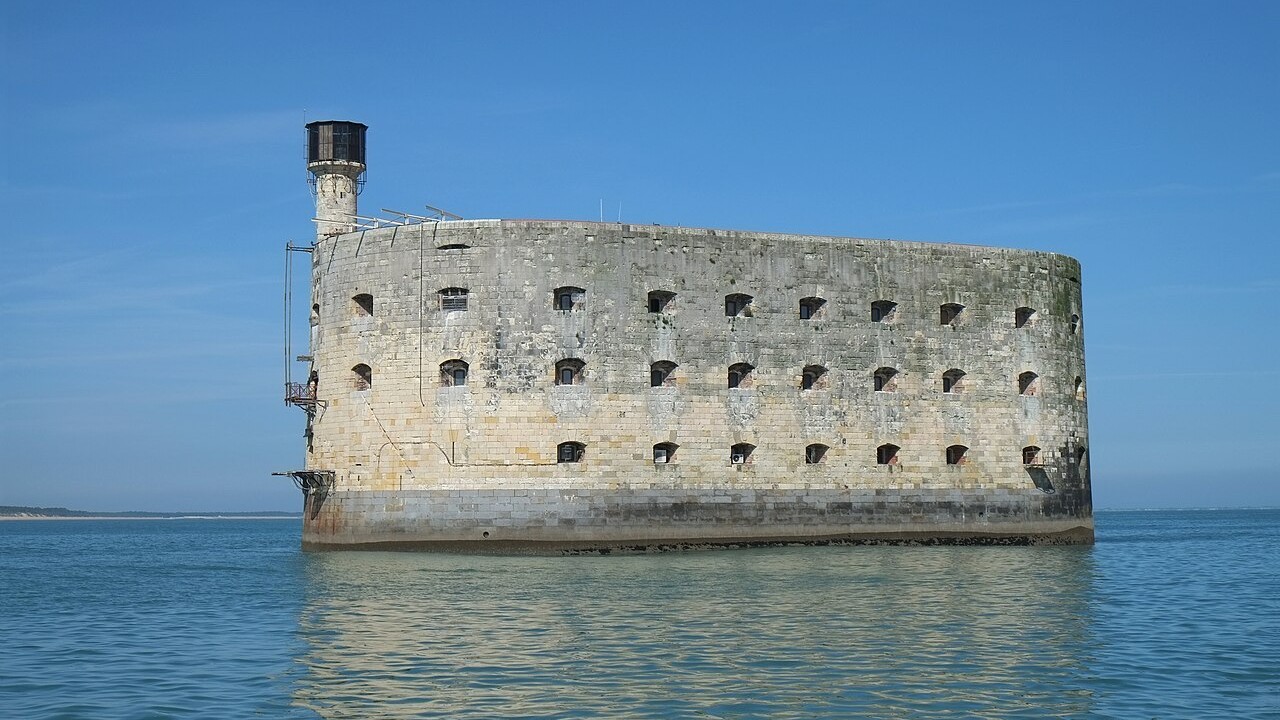
Sixty-two years. That is the time it took to raise a fort that, the day the last worker laid down his tool, was already militarily useless. Fort Boyard, that stone silhouette standing in the open sea between Île d’Aix and Île d’Oléron, has never fired a single cannon at an enemy. Not a single shot, in more than a century and a half of existence. The history deserves a pause here, for it alone encapsulates the absurdity of certain grand military projects.
Key takeaways
- A fortress conceived by Napoleon that Vauban had deemed impossible to build
- Advances in artillery made it obsolete even before construction finished
- From temporary prison to global television icon: how the fort finally found a use
A Bet Launched by Napoleon, Considered Impossible by Vauban
The idea predates the Empire. From the creation of Rochefort’s arsenal in 1666, the question of defending the stretch between Île d’Aix and Île d’Oléron arose. The matter was entrusted to Vauban, the realm’s most celebrated military engineer. His famous answer carried a bitter ironical note: “Sire, it would be easier to seize the moon with one’s teeth than to undertake such a task here.” The project was buried for more than a century.
Napoleon Bonaparte revived the matter at the very start of the 19th century. Fort Boyard was conceived mainly to protect the bay around the Île d’Aix and the royal arsenal of Rochefort, because the range of the cannons of the time did not permit the two islands to cross-fire. The fort was meant to fill this strategic gap on a capricious sandbank known as the Boyard Longe. The First Consul Bonaparte approved the project in 1803, and the rockwork and embankment began the following year. An entire village sprang up on the occasion on Île d’Oléron, Boyardville, which still exists today.
English Fireships, Storms, and Lost Decades
Building on moving sand in the open sea was a pure technical feat. The sandbank sits at 4.50 meters below the lowest tides, battered by currents and storms. The first blocks sink under their own weight, forcing repeated rebuilds. Then comes the military coup de grâce: on April 1, 1809, sailors aboard a British frigate approaching the site machine-gunned the workers, realizing the fort was not defended, which triggers the battle of the fireships. The English hurl ships loaded with explosives at the French fleet. The construction site is razed, or almost, and suspended for nearly thirty years.
It would take until 1841, under the reign of Louis-Philippe, for the work to resume seriously. Twenty-five additional years would be needed. The final report declaring the completion of all work was signed on February 6, 1866. Between the laying of the first stones in 1804 and that signature, sixty-two long years elapsed, under five different political regimes—from the Empire to the Restoration, via the July Monarchy.
Obsolete Before It Could Serve
The problem was that the artillery did not wait for the fort. Between the initial plans and the completion of construction, cannon range had advanced, limiting the fort’s usefulness. The advent of rifled cannons allowed forts on Île d’Aix and Île d’Oléron to cross-fire without any intermediate relay. The strategic gap Fort Boyard was supposed to fill no longer existed. The locals—hard to please—dubbed it “the fort of the useless.”
The consequence is almost comic. The uselessness of Fort Boyard becomes evident, and it will never receive the 74 cannons planned in the original project; to avoid showing the fort’s failure, it is nonetheless armed with 30 old cannons factory-modified, mere antiquities that must be loaded through the muzzle. A fort designed to interlock fire from 74 modern guns ends up with a score of salvaged pieces never used in combat. The operation cost about 8.6 million francs at the time, making Fort Boyard one of the most striking military sinkholes of the 19th century.
Prison, Ruin, Then a Global Television Star
With no military mission, officials searched urgently for a use for the monument. It became a temporary prison for Prussian soldiers in 1870, then for Communards awaiting deportation to New Caledonia the following year, among them journalist Henri Rochefort. In 1913, the army abandoned the site and sold the cannons to scrap dealers. During World War II, the Germans used it as a target for training. The fort then fell into near-total oblivion, pillaged, eroded by salt and storms for almost eighty years.
Its revival was almost accidental. Jacques Antoine acquired it in 1988 for 1.5 million francs and sold it for a symbolic franc to the General Council of Charente-Maritime, while reserving exclusive exploitation of the fort. Two years later, in 1990, the game show bearing his name aired for the first time. The fort found its real utility there, one that Napoleon and his engineers had not foreseen: entertaining tens of millions of viewers around the world.
Today, history continues to be written, and not only on television. The Department of Charente-Maritime has since 2025 undertaken an unprecedented restoration project, with a budget estimated between 36 and 44 million euros, to permanently stabilize the structure against coastal erosion. The stated objective is a regular public opening by 2028, a historic first for the monument: after having been a failed military project and then a TV show backdrop, Fort Boyard is about to become, for the first time in its existence, a place where visitors can walk.
Sources: aquitaineonline.com | geopix.blog
