
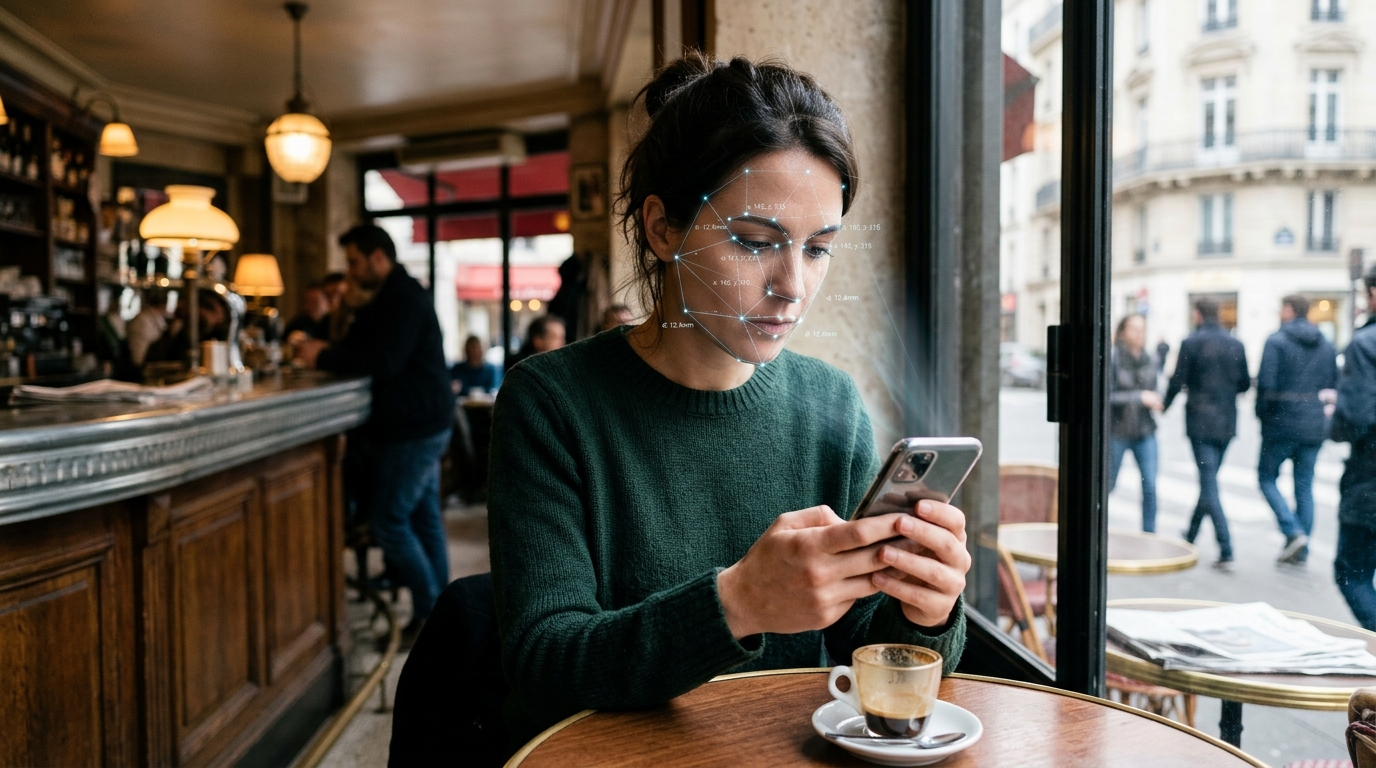
Every morning, millions unlock their phones with a single glance. The gesture has become so commonplace that we hardly question what happens behind the screen. Yet a false idea persists in the collective imagination: we tend to think that facial recognition compares our face to a photo stored somewhere, a bit like an attendant scanning a picture before letting us through. The reality is far more surprising. The system never “sees” a face in the way we understand it. It does not compare images. It transforms, measures, and encodes. Behind every unlock, every automated border crossing, lies a mathematical mechanism of astonishing precision. Understanding what really happens means grasping both the power of this technology and the dizzying questions it raises.
Before recognition, you must first detect
The very first step has nothing to do with identification. Before knowing who you are, the system must first determine where a face is in a scene. This is called face detection. Imagine a camera trained on a crowd, on a selfie, or on the lens of your smartphone: the device receives a flood of pixels with no particular meaning. Its initial mission is to distinguish, within this bright jumble, the regions that exhibit the characteristic structure of a human face.
To achieve this, the algorithm searches for universal patterns: two relatively dark eyes atop a lighter area, the alignment of the nose, the presence of a mouth. It scans the image at different scales, because a face can appear tiny in the background of a photo or fill the entire frame. Once this silhouette is located and bounded by an invisible frame, the system knows where to focus its attention. As long as this step has not been completed, recognition is not possible. That is the foundation of the entire structure.
Your face reduced to a code
Then comes the heart of the mystery, and perhaps the most counterintuitive aspect. Once the face is localized, the system does not keep a photograph. It performs a fingerprint extraction. Concretely, it measures a multitude of geometric features and textures: the distance between the eyes, the depth of the orbits, the shape of the cheekbones, the contour of the jawline, the proportions between the various points of the face. All these data are then condensed into a long string of numbers, sometimes called a vector.
In other words, your face becomes a unique digital signature, a kind of invisible barcode specific to your morphology. This fingerprint looks nothing like an image: it is impossible to “look at” it to guess who it represents. This is the subtlety: the system does not memorize your appearance, it memorizes a set of measurements. Two photos of you, taken from different angles or under different lighting, will produce fingerprints that are very close, because it is the deeper proportions of the face that matter, not superficial details.
Millions of comparisons in a fraction of a second
Once this fingerprint is calculated, the real comparison work can begin. But beware: it is not faces that are being compared, but sequences of numbers. The system takes your freshly extracted fingerprint and compares it to a database containing fingerprints already recorded. In the case of a smartphone, this database is tiny and contains only your own reference. In an airport, it can, however, assemble substantial collections of profiles.
The strength of the machine lies here in its speed. Comparing two sequences of numbers is a task that an computer can perform with remarkable ease, able to run millions in a fraction of a second. The system then computes a mathematical distance between fingerprints: the more similar the numbers, the more likely the faces belong to the same person. This closeness translates into a similarity score, a value that rises when fingerprints match and falls when they diverge.
The verdict hinges on a threshold
Then comes the final decision, the one that opens or blocks access. And perhaps this is the most fascinating element: everything depends on a single threshold value. The system compares the obtained similarity score to a predefined level. If the score exceeds this threshold, you are recognized. If it remains below, access is refused. In other words, recognition is never absolute certainty, but a question of probability crossing a limit.
This threshold is a delicate slider to set. If it is too low, the system risks confusing two different people. If it is too high, it may refuse to recognize you at the slightest change—a new hairstyle or unusual lighting. Designers therefore seek a balance between security and tolerance. It is precisely in this adjustment that many reliability challenges lie, because a poorly calibrated threshold can turn a precise tool into a source of error.
Ultimately, facial recognition never compares photographs. It detects a face, extracts a cryptographic fingerprint, confronts this fingerprint with a database, and then decides based on a similarity threshold. It is not a question of visual resemblance, but of mathematical calculation. This technical elegance explains both why the technology works so well and why it worries: our faces, reduced to sequences of numbers, can circulate and be compared on an unprecedented scale. The question that remains for all of us is: how far are we willing to let a simple threshold value decide who we are?
