
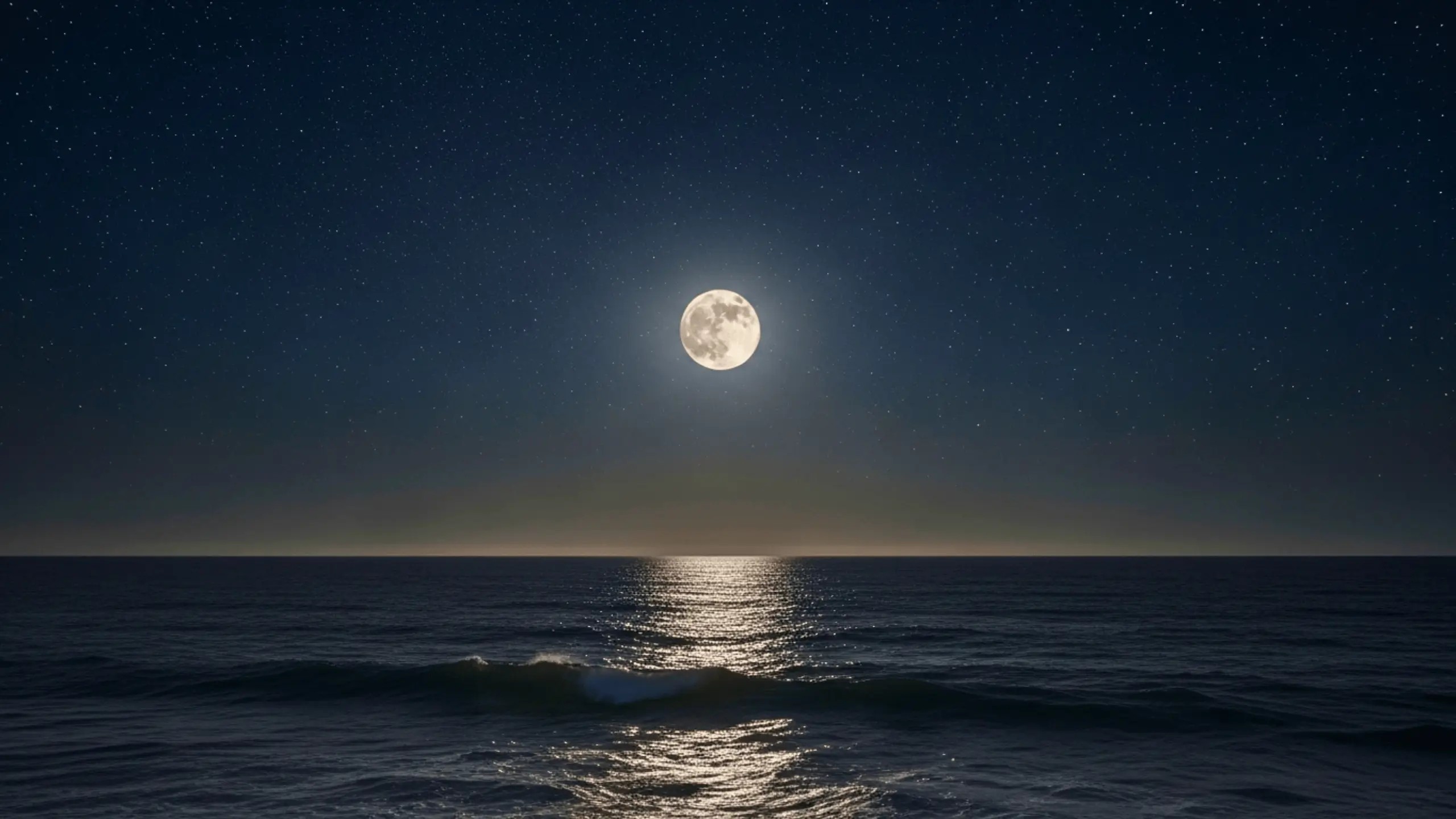
Four seconds per century. That is the magnitude of the slowdown affecting, year after year, the rotation of our planet. A figure negligible on the scale of a human life, but which, accumulated over hundreds of millions of years, has dramatically transformed the length of our days. And behind this phenomenon, a single culprit: the Moon, which inexorably distances itself from the Earth.
On average, we observe that the Moon is moving away from the Earth by 3.8 cm per year. This measurement is far from a rough estimate. This outward drift of our natural satellite has been measured thanks to laser reflectors placed on the Moon by astronauts during the American Apollo missions, by aiming a laser at these reflectors and timing the round trip. A method of formidable precision, since scientists calculate the Earth–Moon distance to the millimeter by simply measuring how long light takes to travel there and back.
À retenir
- The Moon is moving away from the Earth by 3.8 cm per year, a measurement as precise as a millimeter
- Earth days lasted only six to eight hours at the dawn of the planet, then about 17 hours 2.5 billion years ago
- A mysterious billion-year stretch without change would have radically transformed the length of our modern days
Why is the Moon slowly drifting away from us
Everything starts with the tides. Because of its gravitational pull, the Moon raises the seas and oceans, causing tides. But this familiar mechanism hides a vertiginous consequence. The lunar attraction deforms the oceans into two bulges opposite each other, slightly ahead of the Earth–Moon axis due to the faster rotation of the Earth, which exerts a forward pull that accelerates the Moon in its orbit. In plain terms: the Earth spins faster than the lunar orbit, and this speed difference acts like an invisible whip that pushes the Moon outward.
The result of this push is almost counter-intuitive. This offset creates a tug that speeds the Moon along its orbit, and as it gains momentum, it climbs progressively into a wider orbit, steadily moving away from our planet. The more energy the Moon gains, the higher it climbs, a bit like an artificial satellite that one would nudge slightly and would rise into a higher orbit. And this energy does not come from nowhere: it is directly drawn from the rotation of the Earth. The friction of the oceans acts as a brake on the Earth’s crust; an energy transfer occurs: the Earth loses some of its rotation speed to the Moon as it recedes.
Days of six hours at the dawn of time
This slowdown, however tiny it may be from year to year, sketches a spectacular trajectory when we look back in time. Before the formation of the Moon, when the Earth was only about 100 million years old, terrestrial days did not exceed six or eight hours. A frenetic pace, hard to imagine today, where the Sun rose and set almost three times faster than it does now.
The story did not stop there. Geologists read this history in rocks in Australia dating back 2.5 billion years: the Moon was then about 60,000 kilometers closer to the Earth, which had a strong influence on the Earth’s rotation speed and the length of days, which were around 17 hours. Then, surprisingly, the phenomenon experienced a long pause. A team of astrophysicists revealed that the slow lengthening of the Earth’s day caused by lunar attraction was interrupted for more than a billion years, from two billion years ago until 600 million years before present, a solar-driven atmospheric tide counteracting the Moon’s effect, keeping a constant day length of 19.5 hours. Without this climate anomaly as improbable as it was unexpected, our clocks today would look completely different: without this one-billion-year pause in the slowdown, our current 24-hour day would stretch to more than 60 hours.
Then came the era of the dinosaurs, better documented thanks to an unlikely ally: fossil shells. Researchers focused on the fossil of an ancient rapidly growing mollusk named Torreites sanchezi, a small bivalve living in tropical shallow waters at the end of the Cretaceous. By counting the fine growth lines on these shells, a bit like reading tree rings, scientists could date precisely the length of the days at that time. Seventy million years ago, the Earth completed 372 turns in a year, compared with 365 today, which means the days were slightly shorter: 23.5 hours. A Tyrannosaurus lived each day thirty minutes less than a modern human, of course without ever realizing it.
Toward increasingly longer days
The motion continues, unperturbed, beneath our feet. Impossible to feel over the span of a lifetime, but measuring instruments do not lie: the rotation of the Earth slows by two thousandths of a second per century, and the Moon recedes by an average of 3.8 cm per year. Will this ongoing nibble eventually halt everything? Rest assured, the deadline is not urgent. As for the complete stop of Earth’s rotation, leading to a gravitational lock where one day would equal a month, it remains highly unlikely, say researchers studying this long-term system.
One consequence remains more visible, and almost poetic: our night sky will change its face long before our days lengthen perceptibly. In a distant future, this gravitational interaction will alter the appearance of the sky: as it recedes, the lunar disk will appear smaller, and there will come a moment when the Moon is too distant to completely cover the Sun, marking the end of total eclipses. Total solar eclipses, that rare spectacle that draws millions of onlookers with each passage, thus have a cosmic expiration date. Not something to worry about for the coming generations, but a timely reminder that even the most fixed certainties, like the length of a day, are only instantaneous snapshots in a history much longer than our own.
Sources: rse-magazine.com | chosesasavoir.com
