
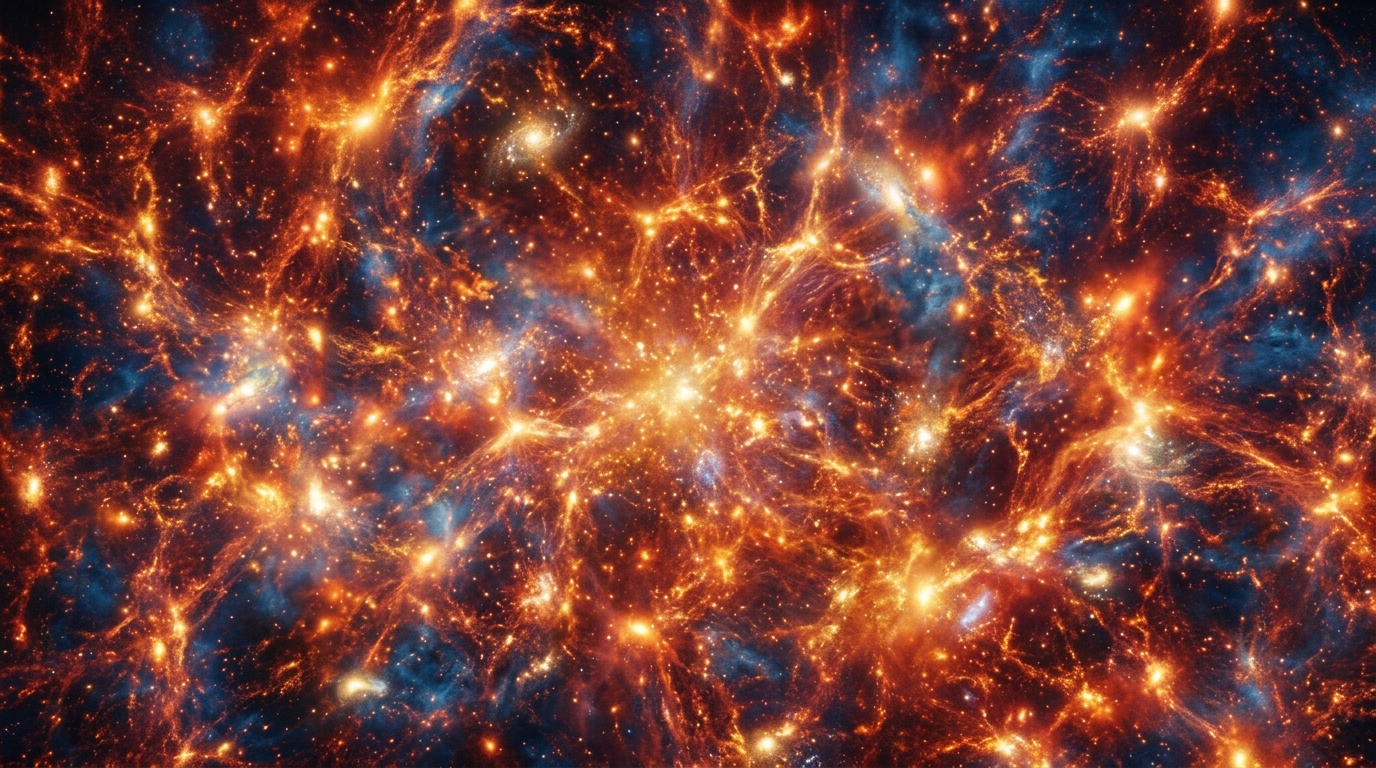
For nearly thirteen billion years, a faint glow has traveled across the cosmos, never fading. It does not shine like a star and belongs to no specific galaxy: it is the very first spark of the Universe, the luminous echo of the moment when the cosmos became transparent. This fossil light, scientists have studied for decades to decipher the portrait of our cosmic youth. And now a new map has just unveiled details that previous surveys left blurred. It promises to redraw, with unprecedented finesse, the very first moments of the Universe.
This fossil light that keeps speaking to us
Imagine the very early Universe as a hot, opaque soup, so dense that light could barely carve a path through it. Then, around 380,000 years after the Big Bang, everything changed: as it cooled, matter released the light, which began to travel freely. This primordial flash has never stopped propagating. Today, it reaches us as an incredibly cold radiation, bathing the entire sky in an almost uniform glow. It is called the Cosmic Microwave Background.
This radiation is a true treasure for cosmologists. It constitutes the oldest image we can observe, a kind of baby photograph of the Universe. By analyzing its every detail, we can trace back to the seeds that gave birth to galaxies, to clusters, and to the vast architecture that surrounds us. Each new, more precise map is a bit like cleaning an old yellowed photograph to reveal faces that were previously indistinct.
Where the old maps lost the thread of the cosmos
Earlier maps had already accomplished remarkable feats. They revealed that this diffuse background was not perfectly smooth: it exhibited tiny fluctuations, regions that were slightly warmer or cooler than the average. These variations, called anisotropies, are the fingerprints of the earliest concentrations of matter. Without them, no structure could have formed, and the Universe would have remained a barren, homogeneous desert.
The problem, however, is that these measurements were reaching their limits. Much like a photo enlarged to excess ends up pixelating, the old maps blurred the finest details. The subtler fluctuations drowned in the instruments’ background noise, and some essential nuances remained out of reach. One could sense there was more to see, without being able to distinguish it clearly. The very first moments of the cosmos thus kept a portion of their secrets well hidden in the blur.
Temperature and polarization: the double signature finally readable
The major breakthrough lies in a new map of the Cosmic Microwave Background that refines the temperature and polarization anisotropies. Temperature, intuitively, is these tiny variations in warmth from one spot to another across the sky. But the polarization is more subtle. It describes how the fossil light was oriented during its very earliest interactions with matter. In plain terms, it’s a second signature, more discreet, etched into this primordial radiation.
Crossing these two pieces of information is a bit like moving from a black-and-white image to a three-dimensional relief. Temperature tells a story, polarization confirms and enriches each chapter. With this now much clearer dual reading, researchers have a coherent and detailed portrait of the earliest moments, where previously only blurred outlines could be perceived.
What this new glow changes about our view of the Universe
This unprecedented precision is not merely a technical feat: it tightens the major parameters that describe our cosmos. Its composition, its age, the rate at which it expands, the proportion of ordinary matter versus this mysterious dark matter… All these values tighten up, gaining reliability. It’s a bit like dialing in the focus of a lens: the reference points become more secure, and the model that describes our Universe is strengthened.
Moreover, this finesse opens the door to dizzying questions. By scrutinizing these tiny reliefs, scientists hope to trace the traces of the very earliest fractions of a second, that explosive period when the Universe may have experienced an enormous expansion. Each detail found brings researchers a little closer to those elusive origins.
By sharpening the oldest image of the cosmos, this new map reminds us that the Universe still hides many secrets, patiently inscribed in a light thirteen billion years old. And if the next leap in precision allows us to finally read, in that first glow, the very first breath of the Universe?
