
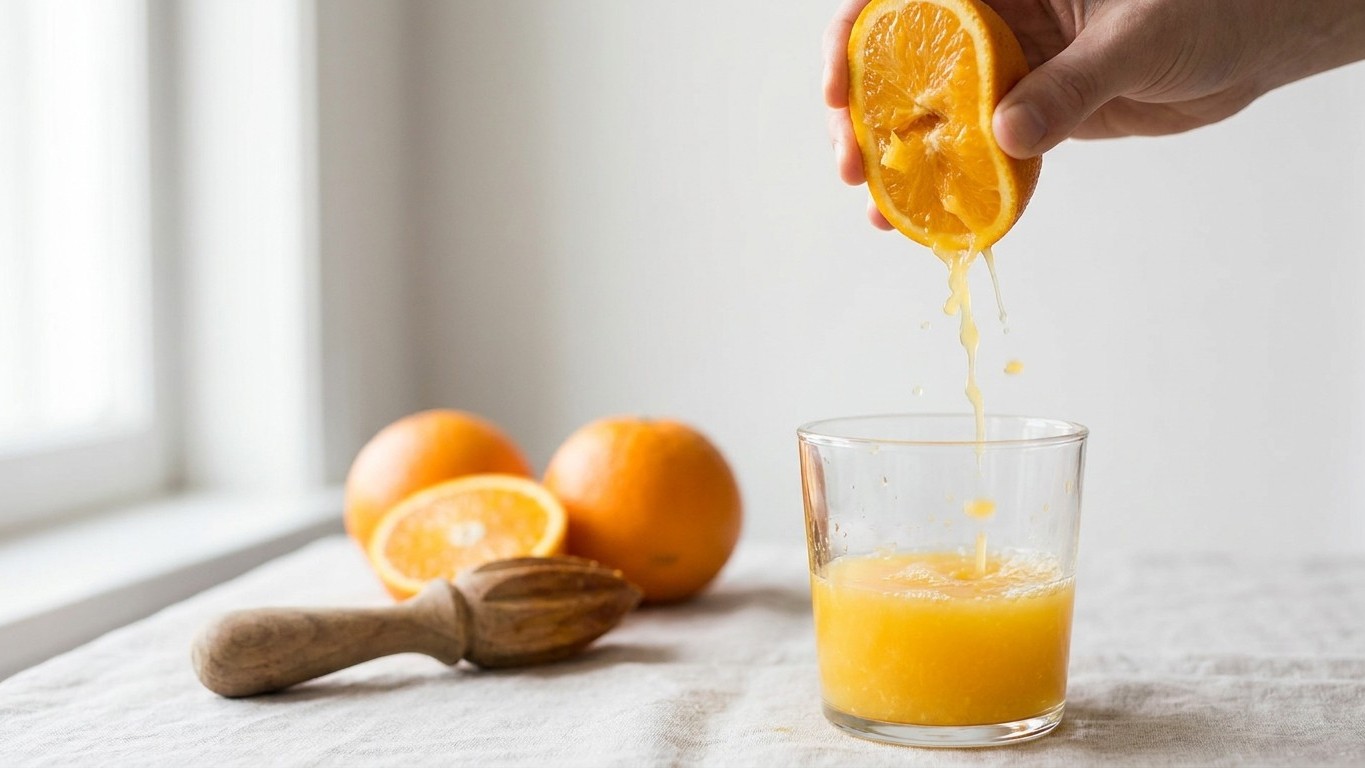
The orange juice you pour into your glass every morning has, in reality, spent up to a year in a gigantic tank with no oxygen at all, before a laboratory artificially restored its fresh-squeezed fruit flavor. This process, known in American industry as “deaeration,” applies to nearly all juices sold in cartons or bottles, including those labeled “100% juice” or “not from concentrate.”
Key takeaways
- Why “100% pure juice” is never as fresh as you think
- Who really creates the taste of your orange juice each morning
- How the industry can legally hide this process
A juice that loses its flavor before it is sold
The mechanism is almost counterintuitive. After the oranges are pressed and pasteurized, those that do not go into frozen concentrate are stored in aseptic conditions, a process that involves removing oxygen from the juice via deaeration, in tanks that can hold millions of gallons for as long as a year. The goal is purely logistical: without oxygen, bacteria do not thrive, and the liquid stays stable without visible changes.
The problem is that removing this oxygen also strips away the orange’s natural aromas. A true paradox. The juice emerging from these tanks bears little resemblance to what you squeeze at home on a Sunday morning. An old ABC News article citing the director of the Florida Citrus Processors Association confirms that, before packaging and shipping, the juice is then boosted with an aroma pack drawn from orange byproducts such as the zest and the pulp to compensate for the flavor loss that occurs during heating.
Flavor packs, an insiders’ secret well guarded
Here lies the core of the issue: these so-called flavor packs are never disclosed on the label. And for good reason: technically, they are not considered an ingredient within regulatory definitions. Since these packs are produced from orange byproducts, they are not required to be treated as ingredients and thus do not have to appear on food labels, even though they are chemically transformed.
What is striking is who actually creates these aromas. It isn’t the juice manufacturers themselves, but specialized companies in luxury perfumery. Juice producers hire aroma and fragrance firms—those same outfits that craft perfumes for Dior and Calvin Klein—to assemble aroma packs that restore a fresh-t squeezed taste to the juice. The perfumer who worked on your favorite scent could also have calibrated the flavor of your breakfast orange juice. It’s hard to imagine a more counterintuitive arrangement.
Each brand has its own aromatic signature, which explains why two cartons of juice—even if they originate from similar varieties of oranges—never taste exactly the same. Different brands use distinct aroma packs to give their product a unique, consistently one-of-a-kind flavor; Minute Maid, for instance, is noted for a distinctly sweet and indulgent profile. Some manufacturers have even gone so far as to replicate a competitor’s flavor: firms have been hired to create an aroma pack that mimics a rival’s taste, producing a veritable “hall of mirrors” of flavors. And these formulas are not universal. Tastes vary by continent, and producers tailor their recipes to local palates: North American packs often contain high levels of ethyl butyrate, a compound Americans particularly enjoy, while Mexican and Brazilian markets favor other compounds like decanal or terpenes such as valencene to match regional preferences.
What the law really says, in France and the United States
French and European regulations impose strict standards on the label “100% pure juice.” By law, an orange juice labeled “100% pure juice” must be produced solely from fresh fruits, without the addition of colorants or preservatives. Yet a loophole exists, and it is perfectly legal: removing oxygen during pasteurization also removes aroma compounds, so manufacturers are permitted to separate the aromas from the fruit before the process and reintroduce them afterward.
In Europe, this practice is regulated by traceability requirements: in France and across the European Union, the aromas must come from the juice in question. You cannot flavor an orange juice with mandarins’ or lemons’ aromas. But that’s as far as the obligation goes, because regulation does not demand any indication on the packaging about this technique. There is no legal requirement forcing brands to print “reincorporated aroma” on their cartons.
In the United States, the room for maneuver is even wider. For the American market, manufacturers are allowed to add an aroma pack, which can be derived from oranges but is not necessarily so, and U.S. regulation does not compel them to disclose this on the packaging. This regulatory ambiguity explains why the topic reappears periodically in Anglophone media for more than a decade without ever resulting in an explicit labeling requirement. There are nonetheless alternatives: some chains advertise the absence of flavor packs and long storage, opting for quick bottling soon after pressing, even if that means the flavor swings more with seasons and harvests.
One question few consumers ask remains: why accept that a juice travels from Brazil, sleeps for a year in a tank, and then emerges, bottle after bottle, identical to itself?
The answer lies in a single word: industrial standardization, which aims less to honor the fruit than to meet a commercial expectation—a taste that never varies. A juice pressed at home, by contrast, shifts in flavor depending on the orange variety, the season, and even the year’s sunshine. It is precisely this natural variability that the industry has chosen to erase.
Sources: sante-nutrition.org | lifestance.eklablog.com
