
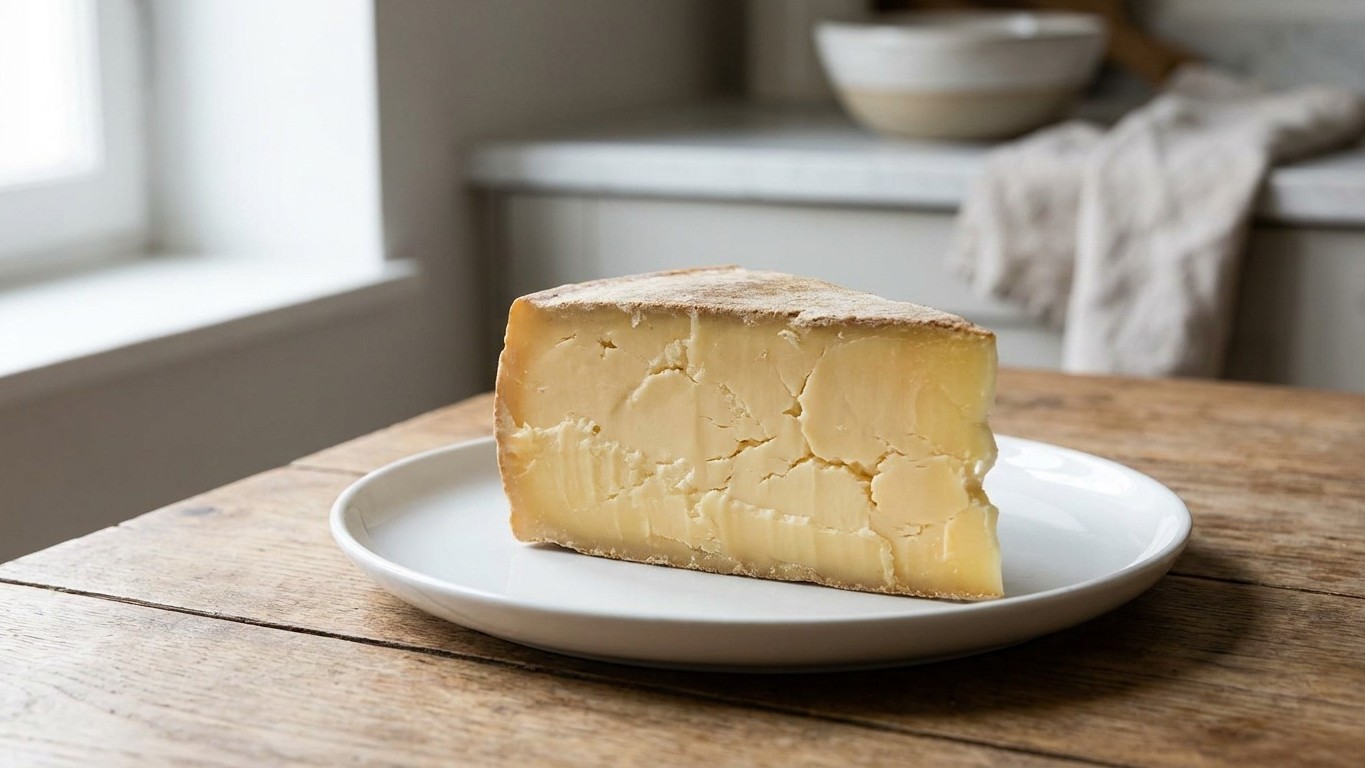
A slice of Comté cheese does not clog your arteries the way a pat of butter does, even when the amount of fat is the same. This is the conclusion reached by several teams of Danish, French, and Irish researchers who uncovered the precise mechanism behind this paradox: the calcium in cheese captures a portion of the saturated fatty acids and expels them directly into the stools, before they reach the bloodstream.
For decades, cheese carried a reputation as a slow-acting heart toxin. Its saturated fat content, often exceeding 20 grams per 100 grams depending on variety, made it an easy target for anti-cholesterol recommendations. The reasoning seemed airtight: more saturated fat means more LDL, and higher cardiovascular risk. Yet intervention studies, conducted on real cheese eaters rather than theoretical models, began to tell a different story.
Key takeaways
- Cheese calcium forms calcium soaps that trap fats and pass them naturally
- With equal fat intake, cheese does not raise cholesterol unlike butter
- The cheese matrix’s structure provides a protective effect that isolated nutrients do not replicate
Calcium, an Unsuspected Fat Trap
The mechanism rests on a simple yet highly effective chemical reaction. In the intestine, the calcium contained in cheese forms calcium soaps by binding to fatty acids—insoluble “soaps” that end up in the stool rather than in the bloodstream. In practical terms, a substantial portion of the saturated fat you just swallowed will never be absorbed. It travels through the digestive system bound to calcium and exits as is.
A Danish team quantified this phenomenon with precision. In a cross-over trial conducted on fifteen young, healthy men in Copenhagen, researchers compared a dairy-poor diet with calcium-enriched diets via milk or cheese. Compared with the control, the milk- and cheese-based regimens attenuated the rises in total cholesterol and LDL triggered by saturated fats and led to greater fecal fat excretion. The two groups consumed exactly the same amount of saturated fat, but it was excreted more in the stools when accompanied by dairy calcium.
A meta-analysis of randomized controlled trials confirmed the magnitude of the phenomenon on a larger scale. According to these compiled studies, increasing dairy calcium intake by 1,241 milligrams per day corresponded to an increase of 5.2 grams per day of fats excreted in the stool. Five grams may seem minor, but when repeated daily and accumulated over months, it ceases to be a trivial detail and becomes a compensatory mechanism that shifts the lipid balance.
Cheese vs Butter: A One-Sided Duel
The most telling comparison remains cheese and butter, two fatty dairy products with very different internal structures. Butter is almost pure fat, lacking the protein and mineral matrix that characterizes cheese. A study directly comparing the two at equivalent fat intake found that, despite its high saturated fat content, cheese does not appear to raise total cholesterol or LDL compared with an equivalent fat intake from butter, a potential effect linked to cheese’s high calcium content that drives greater fecal fat excretion.
The numbers back this trend: the cheese period yielded, on average, 11.6% higher fecal fat excretion than the butter period. A French team across several research centers documented a similar effect: at equal saturated fat input, the presence of calcium forming soaps expelled in the stool makes butter yield higher LDL values than cheese. Cheese is therefore not a neutral food despite its fats; it is active against them, thanks to the very calcium it was accused of containing so lightly.
What the Cheese Matrix Reveals
Biochemists term this the “matrix effect.” The idea is that it is not the isolated saturated-fat molecule that matters, but the environment in which it travels until it reaches the intestine. An Irish team tested this hypothesis in a particularly clever manner, comparing whole cheese to a “deconstructed cheese” that delivered the same nutrients, the same saturated fats, and the same calcium, but in a form separated rather than wrapped within the natural casein matrix. Cheese consumption would lower total cholesterol and LDL compared with a deconstructed matrix providing an equivalent amount of dairy fat and calcium, an effect attributed to the cheese’s complex matrix despite its saturated-fat content.
An intriguing detail: this benefit may not be universal. Among women, total cholesterol decreases in the cheese group while it rises in the decomposed-cheese group, and LDL concentrations fall in the cheese group, whereas the effect is far less pronounced in men. This hints at nutrition that could account for biological sex—an important parameter that remains largely overlooked in general dietary guidance.
In practical terms on the French scene, a study conducted in several cities (Lille, Marseille, Lorient, Grenoble) tested daily Camembert consumption among individuals with moderately elevated cholesterol. The protocol prescribed 60 grams per day for five weeks. The study followed people with moderately high cholesterol who consumed 60 g of Camembert daily, and the result showed no changes in metabolic lipid balance or blood pressure. No deterioration, even in a population at risk. By contrast, a large-scale cohort study even found an inverse association: cheese would be linked to reduced mortality within a balanced diet, with mortality lowered by 39% among high consumers compared with low consumers over 15 years of follow-up.
Yet a critical caveat emphasized by researchers remains: not all studies agree on the precise magnitude of calcium’s role. A more recent Irish experiment, specifically testing cheeses with high and low calcium content, yielded mixed results: varying the calcium content within a cheese matrix did indeed affect fasting LDL levels, but the results did not confirm an increased fecal fat excretion as the underlying mechanism. Calcium might act, but perhaps not exclusively through the fecal route—it could also bind bile acids and alter cholesterol synthesis in the liver. The science of cheese, after all, has yet to reveal all of its secrets.
Sources: resterconnecte.com | cerin.org
