
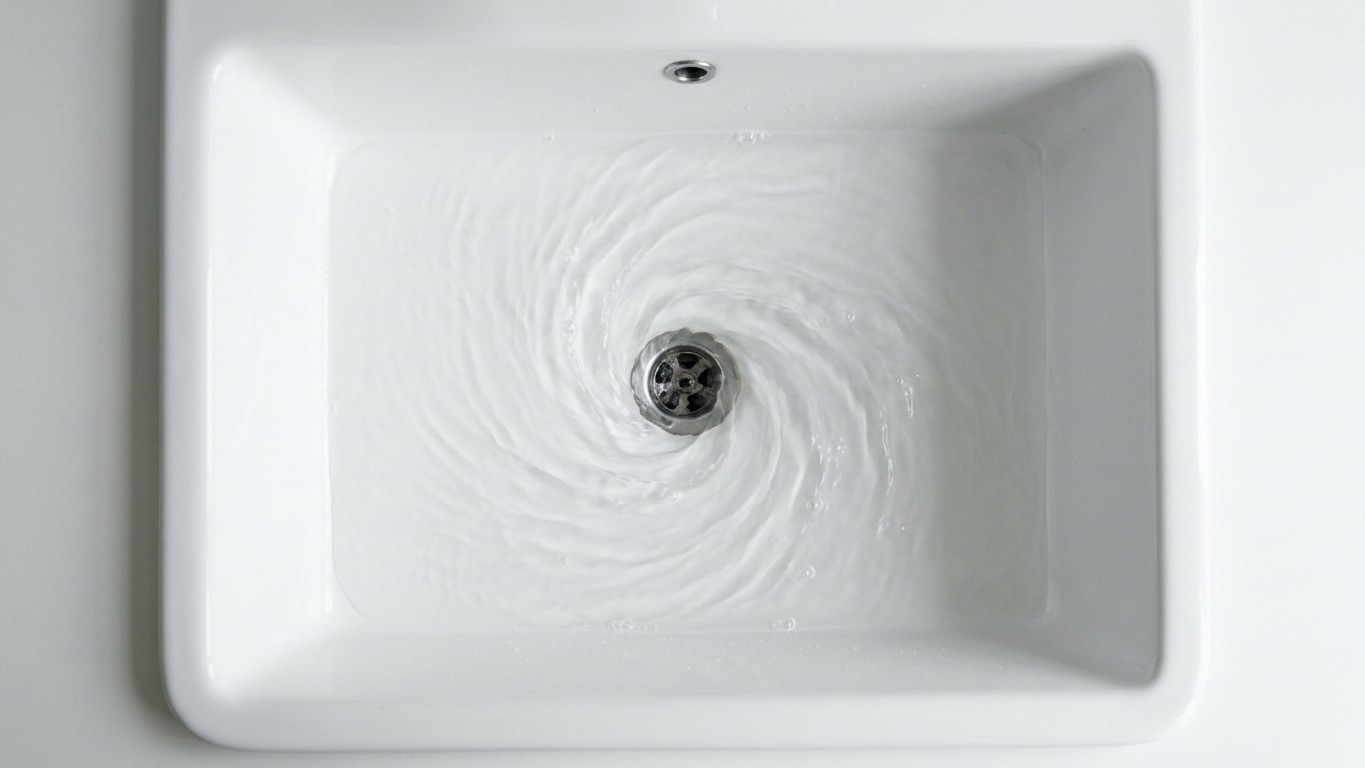
A whirlpool forms on one side in the northern hemisphere, on the other in the southern hemisphere, and water that stubbornly refuses to swirl precisely at the equator. This story has circulated for decades, repeated by professors, tour guides, and sometimes even some physics textbooks. The problem is that it is false for any domestic sink or bathtub. What actually determines the direction water takes when it drains is the shape of your basin, the residual turbulence left by the faucet, and the geometry of the drain hole. The rotation of the Earth has, at this scale, almost nothing to do with it.
Key takeaways
- An MIT professor had to let the water settle for 24 hours under sterile conditions to observe the Coriolis effect
- Equator guides perform pure magic, not geophysics
- Your faucet and the incidental mixing of the water weigh infinitely more than Earth’s rotation
The myth you may have learned in school
The idea is appealing because it rests on a real phenomenon: the Coriolis effect. This apparent deflection, caused by the rotation of the planet, shapes the rotation direction of cyclones, which spin counterclockwise in the northern hemisphere and clockwise in the southern one, as a physicist cited by Scientific American notes about the tendency of fluid circulations to follow this logic on large scales. The intuitive shortcut then seems logical: if it works for a hurricane spanning hundreds of kilometers, why not for the water in a thirty-centimeter sink?
That is precisely where the problem lies. A distinguished professor of atmospheric sciences from Oregon State University, cited by Scientific American, states the issue plainly: he doubts that the draining direction represents anything other than an accidental twist imparted by the initial flow, because the local irregularities of the moving water dominate the Coriolis effect at this scale. Your faucet, the way you pull the plug, the slightest roughness in the basin’s glaze—these all weigh far more than the Earth’s rotation.
What really drives the swirl in your sink
Take any sink at home and watch it for several days in a row. You’ll find it doesn’t consistently swirl in the same direction. An American physicist, also cited by Scientific American, cuts to the chase: for a bath prepared specifically for laboratory conditions, the answer might be yes, but for any ordinary tub you’d find at home, the answer is no. The direction of rotation actually depends on a cocktail of mechanical factors: the exact shape of the basin, the friction against the walls, the agitation you create when you remove the plug, or even a slight thermal current within the water.
The simplest homeproof? Stir the water in one direction before removing the plug, and the whirl will follow that impulse, regardless of the hemisphere you’re in. The Conversation summarizes this with a practical demonstration: you can easily show you have a stronger effect than Coriolis by changing the whirl’s direction simply by stirring the sink water in one direction or the other before opening the drain. An American geophysics institute even measured the phenomenon: scientists found, as predicted, that the tiniest initial rotation—such as that produced by a slightly inclined faucet—persists for many hours, and that the water drains in the direction in which it began to rotate. Your sink remembers, for hours, the small nudge you gave it first.
A 24-hour experiment to track a tiny effect
So, does the Coriolis effect exist at the scale of a bathtub? Yes, but you need laboratory-grade conditions to detect it. In the 1960s, a MIT mechanical engineering professor named Ascher Shapiro accepted the challenge. He let a water tank rest for twenty-four hours to eliminate any residual agitation, before removing the drain with extreme care. The result, as reported by MIT Technology Review, is strikingly slow: it took about twenty minutes for the tub to empty, and during the first twelve to fifteen minutes the float remained still, before beginning to rotate almost imperceptibly, in the counterclockwise direction, reaching a maximum speed of roughly one rotation every three to four seconds.
The actual magnitude of the force at play is mind-bogglingly small. Even in this account, at MIT’s latitude (42 degrees), the effect accounted for only about thirty millionths of the strength of gravity, a value so tiny that it’s masked by filling, temperature differences, and even impurities in the water. Similar experiments were later conducted to check the expected inversion on the other side of the equator: Australian researchers observed, under the same stringent conditions, rotation in the opposite sense to what is seen in the northern hemisphere. This confirms the physics of the phenomenon while underscoring how far one must stray from everyday life to observe it.
And the famous demonstrations near the equator?
Videos filmed near the equatorial line, where a guide pours water into a basin that seems to rotate in one direction on one side and in the other a few meters away, are pure sleight of hand. The basin is slightly tilted or the water receives a different initial impulse depending on which side the guide stands; nothing more. As for toilets, often accused as well, the mechanism governing them is even farther from Coriolis: it’s the orientation of the water inlets in the bowl that dictates the rotation direction—a matter of plumbing design choices rather than geophysical whim.
The next time someone brings up this sink story, you can propose a playful test. Spin the water in the opposite direction to its natural tendency in your hemisphere before pulling the plug, and watch it obey that impulse without caring about the Earth’s rotation.
Sources: futura-sciences.com | omnilogie.fr
