
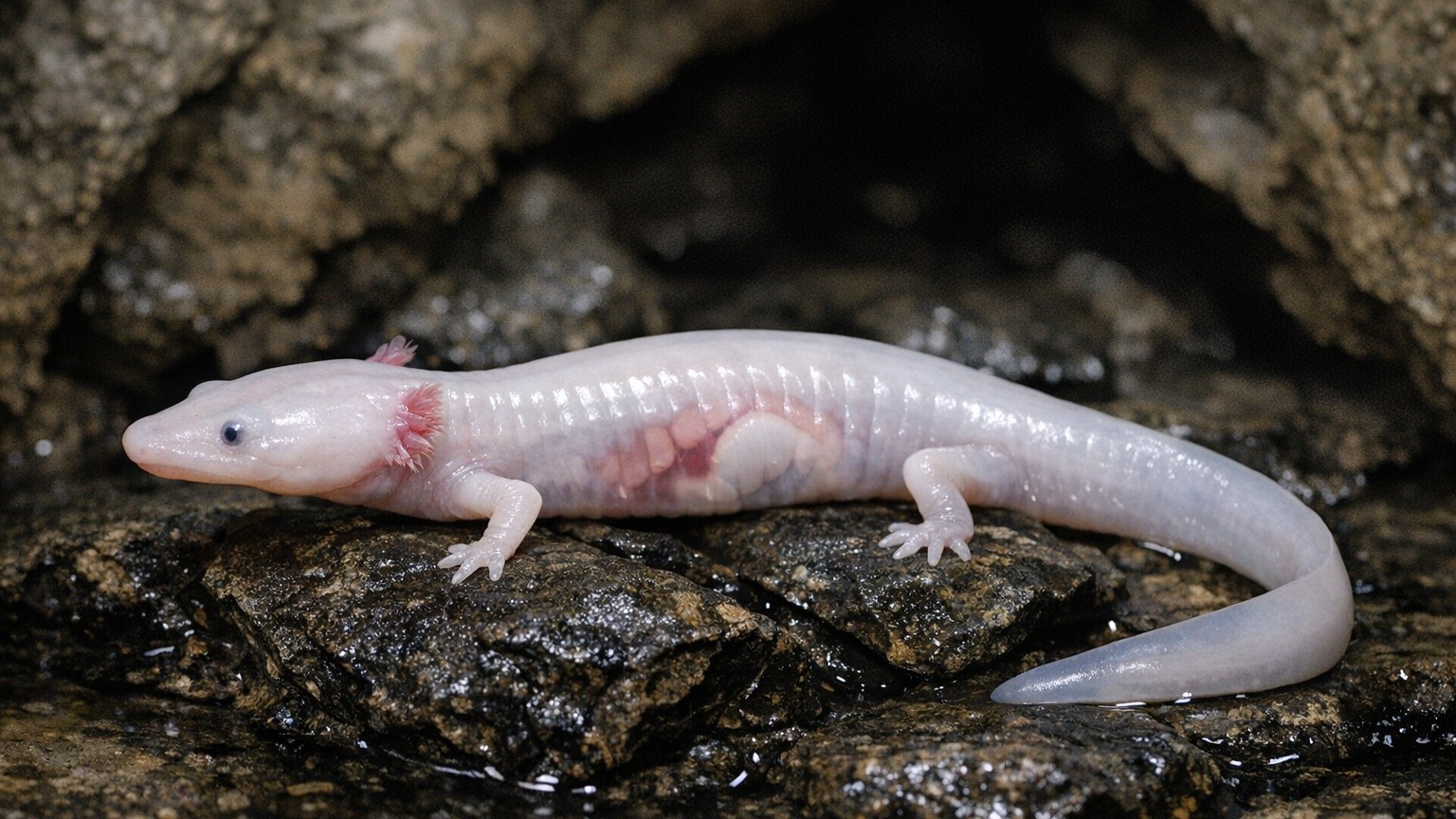
Ten years without eating. Not ten days, not ten weeks. Ten years. It is the record for absolute fasting among vertebrates, and it belongs to a 25-centimeter creature that dwells in the complete darkness of Europe’s karst caves. The olm (Proteus anguinus) is arguably the most overlooked animal on the continent, and by far the most intriguing.
À retenir
- Can a vertebrate really go ten years without eating?
- How does such a fragile-seeming creature guard its secrets in the dark?
- Why are scientists studying this unseen amphibian to unlock aging mysteries
A creature designed for the impossible
The olm, also known as the olm or white salamander, is the sole species in the genus Proteus, the only European species in the Proteidae family, and the only troglobitic chordate in Europe. In short: across the continent, no other vertebrate spends its entire life in underground depths. It is sometimes nicknamed the “human fish” because its skin resembles human skin. A comparison that can give you chills when you first meet the animal.
The olm is an entirely aquatic amphibian measuring between 20 and 30 cm, occasionally reaching up to 40 cm. Its body, long and tapered, recalls an eel’s shape, but it has minuscule limbs: three toes in the front, two in the back, as if it never finished developing. Its internal organs are visible through its transparent skin. A design that is both spectral and functional, carved for an environment where evolution has stripped away anything unnecessary.
When it comes to vision, the olm occupies a class of its own. It lacks functional eyes. It has eyes, but they lie beneath the skin. Larval vestiges that do not see much more clearly than we do in a completely dark cave. To compensate, the olm relies on ultra-sensitive receptors for touch, smell, and vibrations, and even electromagnetic sensors. Its skin contains a molecule called melanopsin, capable of detecting faint variations in light. Even blind, it knows when someone shines a light on it.
The record that defies biology
Because food is scarce in caves, the olm can survive up to ten years without eating. During these periods, it slows its metabolism, stores reserves as lipids and glycogen in the liver, and can even reabsorb its own tissues if necessary. It is precisely this last mechanism that astonishes biologists: the animal consumes itself from the inside, targeting only non-vital tissues. A surgical self-destruction in the service of survival.
To grasp the scale of this feat, compare: scorpions and crocodiles can endure three years without eating by slowing down every vital process. The emperor penguin, meanwhile, keeps its egg pressed against its body without feeding for four months in the heart of polar winter. The olm, with ten years, leaves them all behind, and it remains a vertebrate, that is, a creature with a backbone, like you.
Its immobility is equally striking. Scientists have found a specimen that hadn’t moved for 2,569 days, more than seven years. According to their results, published in the Journal of Zoology, the longest distance traveled by an olm is 38 meters in 230 days. 38 meters in eight months. The distance from one end of a metro line to the other end of nothing.
A century of life in the dark
Fasting is only a symptom of a far more radical biology. This salamander takes 15 years to mature, mates and lays eggs only roughly every 12 years, and moves hardly at all, except when it seeks food. A reproductive cycle that can induce vertigo: if a olm born in 2026 follows the average pace, it won’t reproduce until 2038, then again around 2050, and then around 2062… The olm’s exceptional longevity can reach up to 102 years.
The olm’s telomeres do not shorten with age as they do in humans. This discovery, published in a study reported by The Conversation, has propelled the animal to the status of a model for aging research. Scientists are particularly interested because of its ability to regenerate tissues, which allows the study of certain aging mechanisms in vertebrates. Understanding the olm might help explain why we age, and how to slow the process.
In France, a discreet but real presence
In France, the olm can be seen in aquariums inside Choranche Cave on the western fringe of the Vercors plateau, as well as at Clamouse Cave in the Hérault gorges. These individuals inhabit an aquarium at the underground laboratory of the Station for Theoretical and Experimental Ecology (SETE) installed in Moulis Cave in the Ariège Pyrenees. Laboratories set up in caves across Europe study the animal, notably at Moulis and in the Choranche caves, in France.
Despite its exceptional biological robustness, the olm remains a fragile species in the face of human activity. Classified as “Vulnerable” by the IUCN, the olm is inherently rare, reproduces poorly, and is endemic to fragile habitats. Its confinement within subterranean caves under particular conditions makes it highly sensitive to changes in its environment. The waters in the karst rock networks are quickly contaminated by surface pollution, and these runoff waters swiftly reach the lower levels. A pesticide spread kilometres from a cave entrance can be enough to contaminate an entire colony.
This paradox nicely sums up the olm: capable of surviving ten years without a single bite, resistant to absolute darkness for millions of years of evolution, yet vulnerable to a polluted groundwater source. The most spectacular robustness of the animal kingdom coexists with a fragile, crystal-like vulnerability—provided the water flowing through its cave remains clean. A neotenic cavernicolous amphibian, exclusively aquatic, it retains larval features such as external gills throughout its life, while amphibians typically adapt to a terrestrial lifestyle as adults. A creature that has chosen, somewhere in evolution, never to truly stop growing—and to make that its greatest strength.
Sources : bangkok-realestate.net | images.cnrs.fr
