
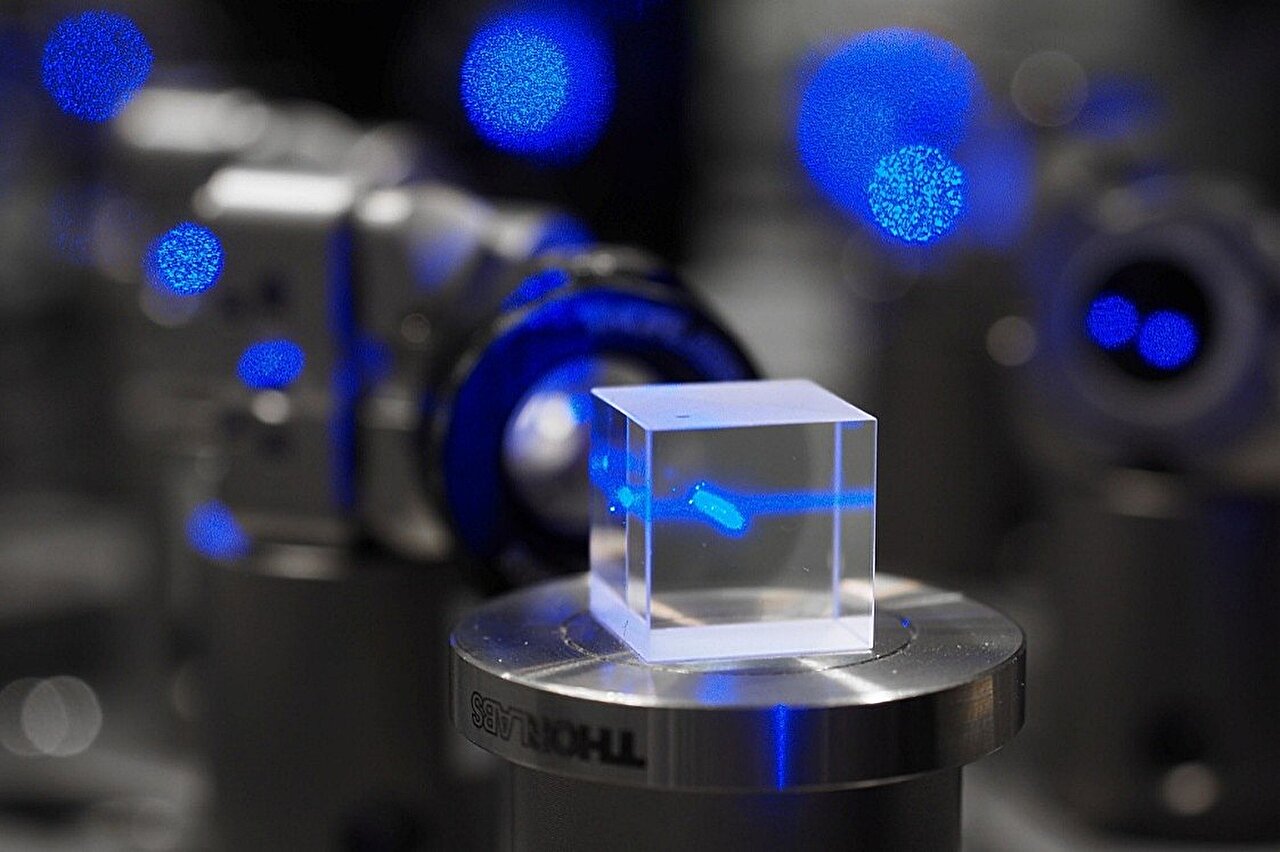
Researchers at Imperial College have taken a pivotal step toward detectors capable of tracking gravitational waves and dark matter. For the first time, a prototype has demonstrated in realistic conditions that one can extract a useful signal from measurements that are individually unusable — by comparing two atomic interferometers to cancel the noise. Published in Nature, this result paves the way for installations at CERN and Fermilab.
What you will learn
- How two atomic interferometers can reveal what neither one can measure alone
- Why laser noise has until now been the main obstacle to next-generation quantum detectors
- What these sensors could detect that current instruments cannot see
A fundamental obstacle: the noise that drowns the signal
The universe is full of incredibly faint signals — gravitational waves from the early universe, signatures of dark matter that have yet to be observed. Detecting them requires instruments of extraordinary precision.
Long-baseline atomic interferometers are among the most promising tools. Their operation relies on lasers that split clouds of ultracold atoms and then bring them back together, enabling measurements with extreme precision of tiny variations in their behavior. Any difference between two atom clouds interrogated by the same laser could reveal the presence of a signal previously undetectable.
But these experiments confront a fundamental problem: the laser itself generates phase noise far exceeding the signals being sought. This noise drowns everything out.
Two interferometers are better than one
The theoretical solution was known: compare two interferometers to cancel the common noise. If both experience the same laser noise but different physical signals, the comparison eliminates the noise and reveals the signal. Yet this approach had never been validated under realistic conditions.
This is precisely what the Imperial College team demonstrated in the Ultracold Strontium Laboratory. Two ultracold clouds of strontium-87, separated in space but interrogated by the same clock laser, were subjected to large amounts of deliberately introduced phase noise — far beyond what the most stable lasers naturally produce.
A dark matter signal detected in the noise
To push further, the researchers introduced into the system an artificial oscillating signal, akin to what a gravitational wave or a dark matter field might produce. This signal remained clearly detectable by the combined measurement — even when each interferometer taken separately yielded no usable information.
This is the first experimental demonstration that this fundamental principle of next-generation detectors actually works under conditions approaching those expected in future large-scale facilities.
The path toward CERN and Fermilab
This tabletop prototype opens the door to far more ambitious instruments. The AION collaboration is working on large-scale versions, in partnership with the MAGIS project at Fermilab in the United States and with a proposed CERN installation — the CERN Atomic Interferometry Experiment, or AICE. These future detectors would explore gravitational-wave frequency bands still out of reach and would search for new forms of invisible matter that make up a large portion of the universe.
