
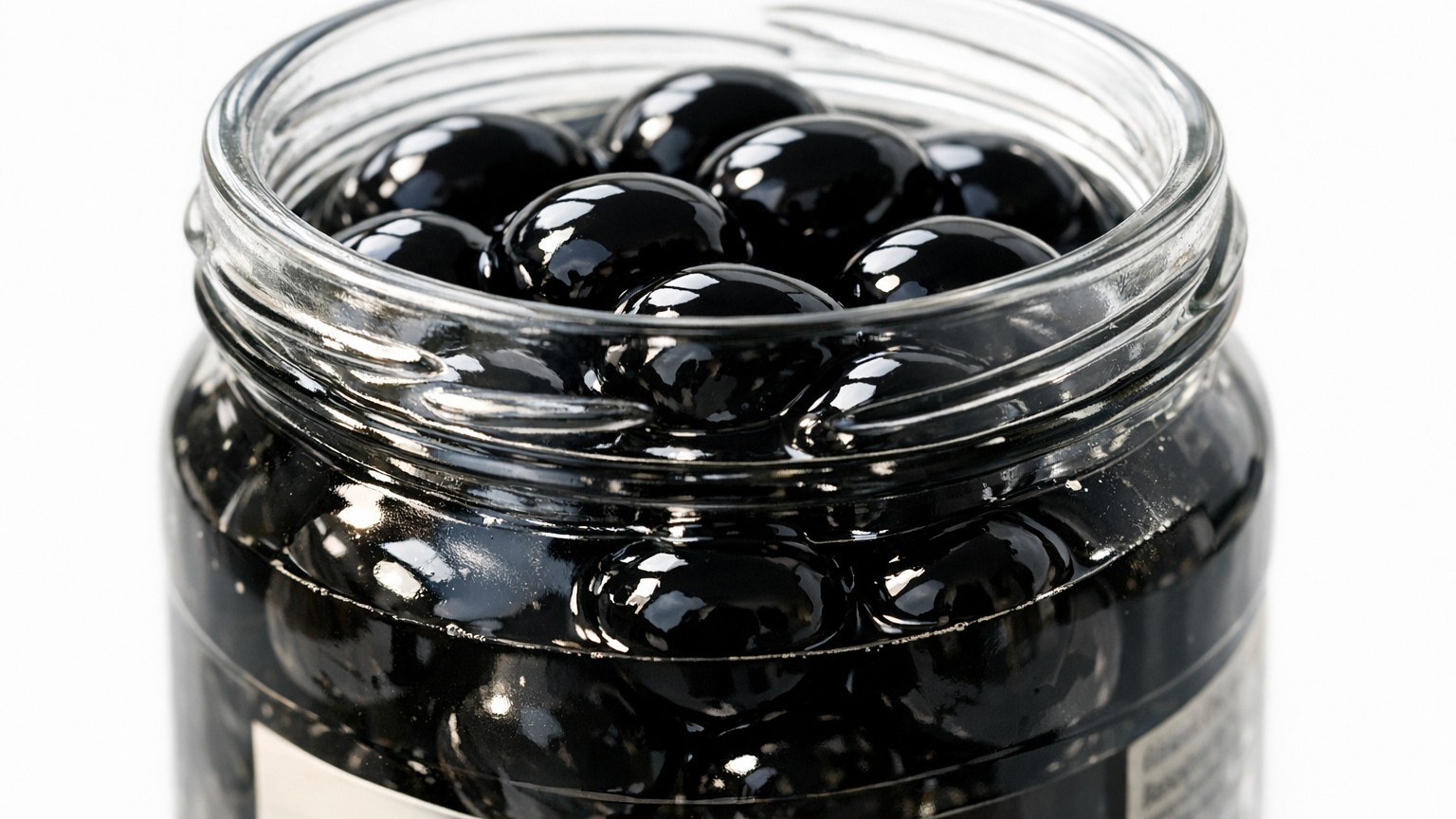
Return the jar of black olives you bought this week at the supermarket. Read the ingredients list. If you find the wording “black candied olives” or the presence of ferrous gluconate (E579), what you are about to open is not what you think you are buying.
These smooth black olives sold in jars are actually green olives that have undergone chemical treatment to alter their color. This isn’t fraud in the legal sense. It’s worse, in a way: it is perfectly permitted, discreet, and widely practiced for decades.
Key takeaways
- Green and black olives come from the same tree; only ripeness differentiates them
- An industrial three-bath process turns green olives black in a few days
- The keyword to look for on the label reveals whether your olives have undergone chemical treatment
One Olive, Two Colors, Zero Difference Between Trees
The first misconception to dispel: there aren’t olive trees that bear black olives and others that bear green olives. Green and black olives typically come from the same tree. The only difference lies in the maturation time: a green olive is less ripe, thus picked long before a black olive. The difference comes down to a single parameter: the fruit’s maturity at the moment of harvest. The olive is born green, remains green for weeks, then begins its chromatic metamorphosis.
During natural ripening, chlorophyll gradually degrades. Dark pigments, anthocyanins (also present in red grapes or blueberries), give the olive its purplish to black hue. The texture also evolves: ripe olives become oilier, less fibrous, and their bitterness diminishes. This process, if left to run its natural course, takes several months, with black olives usually harvested between November and January depending on the region and variety.
The food industry, however, does not have that kind of patience.
The Three-Bath Process That Transforms Green to Black
Caught green, thus hard and immature, olives are plunged into a bath of lye or weakly concentrated potassium hydroxide to remove bitterness, then into a brine bath (water + salt) to soften them, and finally into a solution of ferrous gluconate (E579) which gradually alters their color through oxidation. To boost efficiency, olives are often pitted beforehand. This is a win for the confisers, who manage to accomplish in days what nature does in months.
The visual result is impeccable, in the literal sense. A chemically colored olive displays a uniformly black color, nearly perfect, identical across every olive in the jar. This is precisely the sign that should alert you. A truly black olive, slowly ripened, typically shows an irregular shade, oscillating among brown, purple, and black depending on the fruit. That imperfection is a hallmark of authenticity.
The final result benefits from a mild flavor and a homogeneous color, perfectly suited to industrial production. This technique enables manufacturers to offer olives with a less pronounced taste, thus meeting the preferences of a broader audience. The treatment does not produce a better fruit; it produces a standardized, predictable fruit, safe on the palate, and profitable.
The Word That Gives It Away on the Label
These fake black olives are allowed for sale, but the label must state “black candied olives,” which can be misunderstood by consumers. “Candied” instinctively evokes an artisanal, almost gourmet preparation. It is the exact opposite of the industrial reality behind that term.
To spot these fake black olives on the shelves, simply check for the mention “black candied olives” or ferrous gluconate (E579) in the ingredient list. These two signals are equivalent: one designates the process, the other the chemical used. Ferrous gluconate (E579) is an additive permitted in Europe, regulated and considered harmless at the doses used in food production. Its use isn’t illegal, and manufacturers are required to indicate it on the ingredient list. The labeling obligation is thus in place. But between “mentioned” and “visible,” there is font size, the complexity of the ingredient list, and the fact that the vast majority of shoppers do not read it.
The French market heightens pressure on producers. Domestic production accounts for only 2% of the 67,000 tons of olives consumed each year in France. We therefore turn to imports, mainly from Morocco. This structural imbalance between local supply and mass demand creates precisely the conditions in which this kind of process thrives.
How to Get By Without Breaking the Bank
The price gap between the two categories is telling. In 2025, Nyons AOP black olives were offered at around €16 per kilogram. By comparison, industrial black olives sold for around €4 per kilogram. A 1-to-4 ratio that neatly sums up the difference in processes.
Olives whose quality you can trust carry an AOP (Protected Designation of Origin), such as Nyons, Nice, or the valley of the Baux-de-Provence. The same goes for olives bearing the organic label, because additives are banned there. These two criteria, AOP and organic, are the only reliable guarantees to date to avoid ferrous gluconate.
Texture remains the last clue before purchase. A genuine black olive often exhibits irregular color variations and may not be perfectly uniform. A colored olive is often a deep, uniform black, almost too perfect. Naturally ripe olives are also softer and meatier. This isn’t a cosmetic detail: it’s an indicator of the process. Absolute uniformity does not exist in nature; it is manufactured in a factory.
What this case reveals goes beyond a simple jar of olives. A class action was even attempted in Quebec against distributors of treated black olives: their critics accused them of not telling consumers the truth and of omitting on the labels that these olives were darkened by an artificial chemical process, thereby violating various laws, including consumer protection law. The court ultimately dismissed the plaintiff, ruling that the olives were indeed “black and ripe,” technically. Legality and transparency are not always the same thing.
Sources: letribunaldunet.fr | lasantedanslassiette.com
