
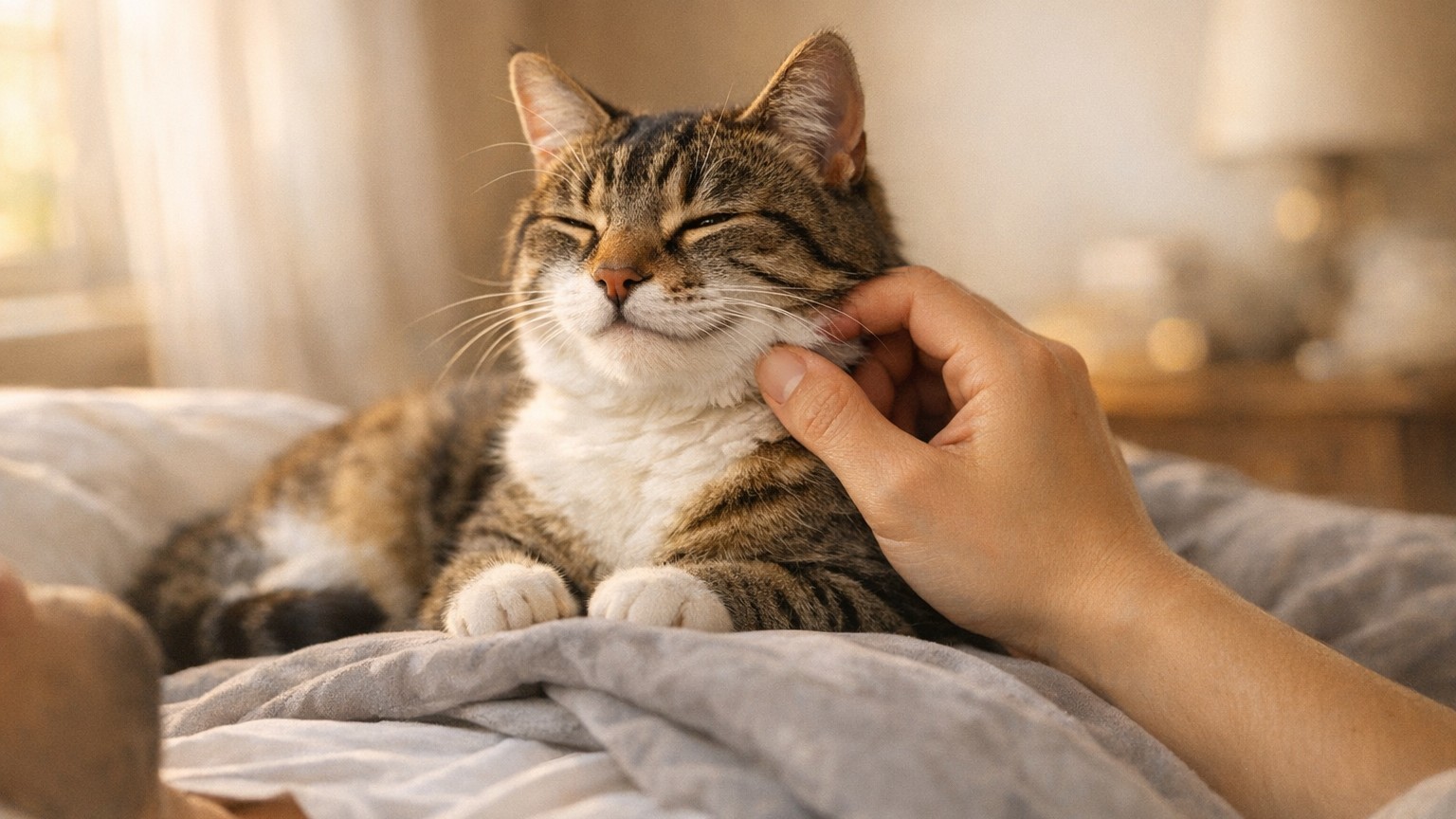
6:47 a.m. Your cat curls up on your chest and starts purring. Not just any purring: with something insistently, a faint edge of annoyance you just can’t ignore. You end up getting up and filling the bowl. Congratulations: you have just yielded to one of the best-documented manipulations in the animal kingdom.
Key takeaways
- Within ordinary purring lies a high-pitched frequency that cats develop only in front of a solitary human
- This mysterious frequency resonates exactly like the cries of a baby, but no one knows since when cats have used it
- A scientific experiment revealed that even without any feline experience, humans judge these purrs as more urgent and pressing
A Soft Sound That Hides a Cry
Purring is typically associated with well-being, warmth, those Sundays when a cat stretches out on the sofa. Yet domestic cats make a subtle use of this characteristic vocalization to solicit food from their human hosts, apparently exploiting the perceptual biases humans have developed to care for their young. This particular purring carries a precise name: the solicitation purr, or solicitation purring.
The difference from ordinary purring isn’t easily discernible to the naked ear. That is where science steps in. Inside the naturally deep purr, researchers have identified a high-pitched vocal component, evoking a cry or a meow, whose frequency spans roughly 220 to 520 Hz, with an average near 380 Hz. To put it in context: at around 380 Hz, roughly a mid-range note, this extra sound stands out clearly from the usual low frequencies of the purr and resembles a cry or a meow more than a purr.
What makes the mechanism particularly powerful is that this frequency does not emerge from nowhere. It is very close to the pitch of human infant cries, which explains why it touches the sensitive strings of humans. The cat didn’t invent a new signal: it borrowed one that our brain has spent millions of years learning to recognize as urgent.
The Experiment That Proves It All
Researcher Karen McComb, from the University of Sussex, was inspired to launch this study by her own cat, Pepo, who had the habit of waking her every morning with an insistent purr. She published her results in July 2009 in Current Biology, under a title that says it all: The cry embedded within the purr.
The protocol is straightforward, and the results speak for themselves. With volunteer help, Dr. McComb’s team recorded, in ten cats, normal purrs and purrs produced when the cats were soliciting food. These solicitation purrs consist of the normal, inherently low-pitched purr and a higher-frequency sound, closer to a meow or a cry.
These recordings were then presented to fifty people. Even at the same volume, and even among individuals with no prior experience with cats, the solicitation purrs were judged as more urgent and less pleasant. The evidence is clear: it is not affection for cats that makes owners give in; it is a deeply wired reflex. By using this buried cry, cats seem to exploit humans’ innate tendencies to care for their young.
McComb went even further. She took recordings of solicitation purrs and removed only the high-pitched vocal component, leaving everything else identical. Without the high-frequency element, volunteers could no longer distinguish these purrs from other ones. The hidden frequency is thus the sole trigger. Remove it, and the charm fades.
A Tailored Learning
What is striking is that not all cats master this trick. This solicitation purr does not appear in every individual. It tends to develop mainly in cats living one-on-one with a single human. In households with several people, children, or other animals, this subtle form of purring goes unnoticed. Result: cats living in busier homes never develop this technique, or give it up due to a lack of results.
It is a reinforcement learning process: the cat purrs in a certain way, the human gets up and fills the bowl, the cat learns the lesson. The studio cat, alone with its owner, thus becomes a virtuoso of acoustic manipulation, whereas the cat in a large family never develops this repertoire. It is a notably adaptive form of intelligence: the signal is refined according to the available audience.
This capacity for adaptation fits into a broader dynamic. Kittens meow to call their mother when they are hungry or cold, but once weaned, wild cats and stray cats almost completely abandon this sound among themselves. Adult meowing, like solicitation purring, is therefore an invention almost exclusively for communicating with humans, not with peers. We are their target audience, and they have adapted their repertoire accordingly.
Being Duped, With Full Awareness
Does knowing all this change anything? Probably not. When a cat purrs to ask for food, it unconsciously activates a parental-care brain circuit. You cannot ignore it, even if you try. Awareness of the mechanism does not deactivate the reflex, just as knowing that an advertisement taps into emotion does not make that advertisement any less effective.
What deserves attention is the sophistication of the process. An evolutionary, refined strategy to capture the caregiver’s attention without resorting to a direct meow. The solicitation purr isn’t a cry: it’s worse. It’s a pleasant-sounding signal that hides an urgent alert. A soft wrapper for a pressing message. And while you tell yourself you yield because you love your cat, your reptilian brain responds simply to an imaginary infant crying in the dark. Cat owners identify these purrs somewhat more readily than non-owners, suggesting that the ability to recognize them improves with experience, without making you any better at resisting them. We learn to hear them. Not to ignore them.
Sources: letribunaldunet.fr | woopets.fr
