
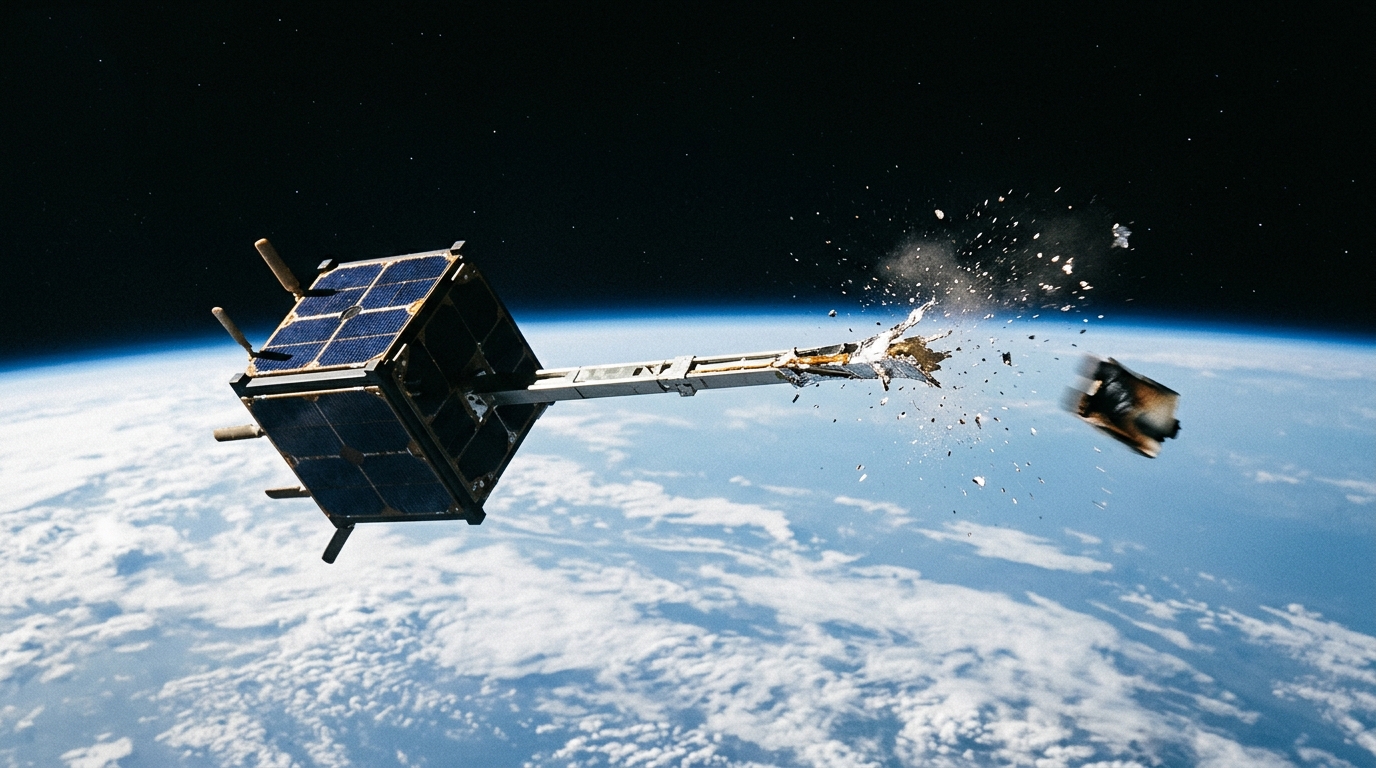
In the seemingly peaceful void of low Earth orbit, thousands of fragments streak by at dizzying speeds, invisible and silent, sometimes waiting years before striking something. That is precisely what happened to Cerise, a small French espionage satellite that carried out its mission quietly until a ten-year-old piece of debris, an forgotten legacy of an Ariane launch, cleanly severed one of its essential components. This story, long a case study in the small world of space surveillance, deserves attention, as it vividly illustrates the dangers posed by our own orbital technological waste.
- In 1996, debris from an Ariane rocket launched in 1986 struck the French espionage satellite Cerise at about 14 km/s, slicing 4.2 meters from its stabilizer mast and triggering a total loss of attitude control
- This event marked the very first detected and confirmed collision between two catalogued space objects, analyst B. Gimle identifying the debris as originating from the 1986 Ariane stage
- The engineers at SSTL in Guildford saved the satellite by reprogramming its onboard systems to use electromagnetic stabilization—a feat unmatched until the 2009 Cosmos 2251/Iridium 33 collision
- A phantom debris in orbit since 1986
- The shock that nearly doomed Cerise
- The technical investigation to identify the culprit
- The reprogramming that saved the espionage satellite
A Phantom Debris in Orbit Since 1986
Let us rewind a little more than a decade before the events. In 1986, France launches an Ariane rocket into space, as it had been doing regularly since the beginning of its space program. Once its mission was accomplished, the rocket’s third stage remained to drift on its own, doomed to wander indefinitely in low Earth orbit. Nothing unusual for the time: this practice, now widely questioned, was then commonplace. The problem is that this stage does not stay intact for long.
Under the influence of various factors, such as extreme thermal variations or an internal explosion related to leftover propellants, these structures often fragment into a multitude of pieces. These fragments, sometimes tiny, become real time bombs, continuing to orbit Earth at speeds close to 28,000 kilometers per hour. No one at the time suspected that one of these shards would, ten years later, cross paths with a very particular French satellite.
The Shock That Nearly Doomed Cerise
Cerise was not an ordinary satellite. This little jewel of military technology, weighing barely fifty kilograms and roughly the size of a large suitcase, was tasked with discreetly listening to electromagnetic communications from low Earth orbit. To stabilize properly and maintain a constant orientation, it was equipped with a six-meter-long telescopic mast, operating on the gravity-gradient principle—an elegant technique that uses simply the difference in Earth’s gravitational pull along the two ends of a structure to keep it oriented.
It was precisely this mast that paid the ultimate price. A catalogued debris object, moving at an impressive relative speed of 14 kilometers per second with respect to the satellite—far faster than a rifle bullet—struck this delicate structure. The impact was astonishingly violent, slicing a 4.2-meter section from the mast as if with a knife. In mere moments, the control center observed a brutal and unexplained loss of attitude, the satellite tumbling dangerously end over end, unable to regain any stability on its own.
The Technical Investigation to Identify the Culprit
Confronted with this sudden and worrying incident, engineers naturally wondered about the source of the impact. Was it an internal satellite failure, a mechanical problem with the mast itself, or an external unforeseen event? Analyses at the time quickly established that it was indeed a collision with an external object—a finding that would mark the history of astronautics, as it was the very first detected and confirmed collision between two catalogued space objects.
To trace the culprit, a meticulous forensic-style investigation was undertaken. It was in this context that independent analyst B. Gimle proposed a precise hypothesis, suggesting that the responsible fragment most likely matched catalogued object 18208, identified as 1986-19RF, a piece originating from the Ariane rocket launched a decade earlier. A conclusion that completed the loop in almost vertigo-inducing fashion, demonstrating how our space junk can continue to pose a threat long after its creation.
The Reprogramming That Saved the Espionage Satellite
While scientists investigated the origin of the impact, another team worked frantically to salvage what could still be saved. Controllers at the Surrey Space Centre in the United Kingdom watched with growing concern as Cerise became completely unstable, spinning uncontrollably. The situation appeared hopeless, the stabilizing mast now too short to perform its original function effectively.
It was then that the ingenuity of the SSTL teams, based in Guildford, stepped in. Rather than attempting an physically impossible remote repair, the engineers opted for a far cleverer solution: a complete reprogramming of the spacecraft’s onboard systems, enabling the use of electromagnetic stabilization to compensate for the damaged mast. Thanks to this technical tour de force, the controllers ultimately managed to regain command of the satellite, granting it a second life despite its injuries. For a long time, this achievement stood as the gold standard in debris handling, until 2009, when the peak event of the Cosmos 2251/Iridium 33 collision occurred and proved to be of comparable scale.
This brief but intense space odyssey remains a superb example of technological resilience in the face of a danger that we still do not fully master today. It also serves as a stark reminder that the vast expanse of space we perceive as infinite is in reality cluttered with our own refuse, capable of resurfacing years later to threaten our most precious technologies.
