
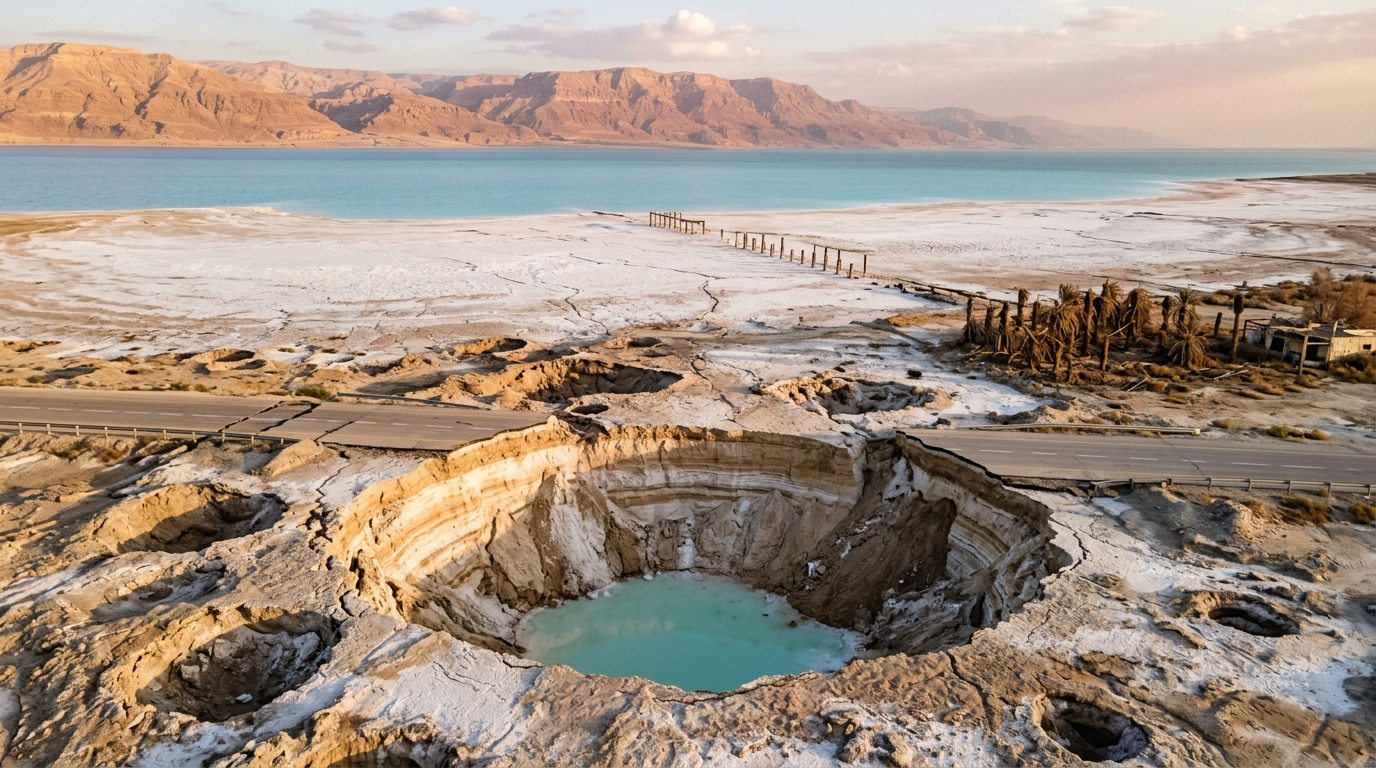
There is something disorienting about imagining a sea dying of drought in the middle of a desert where water is the most precious resource. Yet that is exactly what is happening at the edge of the Dead Sea, that salt lake tucked between Israel, the West Bank, and Jordan, which holds the record for the lowest point on Earth’s surface. For more than six decades, its shores have been inexorably retreating, and the ground surrounding it is literally sinking beneath human infrastructures. Roads are torn open, beaches are closed, orchards are swallowed: the landscape increasingly resembles a geological minefield, where every step may reveal an unforeseen crater. The cause of this silent disaster is nothing mysterious; it hinges on one word: the Jordan, that mythical river whose waters are captured before they even reach the Dead Sea.
- The Jordan’s diversion since 1964 has reduced its flow by more than 90%, depriving the Dead Sea of most of its water.
- The dropping level of the Dead Sea allows freshwater to dissolve underground salt layers, creating more than 6,000 dolines on the Israeli side.
- The Dead Sea is retreating by about one meter per year, having already lost a third of its area since the 1960s–70s.
- A river drained of 90% of its water in sixty years
- The freshwater that dissolves salt buried beneath the Dead Sea
- Thousands of craters swallowing roads and orchards
- A sea retreating by one meter a year, with no return possible
A River Drained of 90% of Its Water in Sixty Years
To grasp the scale of the phenomenon, one must go back to 1964, the year Israel commissioned its National Water Carrier, a system of aqueducts designed to carry water from the Sea of Galilee to the southern agricultural zones of the country. Jordan and Syria quickly followed suit, diverting portions of the Jordan’s course for their own irrigation and potable-water needs. The result: the river’s flow, which hovered around 1,300 cubic meters per second in the 1960s, dropped to about 300 cubic meters per second in the early 2000s. It is a dizzying decline, representing a loss of more than 90% of the river’s original discharge.
In response to criticism, Israel has made a goodwill gesture since 2013, releasing around 9 million cubic meters of water per year from the Deganya dam, located south of the Sea of Galilee. A substantial volume on paper, but negligible when compared with the Dead Sea’s real needs to stabilize its level. It’s a bit like trying to fill a leaky bathtub with a glass of water: the gesture is commendable, but it clearly cannot offset decades of heavy withdrawals.
The Freshwater That Dissolves Salt Buried Beneath the Dead Sea
What makes the situation particularly alarming is the insidious geological mechanism that has taken hold as the Dead Sea’s level falls. The land surrounding the lake indeed hides thick salt layers, accumulated over millennia when saline waters covered areas now exposed. While the Dead Sea held its historic level, these layers remained stable, protected by the surrounding water’s pressure.
But as the level recedes, freshwater from underground aquifers infiltrates these former salt pockets and gradually dissolves them, much like sugar dissolves in a glass of water. This process creates underground cavities invisible from the surface, which sooner or later collapse on themselves. It is precisely this dissolution phenomenon that explains why the Jordan’s deprivation does not merely make the Dead Sea recede: it also weakens all the soil around it, turning every patch of land into a high-risk zone.
Thousands of Craters Swallowing Roads and Orchards
The consequences of this underground dissolution are now plainly visible along the western shores of the Dead Sea, on the Israeli side. More than 6,000 dolines have been recorded here, craters that appear abruptly, with no warning signs, and that can reach several meters in width and tens of meters in depth. The phenomenon, which emerged in the late 1980s, has intensified since, to the point of making certain areas completely impractical to inhabit or access.
Iconic tourist sites such as Ein Gedi Beach and Mineral Beach have had to close their doors, unable to guarantee visitors’ safety on this capricious ground. Whole roads have collapsed overnight, and orchards cultivated for generations have simply vanished, swallowed by gaping holes. Regional geologist Hanan Ginat, who studies the phenomenon closely, confirmed an average retreat of one meter per year along the western shore, a figure that underscores the urgency. A revealing point, according to an expert cited by EcoPeace, is that there are ten times fewer dolines on the Jordanian side than on the Israeli side, a difference explained in part by the volumes of freshwater drawn on either side of the border.
A Sea Retreating by One Meter per Year, with No Return Possible
The global figures are startling when put together. Since the 1960s–1970s, the Dead Sea has lost about a third of its surface area and nearly 28% of its depth relative to the levels measured in the 1970s. A relentless erosion, year after year, that redraws the map of this historically rich and symbolic region.
What is most troubling is the trajectory of this decline. According to Israel’s Ministry of Environmental Protection, the 1-meter-per-year drop is expected to continue until the lake reaches only two-thirds of its current size, and 80% of this loss is directly attributed to the Jordan’s diversion. In other words, deprived of the essential feeding river, the Dead Sea keeps retreating, leaving behind soil riddled with invisible cavities that wait, sooner or later, to yield under the weight of a road, a beach, or an orchard.
In light of this assessment, it is hard not to see the Dead Sea as the emblem of a broader paradox: in arid regions where water—vital above all—becomes the instrument of an irreversible geological transformation. The few million cubic meters released each year from the Deganya dam weigh little against the phenomenon’s scale, and as long as agricultural needs continue to trump the river’s balance, the ground will keep sinking, quietly, beneath the feet of those who live and work along these ancient shores.
