
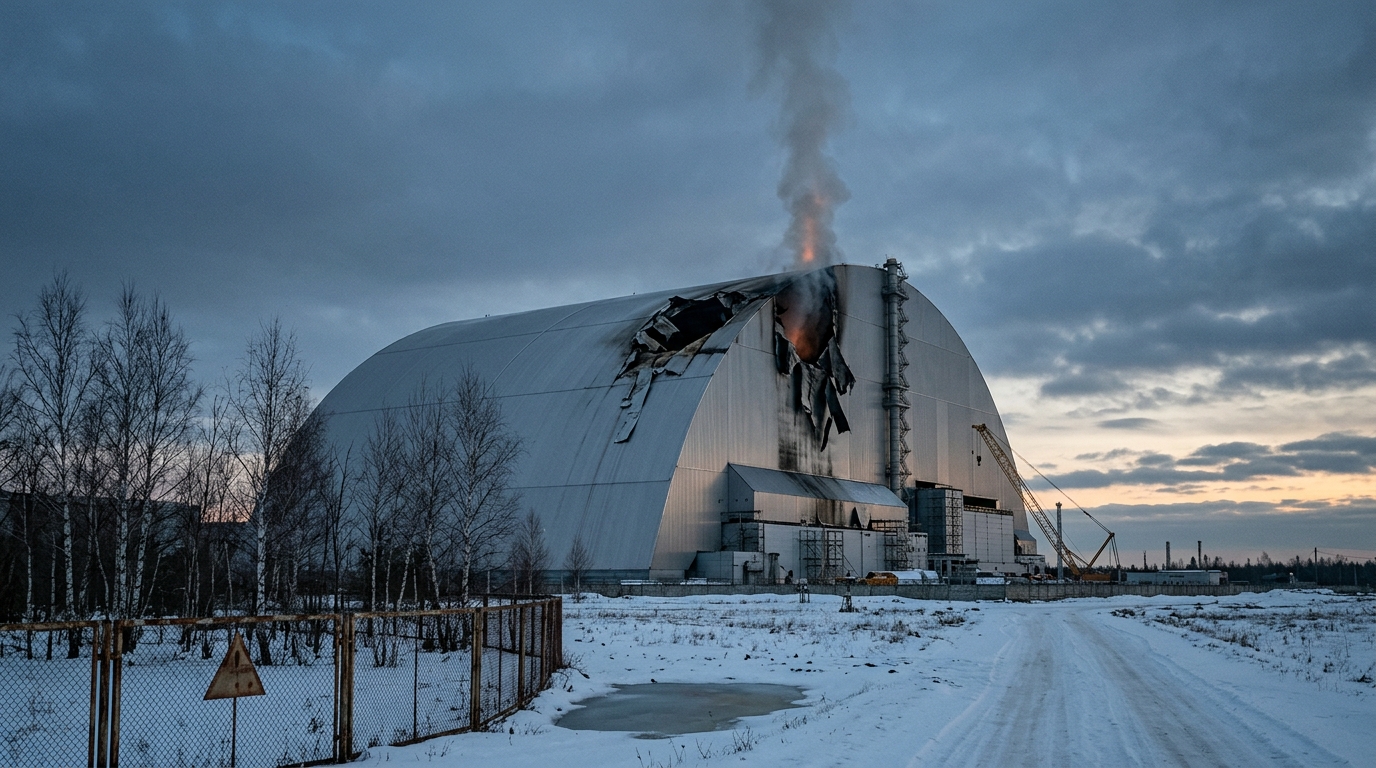
In the night from February 13 to 14, 2025, around 1:50 local time, the IAEA team on site at Chernobyl heard an explosion. A drone had struck the New Safe Confinement, this 36,000-ton arch intended to protect the damaged reactor for a century. The fire it sparked would smolder for three weeks.
- A drone pierced the New Safe Confinement at Chernobyl, triggering a fire that smoldered for three weeks between the two steel shells without any detectable rise in radioactivity
- The IAEA confirmed in December 2025 the loss of the arch’s main safety functions, including confinement, delaying the dismantling of the old sarcophagus
- Ukrainian and international funding is being unlocked for the repairs, notably entrusted to French companies Bouygues Travaux Publics and VINCI Construction Grands Projets, with an estimated timeframe of three to four years
- A 36,000-ton arch pierced by a mere drone
- Three weeks of silent burning between two steel shells
- A promised century of protection, a confinement function already lost
To be frank, I did not expect to write one day an article about a drone piercing a structure designed to withstand almost anything. And yet, that is precisely what happened at one of the most closely watched sites on the planet.
A 36,000-tonne arch pierced by a simple drone
To grasp the scale of the event, one must first understand what the New Safe Confinement really is. This metal structure measures 257 meters in width, 162 meters in length, and 109 meters in height. It weighs 36,000 tonnes.
Built between 2008 and 2017 with international financial and technical support, it was slid over the old sarcophagus in 2017. This first confinement, erected in haste after the 26 April 1986 accident, could no longer guarantee its resistance beyond about forty years. The arch was meant to take over for a full century, until 2117.
It is precisely this shell, designed to withstand the worst scenarios, that a drone managed to puncture. The Ukrainian Air Force indicated that Russia had launched that night 133 Shahed-type drones and decoy drones against Ukraine, of which 73 were shot down. The Kremlin, through Dmitri Peskov, denied any involvement, asserting that the Russian military does not target nuclear facilities.
The French Nuclear Safety and Radioprotection Authority confirmed that the impact caused a wall perforation, followed by a fire brought under control in the morning. Good news in passing: no rise in radioactivity was detected near the plant.
Three weeks of silent burning between two steel shells
The initial impact left a roughly fifteen-square-meter hole in the structure, accompanied by several hundred perforations in the external cladding. A figure that makes one’s head spin when you consider that every breach weakens the insulation and the seal of the whole assembly.
To extinguish the fire, responders had no choice but to make 330 additional openings in the outer shell. A logical decision at the time, but heavy with consequences: moisture could infiltrate freely, exposing the internal metallic supports to corrosion.
The fire actually settled between the two steel shells of the arch, in the insulation that separates them. It continued to smolder for three weeks, out of sight, destroying the hydro-insulation and damaging the membrane intended to ensure the structure’s watertightness.
Direct consequence of these damages: the dismantling of the old sarcophagus, already delayed by incomplete funding, the pandemic, and the Russo-Ukrainian conflict, remains suspended until the seal is restored. To make matters worse, a Russian strike in October 2025 on a nearby substation cut power to the entire confinement structure.
A century of protection promised, a confinement function already lost
In December 2025, the IAEA Director General Rafael Grossi delivered a blunt assessment: an inspection confirmed the loss of the arch’s main safety functions, including confinement. The supporting structure and monitoring systems remain intact, which limits, for the moment, the severity of the situation.
Sergiy Tarakanov, the plant’s director, told AFP that it will take another three to four years before the outer dome regains its primary safety functions. In other words, the arch designed to endure a century is undergoing its first major crisis barely eight years after it began operation.
In response to that, funding is beginning to flow. The Ukrainian government has allocated more than 1.6 billion hryvnias, about 31.4 million euros, for safety works on the new confinement. Donors to the Chernobyl International Cooperation Account, managed by the EBRD, approved engineering prep and procurement work, finally paving the way for real repairs.
The EBRD notes that the international community has already contributed about 2 billion euros to Chernobyl-related programs since 1995. To carry out the repairs, it has engaged two French companies, Bouygues Travaux Publics and VINCI Construction Grands Projets, tasked with assessing and remedying the damages.
This case illustrates a reality that goes far beyond Ukraine: even infrastructures designed to last a century remain vulnerable to armed conflict. The Chernobyl arch was meant to symbolize the end of a threat inherited from 1986. Today it reminds us that no protection is entirely immune to the geopolitical context in which it operates.
