
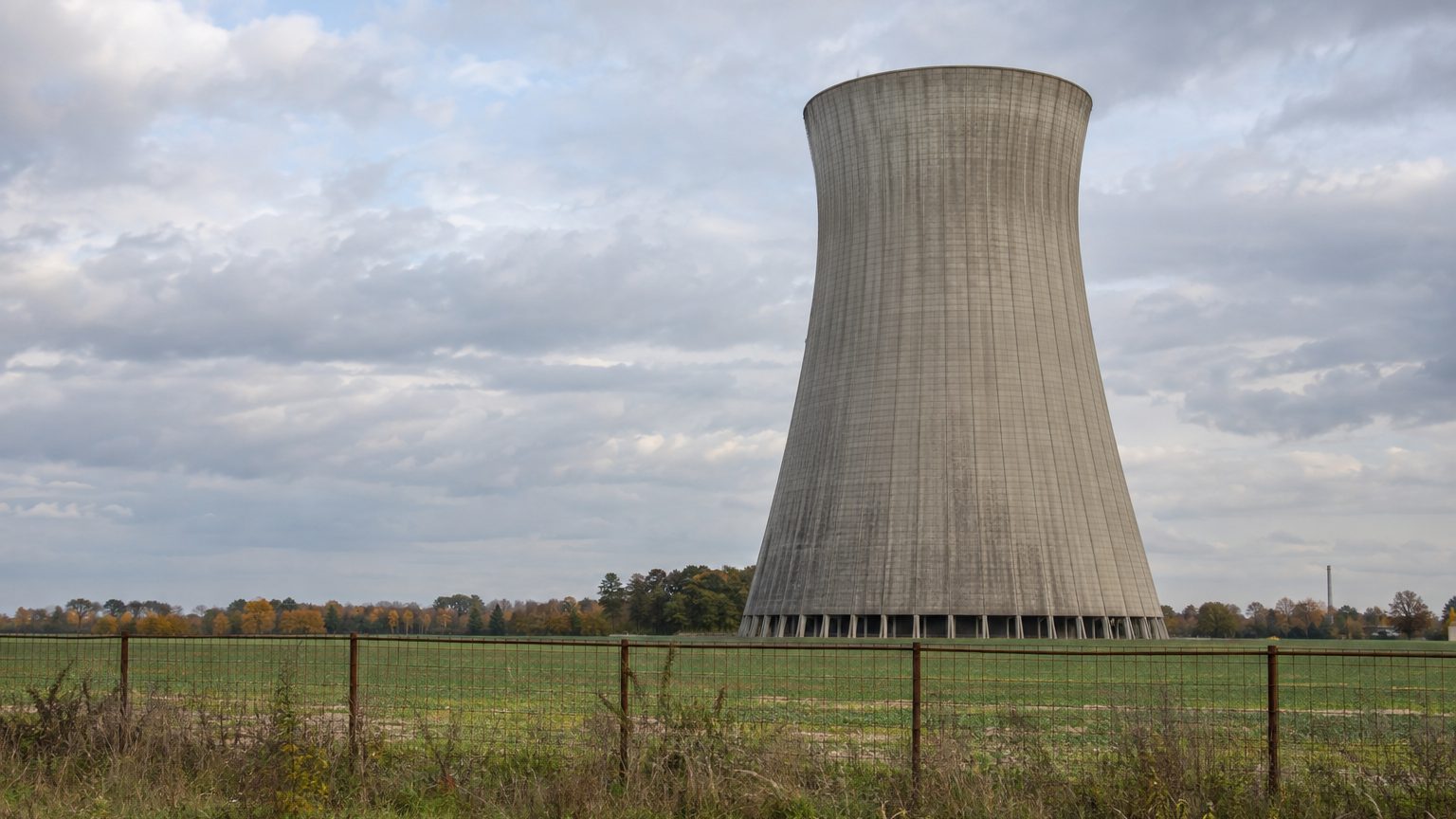
In Kalkar, North Rhine-Westphalia, just a few dozen kilometers from the Dutch border, a nuclear power plant was completed in 1985. Its reactor, the SNR-300 fast breeder, never received a single fuel assembly. Its cooling tower therefore never had a reactor running to be cooled.
The bill totaled about 7 billion marks, or 3.5 billion euros.
- The SNR-300 fast breeder never received fuel
- The project cost about €3.5 billion
- The site was bought for €2.5 million and turned into an amusement park
- The reactor was abandoned in 1991 for political and economic reasons
A fast breeder reactor born from the oil crisis
The project began in April 1973, amid the oil crisis, as Europe sought to reduce its energy dependence. The SNR-300 is a fast-neutron reactor cooled by sodium. It was designed to operate on plutonium and to breed more fissile material than it consumed, with a power output of 327 megawatts. Germany financed 68.5% of the operation, alongside Belgium, the Netherlands, and the United Kingdom.
France, however, had forged ahead. EDF and the CEA had launched Phénix as early as 1968, a prototype of 233 net megawatts located at Marcoule near Orange, which achieved criticality in December 1973. While Phénix was turning, Kalkar racked up delays, totaling more than seven years. The initial bill, estimated at 150–200 million dollars, ended up around 4 billion dollars.
Outside, opposition was rising. In September 1977, a massive demonstration prompted a large police operation, with the complete closure of highways in northern Germany and identity checks for around 150,000 people. The 1979 Three Mile Island accident increased pressure, without stopping the project.
Finished, filled with sodium, but never authorized
By mid-1985, construction was completed. But the winds had shifted in Düsseldorf: the state government, led by the SPD, began to question nuclear energy and blocked the final authorizations. Up to that point, 17 partial authorizations had been issued, each confirming the overall approval of the project. The final green light was still missing.
In April 1986, Chernobyl raised the opposition to another notch.
The site, however, was not idle. Sodium circulated already in the cooling loops and had to be kept hot by electrical resistors to prevent it from solidifying. Operating costs exceeded 5 million euros per month, and since 1989 the federal government, Siemens, and three electric utilities (RWE, PreussenElektra, and Bayernwerk) shared an interim bill of 105 million marks per year. With no reactor in service, the cooling tower never had any nuclear heat to dissipate.
The axe fell in March 1991. The Federal Minister of Research, Heinz Riesenhuber, announced the abandonment of the fast breeder after a meeting with Siemens and the electric utilities, and turnkey contracts with the supplier were terminated on 10 April. No accident occurred on site: it was a political decision, and the cost of continuing maintenance made it economically indefensible.
From the nuclear site to an amusement park
The Dutch investor Hennie van der Most bought the site for €2.5 million, an amount roughly 1,400 times smaller than the construction cost. According to one source, the transaction occurred in 1995. His profile was unconventional: the businessman had already invested in a fried chicken restaurant chain and in a golf course built on a former NATO camp.
The complex became Kernwasser Wunderland, literally the “Water Wonderland of Nuclear Power.” It includes a 400-bed hotel, rides, a freefall tower housed in the cooling tower, and an exterior wall converted into a climbing wall. Attendance is estimated at around 600,000 visitors per year, a figure that approaches Strasbourg and its nearby environs multiplied many times over.
For the park, it is 100% safe: the reactor never operated.
Numbers that leave you dizzy
The scale of the project deserves attention. The complex covers the equivalent of 80 football fields; it used enough concrete to build a highway between Amsterdam and Maastricht; and there are enough cables laid out to go twice around the Earth. With the same amount of money, one could have built 20,000 houses at €200,000 each, or roughly €4 billion.
Then there is the fuel. The fissile material planned for the SNR-300, enriched to about 35% plutonium, was kept under state supervision in Hanau. According to a 2011 article, it was to be reprocessed at La Hague in Normandy, to be transformed into MOX fuel and used in conventional power plants.
Sources: osti.gov | publikationen.bibliothek.kit.edu | enerzine.com
