
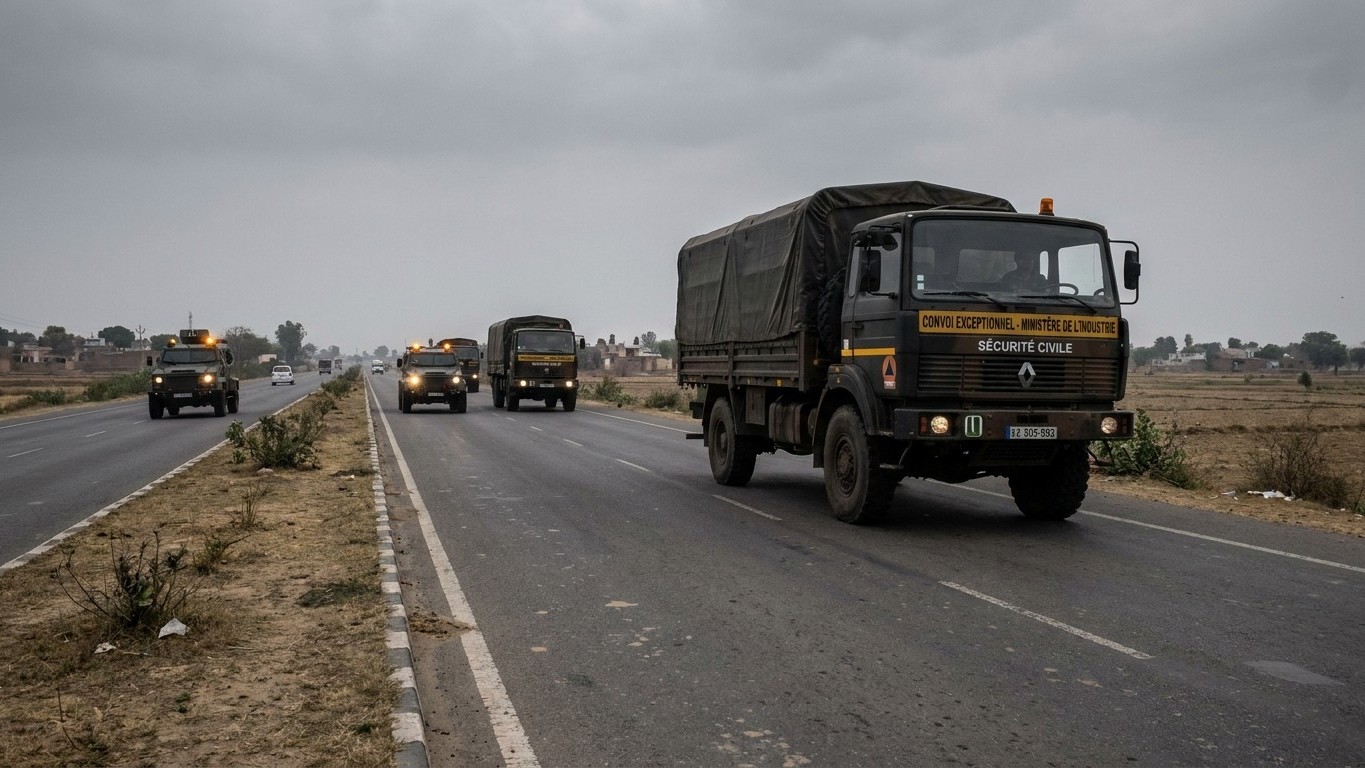
Twelve trucks, a police escort, ambulances and firefighters, and above all four decades of waiting: that is what it took to compel the 337 tonnes of toxic waste to leave the grounds of the former Union Carbide plant in Bhopal. Four decades after the Bhopal gas disaster, these wastes finally left the site on January 1, 2025 to join the Pithampur industrial zone, in Dhar district, transported in 12 containers over a 250-kilometre journey. A move that, on paper, might seem almost routine. But it required forty years, dozens of lawsuits, and an extraordinary human catastrophe for it to happen at last.
Key takeaways
- Forty years: the time it took before someone dared to touch these buried wastes
- A fortified convoy under police escort traversed 250 km, described as the most secure transport of industrial waste ever seen in India
- Hundreds of tonnes more still lie in 21 pits on the site, an underground time bomb
The judicial countdown that unlocked the situation
It was no accident that the operation began precisely at the start of January 2025. The High Court of Madhya Pradesh, on December 3, 2024, rebuked the authorities for failing to clean up the Bhopal site despite directives from the Supreme Court, and set a four-week deadline to evacuate the waste. An explicit judicial ultimatum, after years of administrative inertia. It wasn’t for lack of warnings: as early as March 2024, the department responsible for relief and rehabilitation had signed an agreement with the company managing industrial waste in Pithampur, and a contract dated October 7, 2024 set a timeframe of 185 to 377 days for the entire process, from incineration to final reporting.
The timeline actually extends even further back. On June 19, 2023, a supervisory committee met to discuss the elimination of the 337 tonnes of waste and urged the Environment Ministry to unlock the necessary funds. A substantial amount was indeed mobilized: the government allocated 126 crore rupees to accelerate the project. Despite this funding being available, the file remained stalled. Local demonstrations in Pithampur, an industrial hub near Indore, delayed progress, as local residents simply did not want to shoulder Bhopal’s problem.
A convoy under very high security to Pithampur
The relocation of these 337 tonnes was far from a routine operation. A dozen trucks began moving the waste, sealed in containers and under police escort, in a slow convoy to the disposal site roughly 225 kilometres away, in what the head of the relief department described as a fortified convoy with the highest security protocol ever observed for an industrial waste transport in the country. The scale of preparation is staggering: around a hundred people worked in crews of thirty minutes since the preceding Sunday to wrap and load the waste into the trucks.
The equipment itself was far from trivial. The containers used were watertight and fire-resistant, and their movement was monitored by GPS. Contrary to what one might imagine, the waste was not in liquid form: it was solid material, largely covered in sand and soil, with no plastic, packaged in large PVC bags and stored for decades in Bhopal without injuries or illnesses reported. A detail that, nevertheless, did not reassure everyone, far from it.
Incineration, between relief and fierce protests
Once arrived in Pithampur, the waste was to be destroyed by fire. The process involves burning the materials at temperatures between 900 and 1200 degrees Celsius, which breaks the substance down into its basic components—ash, combustion gases, and heat—and reduces the waste volume by 80 to 85 percent. On paper, the method is proven. The federal pollution control agency had even tested this process in 2015 with 10 tons of the same waste, concluding that the resulting emission levels were in line with national standards.
This official assurance did not convince the victims’ associations. Rashida Bee, president of a women’s victims of gas organization in Bhopal, pointed to a detail that could change everything: in the 2015 test burn, some 80,000 litres of diesel had been used, more than thirty times the amount used for hazardous waste of another origin between 2010 and 2012. Her blunt concern: burning such a large amount of diesel would not only cause severe pollution but would also mask, through simple dilution of emissions, the true presence of dioxins and furans. In Pithampur itself, anger spilled beyond the scientific debate: a group of protesters blocked a road near an industrial site before police restored traffic, while one man began a hunger strike against the project. Two protesters even went so far as to attempt self-immolation, according to local authorities.
A chapter closed, but not the whole file
The operation eventually stretched over several months. Of the 337 tonnes, 30 had been burned during three preliminary tests, and the remaining 307 tonnes were incinerated between May 5 and the night of June 29-30, 2025, marking the end of this particular phase of the case. Yet speaking of a “full cleanup” of the site would be misleading. A few days later, 19 more tonnes of soil contaminated by Union Carbide’s waste were incinerated in the same facility.
Perhaps the most troubling part lies elsewhere. A field activist, Rachna Dhingra, notes that hundreds of tonnes of waste remain buried in 21 pits scattered across the plant site, a situation she calls extremely dangerous. She also demands that Dow Chemical, which bought Union Carbide, bear the cost of the cleanup, but to date no concrete steps have been taken in that direction. These 337 tonnes evacuated represented only a visible fraction of a much larger problem, buried underground since the night of December 2-3, 1984, when a methyl isocyanate gas leak killed thousands and forever changed the name of this Indian city.
Sources: cnews.fr | laminute.info | university.open.ac.uk
