
A quick note before diving into this extraordinary story: no human has set foot on the Moon since the Apollo missions, and this tale does not concern a living journey to our natural satellite.
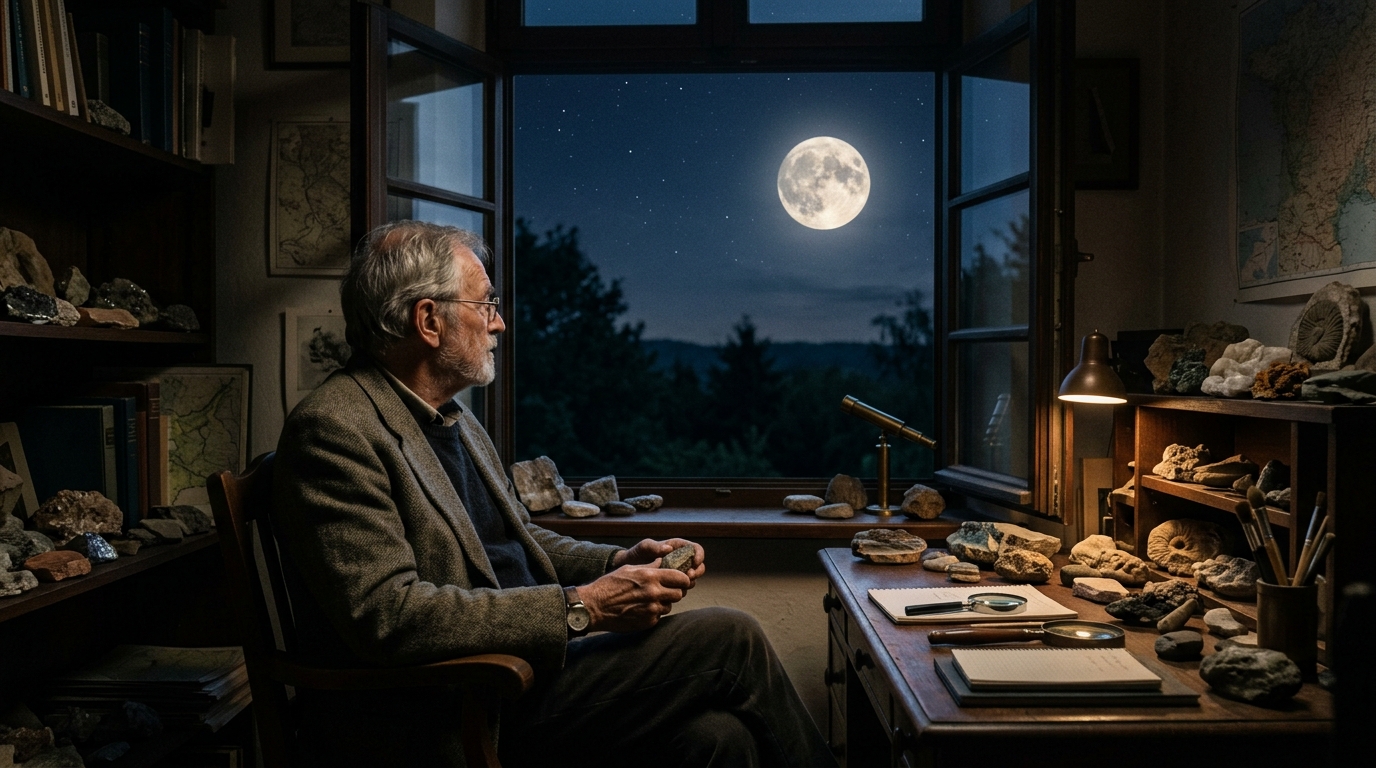
Yet Shoemaker’s story deserves attention, for it vividly illustrates how a passion can transcend the limits of the body. This American geologist, whose name is linked to the discovery of numerous impact craters around the world, devoted his life to studying the Moon without ever stepping foot on it himself. A heart condition prevented him from joining the astronaut corps, abruptly ending his most cherished dream. But the universe, at times, seems to savor irony: thirty-six years after that diagnosis ended his space career, a part of him ultimately touched the lunar surface, under circumstances as moving as they were unexpected.
The Broken Dream of a Pioneering Space Explorer
In the 1960s, as the United States and the Soviet Union raced toward space, Eugene Shoemaker stood out within the scientific community. A trained geologist, he understood early on that the Moon was not merely a conquest to be claimed but a vast open laboratory for deciphering the history of the solar system. His clear aim was to become the first scientist to walk on the Moon and to conduct geological analyses there himself.
That dream collapsed in 1963, when NASA doctors detected a cardiac malformation incompatible with the physical demands placed on astronauts. At that time, selection criteria were extremely strict, and even the smallest medical deviation could permanently disqualify a candidate, no matter how academically gifted. For Shoemaker, the news represented a devastating blow: after years of preparation, scientifically and physically, he suddenly found himself barred from realizing his deepest aspiration.
When Science Becomes the Only Way to Reach the Stars
Refusing to be defeated by this exclusion, Eugene Shoemaker chose to transform his frustration into a major scientific contribution. Rather than turning away from the Apollo program, he put his expertise at the service of the astronauts who would walk on the Moon in his stead. He actively contributed to the selection and geological training of the lunar crews, teaching them how to recognize the most interesting rock formations, how to collect meaningful samples, and how to interpret what they would observe on the ground.
This indirect involvement left a lasting imprint on lunar exploration, while Shoemaker himself remained Earthbound. He continued to be a central figure in planetary science, notably for his work on impact craters—the famous Barringer Crater in Arizona among his favorite study sites. His passion for impact events even led him, in July 1997, to Australia, where he visited a crater site when a car accident took his life. His wife Carolyn, injured in the same crash, survived.
Lunar Prospector, the Vessel that Granted a Final Wish
It was the day after Shoemaker’s death that a singular idea took root in the mind of Carolyn Porco, a former student of the geologist who had become a renowned scientist in her own right. Since her mentor had never been able to visit the Moon in life, why not offer him this journey posthumously? The notion, both bold and moving, quickly found a receptive response in Carolyn Shoemaker, who pursued the project with remarkable determination.
The opportunity arose with the launch of the Lunar Prospector, which lifted off from Cape Canaveral at the very start of 1998. On board rested a small polycarbonate capsule containing about 28 grams of the geologist’s ashes. The capsule was carefully wrapped in a brass ribbon bearing a photograph of Barringer Crater—the landmark in Shoemaker’s career—and a quotation from Romeo and Juliet by Shakespeare. A poetic tribute to a man whose life had been entirely oriented toward the stars.
A Unique Tribute That Redefined the Rules of Lunar Exploration
For roughly eighteen months, Lunar Prospector carried out its scientific mission with distinction, mapping the lunar surface and detecting precious hints of water ice at the Moon’s poles, a discovery that would fuel many future inquiries into the presence of water in space. Then, on July 31, 1999, ground teams made the decision to deliberately crash the craft near the Moon’s south pole, bringing that era of exploration to a symbolic close.
At that precise moment, Shoemaker’s ashes finally joined the Moon, sealing forever his fate with the celestial body he had studied so intensely without ever stepping foot on. To this day, he remains the only human whose ashes have been dispersed on the Moon—a unique status that left an indelible mark on the history of space exploration. The episode also sparked a new debate about whether space might one day serve as a memory site for scientists or other notable figures of space exploration.
Shoemaker’s story reminds us that grand space adventures are not solely about the physical feats of astronauts treading the soils of distant worlds. They also bear the imprint of those who, from the shadows, shaped these missions through knowledge and resolve. As plans to return to the Moon proliferate today, especially under the Artemis program, this tale resonates as a poignant reminder: sometimes reaching the stars does not require leaving Earth while alive, but rather leaving a legacy strong enough to invite the universe to honor you one day.
