
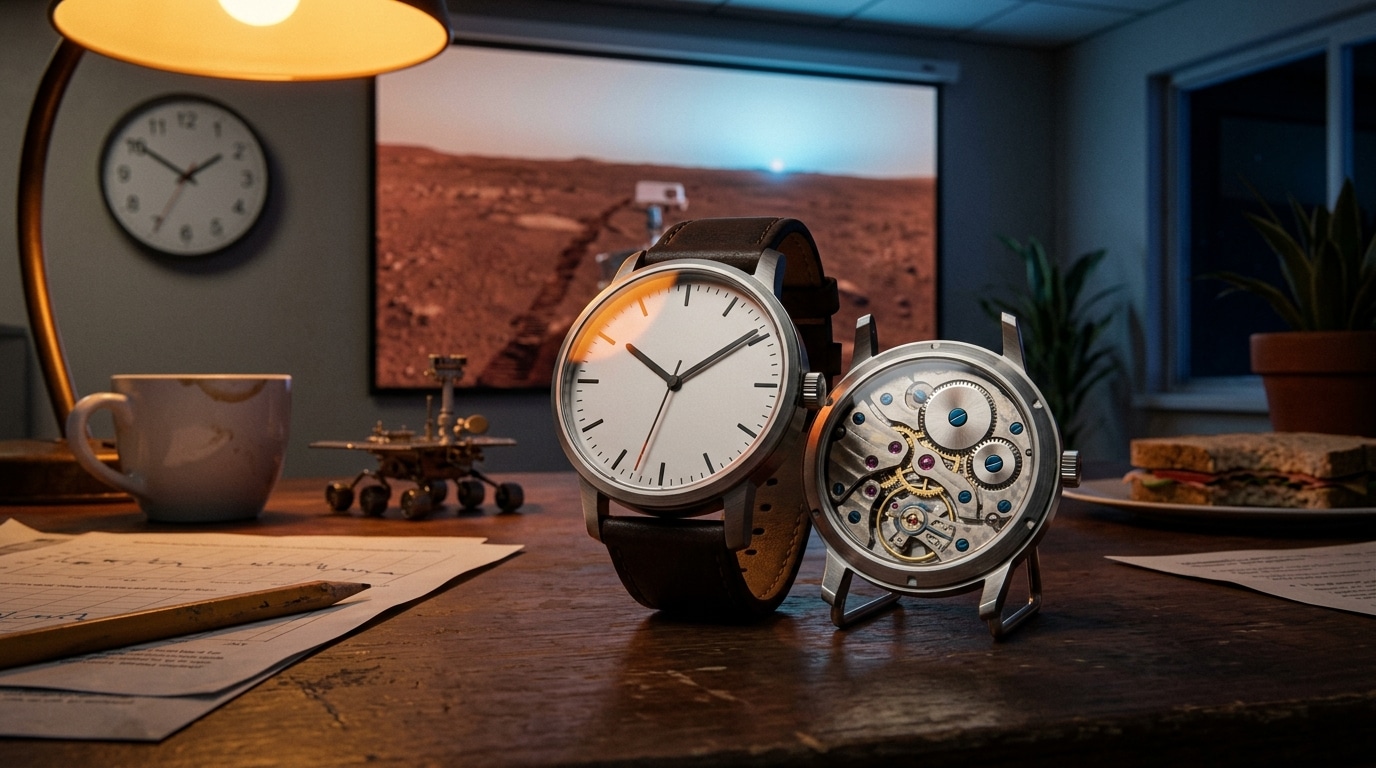
What if your alarm clock rang forty minutes later every morning, until your entire life slipped into a time zone that exists nowhere on Earth? That is precisely what the teams at JPL experienced in 2004. To operate the Spirit and Opportunity rovers on the Martian surface, engineers and scientists had to abandon Earth time and adopt the time of another planet.
- A Martian sol lasts 24 hours 39 minutes and 35.244 seconds, about 40 minutes longer than a terrestrial day.
- Watchmaker Garo Anserlian, after costly experiments, designed watches that add lead to the gears to reproduce this time lag.
- This desynchronization had measurable physiological effects, including an average sleep of 6.2 hours per sol during a Phoenix mission study.
- Living by a clock that does not exist on Earth
- 37 minutes that shift an entire life
- The watchmaker who reinvented time for NASA
Living by a clock that does not exist on Earth
Mars rotates a bit more slowly than Earth on its axis. Its sidereal rotation lasts 24 hours 37 minutes 22.66 seconds. But what matters to the ground teams is the solar day, the Martian solar day, which truly governs life on the ground, lasting 24 hours 39 minutes 35.244 seconds.
This detail became crucial in early January 2004, when Spirit landed in the Gusev Crater, followed three weeks later by Opportunity at another Martian site. Their initial mission was supposed to last only 90 sols, a short duration that pushed teams to squeeze every minute of available daylight.
Because the rovers run on solar power, their workdays had to align as closely as possible with the Martian day-night cycle. Thus, it was impossible to rely on Earth’s calendar: crews literally had to live to the rhythm of another planet, day after day, with no room for deviation.
37 minutes that shift an entire life
A sol lasts about 39 minutes and 35 seconds longer than a terrestrial day. It may seem negligible in isolation, but repeated across the 90 sols of the primary mission, this offset eventually reversed the teams’ daily rhythm. Their workday drifted back by roughly 40 minutes each day, to the point of crossing Earth’s night and day without distinction.
Even before landing, the science lead Steven Squyres anticipated the issue. Teams rented apartments with blackout blinds—essential for sleeping in full daylight when a nocturnal wake-up was required. Some team members even wore watches set to Martian time, lagging behind Earth time by 39 minutes and 35 seconds each day.
This desynchronization did not come without physiological consequences. A later study of the Phoenix ground crew, involving 19 people followed for 78 days, found a main sleep duration averaging only 6.2 hours per sol. Nearly 64% of participants reported increased fatigue, evidence that the human body struggles to adapt to an extraterrestrial time zone.
The watchmaker who reinvented time for NASA
To materialize Martian time, JPL engineers Julie Townsend and Scott Doudrick turned to a watchmaker based in Montrose, California: Garo Anserlian. Their brief, on paper, was simple but daunting to execute: craft watches that delay roughly 40 minutes each day compared to Earth time, to match the Martian sol exactly.
Anserlian himself has said he spent more than $1,000 on trials, damaging several watches before finding the right method. The solution came from adding lead masses to the gears, mechanically slowing the clock’s movement without relying on electronics.
The result exceeded technical expectations: the first watch delivered deviated by only a maximum of ten seconds per 24-hour Earth period, an impressive precision for a hand-modified mechanism. Anserlian noted that the request targeted a setting of 24 hours, 39 minutes and 25 seconds, while reminding that the mission itself did not depend on these watches: they served primarily as a human anchor in a completely offset daily life.
This anecdote, which might elicit a smile today, actually foreshadowed a broader issue. In 2024, the White House Office of Science and Technology Policy asked NASA to define, by the end of 2026, a standard called Coordinated Lunar Time. Intended initially for the Moon, this reference time is meant to extend to Mars and beyond, demonstrating that the question of extraterrestrial time is no longer a matter of one Californian clockmaker’s ingenuity, but a matter of space policy.
👉 A small gesture for Space Group? Follow us on Google, add us to your bookmarks, and find us on Google News so you won’t miss any discoveries.
