
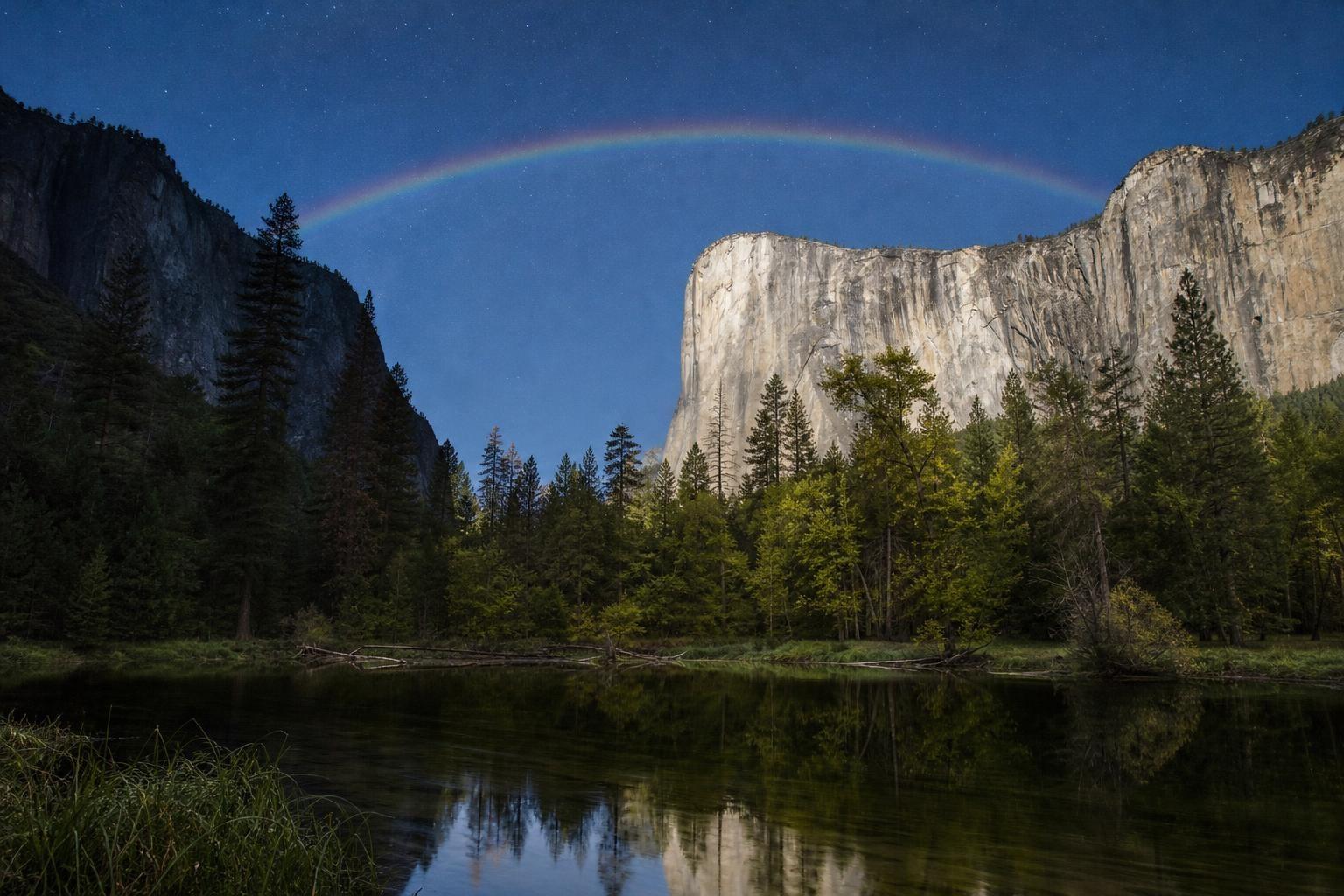
Night in Yosemite can feel electric, as if the granite walls are humming with secrets. Then the mist swirls, the moon climbs, and a pale arc kindles above a waterfall—an otherworldly bow that looks impossible yet absolutely real. People go quiet, cameras come out, and you can hear whispers: “Is that really there?” Yes. It’s a moonbow, and it’s one of the park’s most mesmerizing sights.
What exactly is a moonbow?
A moonbow is a rainbow made by moonlight, not the sun. The physics are the same—water droplets refract, reflect, and disperse light, splitting it into spectral color. Because the moon is far dimmer than the sun, our eyes perceive the bow as a soft, ghostly arc, often silvery or almost white. Long-exposure photos reveal the full spectrum, painting crimson through violet in quiet brushstrokes. “It looks like a secret rainbow the night forgot to hide,” one visitor murmured.
Why Yosemite is perfect for it
Yosemite’s towering falls throw off abundant spray, and the valley provides broad, dark vistas—ideal ingredients for nocturnal optics. In late spring through early summer, snowmelt turns waterfalls into theaters of mist. When a bright moon sits at the right angle—low in the sky, opposite the spray—the bow blooms like a whispered spell. You don’t need total darkness, but you do need clear skies and minimal competing light. The less haze and the more mist, the brighter the arc.
Best spots and timing in the valley
Seek viewpoints with strong spray and an open horizon, where the moon can sit low and brilliant. Lower Yosemite Fall is a classic, especially near the footbridge, where mist billows across the void. Cook’s Meadow can frame Upper Yosemite Fall with spacious sky, giving the bow room to breathe. On misty nights, Vernal Fall along the Mist Trail can surprise, though footing is slick and spray is intense. Ideal dates cluster around the full moon—typically two nights before to two nights after—and the best window often falls a couple hours after moonrise or before moonset when the geometry is just right. “Blink and the angle changes—you’re chasing time as much as light,” says a seasoned night hiker.
How to give yourself the best chance
- Check full-moon dates, monitor waterfall flow, and aim for clear forecasts. Arrive early to scout sightlines, watch the wind, and note where spray is drifting. Pack a small headlamp with a red mode, warm layers, and a microfiber cloth for lens mist. Keep a respectful distance from slick edges, stay on trails, and let your eyes adjust to the dark.
Seeing what your eyes can’t
Human vision at night prioritizes contrast over color, which is why a moonbow can seem pale or “colorless.” Your camera, though, stretches time. With a tripod and multi-second exposures, the colors surge into view. Try a wide aperture and moderate ISO; start around a handful of seconds and adjust until the bow feels alive. Use manual focus—magnify a bright star, a distant light, or the fall’s edge—then lock it in. Daylight white balance can keep hues honest, while a polarizer usually dims the already fragile light. Frame with silhouettes—pines, granite, a curve of river—to anchor the surreal arc in a real, textured place.
The dance of angle and spray
Geometry rules this show. The bow forms about 42 degrees from the antisolar—or, at night, anti-lunar—point. That’s why the moon’s height matters, and why a small shift can break or make the arc. Spray is equally crucial: too little and the bow fades; too much and wind shreds the pattern. On blustery nights the arc writhes like a living thing, pulsing, flickering, then brightening as the breeze settles. “It felt like the waterfall was breathing, exhaling the spectrum, inhaling the dark,” a photographer said afterward.
Etiquette in the dark
Night concentrates sound, light, and impact. Keep lamps low and pointed down. Avoid bright beams into the mist, which wash out the bow and other people’s exposures. Share space politely; the footbridge can get crowded. Pack out everything, step gently around fragile plants, and give wildlife wide berths. The rocks hold a glassy sheen after a day of spray; tread as if the floor were made of marble, not grit.
Chasing wonder without rushing it
The best encounters unfold at the pace of breath, not the tempo of a checklist or feed. Set your tripod, then step back and just look. Let your eyes tune to the dim, and you’ll start to sense color in the pale curve. You may feel the same hush that moves through the crowd, the kind that makes strangers whisper thank you to a cliff of stone and a sliver of moon. In a place shaped by ice, time, and falling water, this quiet ribbon of light is a reminder: even in darkness, the world knows how to shine, and we are lucky enough to watch.
