
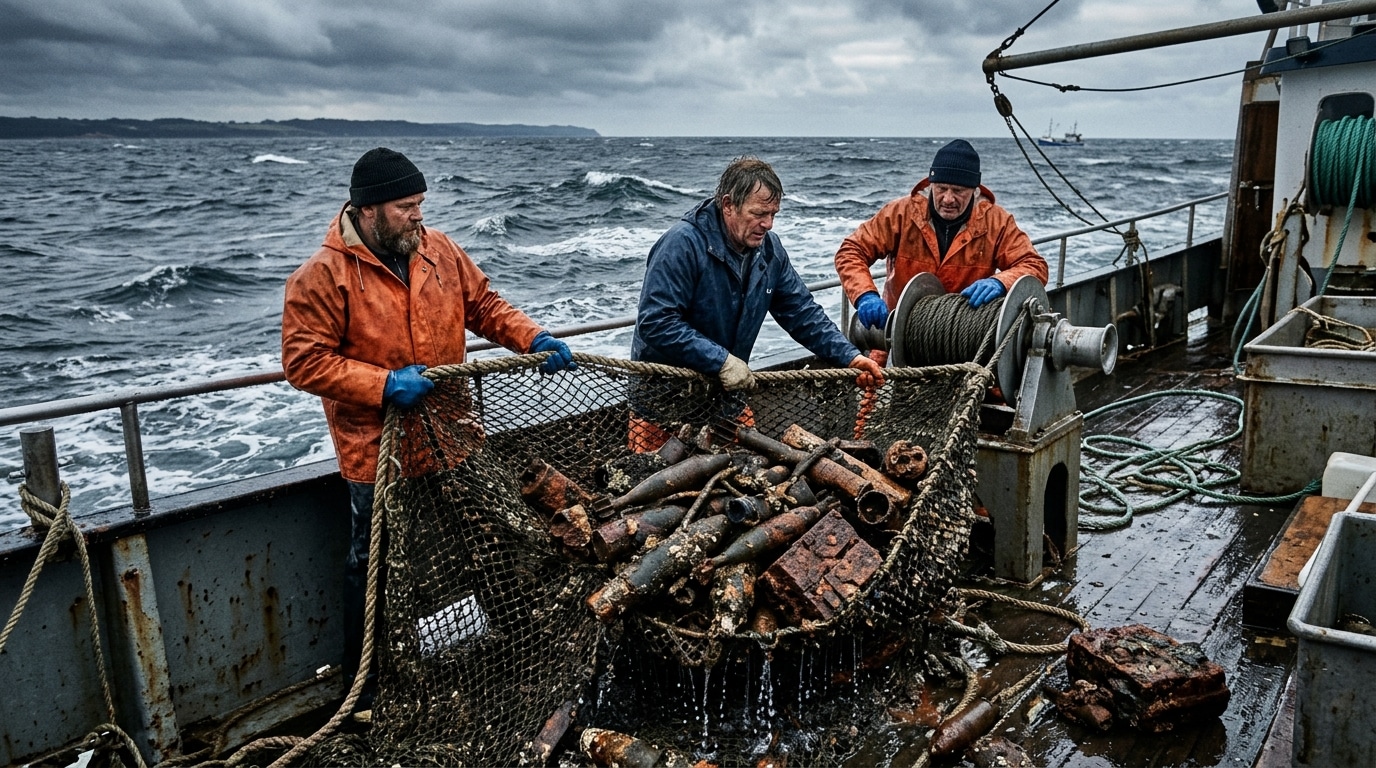
A trawler pulling up its nets off the coast of Bornholm can still haul up a greasy, skin-burning lump. This isn’t fiction: according to HELCOM, about 32,000 tons of chemical munitions lie beneath the Baltic Sea since the end of World War II, and Danish fishermen still pay the price.
- Approximately 32,000 tons of chemical munitions, including nearly 11,000 tons of agents such as mustard gas, were dumped by the Soviet Union into the Bornholm basin after 1945
- Under corrosion, mustard gas forms compact blocks that fishermen still regularly haul up from nets, sometimes mistaken for amber
- The contamination extends up to 250 meters around the munitions, and traces of chemical agents have been detected in sediments and local fish
- 32,000 tonnes of chemical weapons sunk by the Soviet Union
- Mustard gas that refuses to disappear: Danish nets trapped for 80 years
- Bornholm, a phantom zone: what HELCOM reveals about an ongoing danger
32,000 tonnes of chemical weapons sunk by the Soviet Union
Let’s trace the thread of history a bit farther. At the end of World War II, the Allies faced a cumbersome problem: enormous stocks of German chemical weapons to dispose of. Rather than destroying them properly, the Soviet military administration in Germany chose the simplest—and most long-term dangerous—solution: dump them at sea.
According to HELCOM’s reference report, the Baltic Marine Environment Protection Commission, roughly 32,000 tonnes of chemical munitions were submerged in the Bornholm basin. They would alone contain nearly 11,000 tonnes of chemical warfare agents, a cocktail that is dizzying: mustard gas, viscous mustard, Clark I, Clark II, Adamsite, and chloroacetophenone.
Other estimates point to even larger volumes. About 34,000 tonnes were dumped east of Bornholm and near Gotland in 1947 and 1948, for a total close to 12,000 tonnes of active agents. Some older studies propose ranges from 36,000 to over 50,000 tonnes. In short, no one today knows the exact figure.
This ambiguity is not trivial. It reflects the logistical chaos of the era: overloaded ships, crews eager to finish, and sometimes munitions dumped overboard long before reaching official immersion zones. As a result, the chemical agents do not rest solely at the bottom of a clearly defined trench, but would be dispersed over a much larger area along the shipping routes used at the time.
The mustard gas that refuses to disappear: Danish nets trapped for 80 years
Mustard gas, the infamous tear-producing gas of the 1914 trenches, has lost none of its danger after eighty years underwater. It is, in fact, the most abundant agent in the submerged stock near Bornholm. According to the work of Knobloch and colleagues published in 2013, an estimated 7,027 tonnes are present in the Bornholm Deep, versus 608 tonnes in the Gotland Deep.
Concretely, this mustard gas was not dumped loose. It was primarily sealed in 250-kilogram airplane bombs (KC 250) and in 105- or 150-millimeter artillery shells. These munitions lie today at depths of 80 to 100 meters, according to a Marine Environmental Research study that used caged mussels to gauge the surrounding contamination.
The problem is that the metal casings corrode over time. Mustard gas, which hardens upon contact with cold water, forms compact blocks that are occasionally mistaken for amber by passersby or accidentally hauled up in fishing nets. Between 2000 and 2005, up to 1,110 kilograms of chemical munitions per year are said to have been retrieved by fishermen east of Bornholm.
The previous record dates back to 1991: that year, 103 catches totaling 5,378 kilograms of munitions. Between 1994 and 2012, HELCOM recorded about 4 tonnes of mustard gas blocks pulled to the surface by fishing gear in the Bornholm area alone. A figure that underscores a problem far from resolved, even eight decades after the end of the conflict.
Bornholm, a phantom zone: what HELCOM reveals about an ongoing danger
Beyond incidental catches, the chemistry of the sea floor itself worries researchers. The study titled Exposure status of sea-dumped chemical warfare agents in the Baltic Sea shows that contamination does not stay confined to the munitions themselves. It would extend more than 250 meters around each chemical object, and it is precisely in the Bornholm Deep that sediment concentrations are the highest.
Scientists have also found traces of arsenical agents and degradation products of mustard gas directly in fish caught near three dumping sites. In other words, contamination is not locked under 80 meters of water: it slowly seeps into the marine food chain, even if measured concentrations remain highly localized.
The danger does not stop offshore. On February 18, 1992, a 250-kilogram bomb containing mustard gas was found directly on the Dueodde beach in Bornholm, a site popular with tourists. A stark reminder that these war relics do not always remain confined to the sea floor.
Nevertheless, keep in mind that figures vary widely depending on sources, whether 32,000, 34,000, 40,000, or more than 50,000 tonnes, as well as the exact immersion period, sometimes placed between 1947 and 1948, sometimes extended to 1965 according to some studies. This uncertainty mainly reflects that the Soviet archives from that era remain incomplete, and mapping this underwater cemetery precisely remains a genuine scientific challenge.
In response, Danish authorities and organizations like HELCOM continue to monitor the area, raise awareness among local fishermen of the risks, and document every discovery. One thing is certain: as long as these munitions lie on the bottom of the Baltic, the sea will occasionally yield its dangerous legacy.
👉 A small gesture for Space Group? Follow us on Google, add us to your favorites and find us on Google News so you don’t miss any discovery.
