
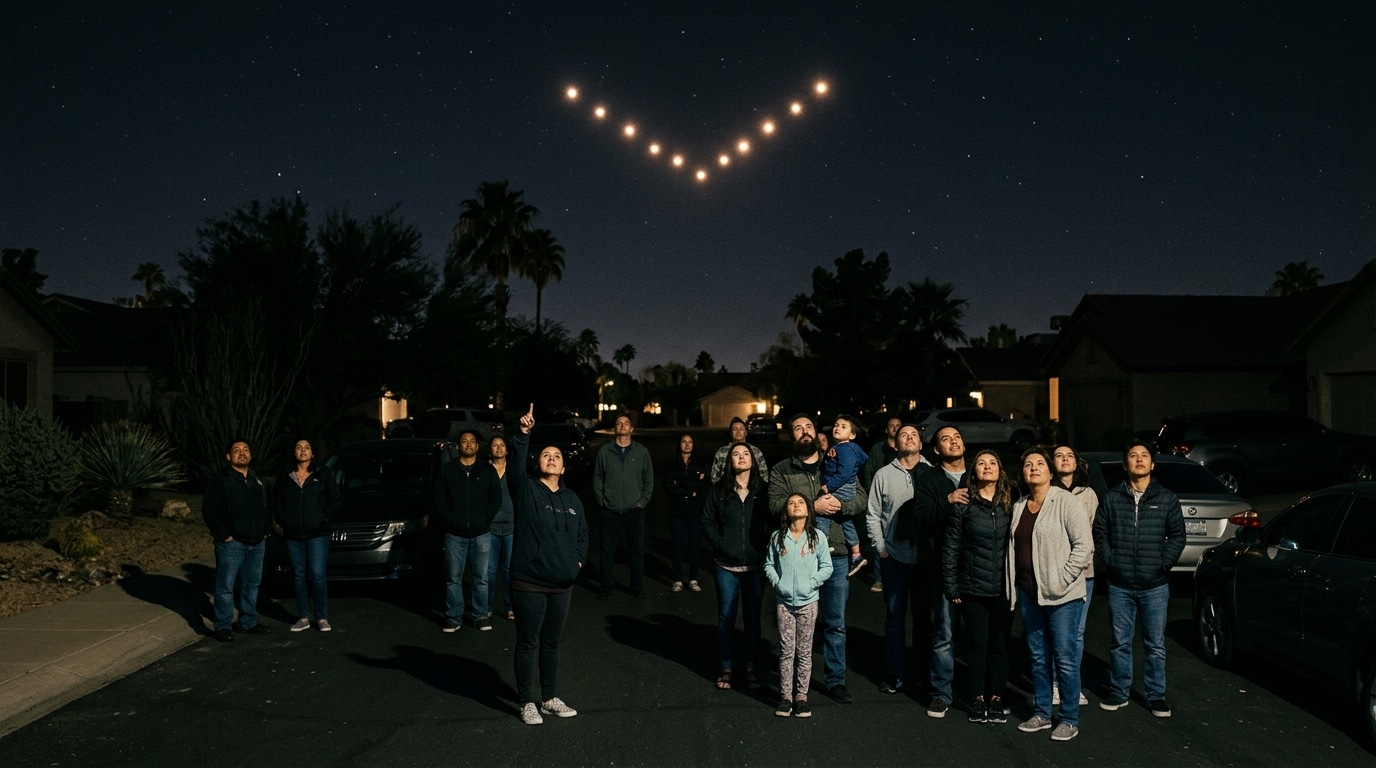
What would you do if, when you looked up at the sky on an ordinary evening, you witnessed a vast glowing structure gliding overhead, silent, immense, and seemingly impossible to fit into any familiar category? That is precisely what thousands of Arizona residents experienced on a March night in 1997. In a matter of hours, a quiet desert in the American Southwest transformed into one of the most famous stages in the history of unexplained aerial sightings. What is now known as the Phoenix Lights continues to fascinate precisely because no explanation has managed to close the case completely. Some view it as evidence of the passage of an extraordinary object, while others see a mere military misunderstanding. The truth, as so often, probably lies somewhere between the two.
A March Night When Arizona Lifted Its Eyes to the Sky
It all begins in the evening, with the desert sky perfectly clear. Between 7:55 p.m. and 8:40 p.m., the first wave of testimonies pours in. Residents report a gigantic formation of lights arranged in a V, moving slowly and with no sound. The phenomenon is not confined to a single area: it crosses nearly 300 miles, about 480 kilometers, from the Henderson area in Nevada to Tucson, at the southern edge of Arizona. As it passes, whole families step out into their yards, camera in hand, incredulous.
Then, later in the night, between 9:15 p.m. and 9:35 p.m., a second episode occurs. This time, a row of luminous orbs appears to hover motionless near the Sierra Estrella mountains, as though suspended in midair. A survey conducted that year suggested that up to 10 percent of Arizona residents had seen something that evening. It is difficult, under these circumstances, to dismiss the affair with a wave of the hand.
Lights That Defy All Aeronautical Logic
What makes this event so troubling is the conjunction of several characteristics rarely seen together. First, the total silence reported by witnesses. An airborne object of that apparent size would have produced a deafening roar, yet many describe a silent glide, almost unreal. Next, the colossal size of the formation, which some compare to several football fields laid end to end. Finally, the geometric regularity of the famous V, which gave the impression of a single aircraft rather than a cluster of separate elements.
It is precisely this impression of a single block that fueled the boldest hypotheses. Because our brains, faced with aligned distant lights, tend to fill in the gaps and connect what we see into a coherent shape. A bit like spotting a face in the clouds. This perceptual bias, very real, is not enough by itself to silence all doubts.
The Official Version That Didn’t Convince Anyone
In the face of the phenomenon’s scale, one explanation eventually gained traction among skeptics: military activity. The initial sighting, the large V, would have corresponded to a group of A-10 Thunderbolt fighter jets flying in tight formation. Seen from afar, their formation lights would have created the illusion of a single continuous structure. As for the motionless orbs in the later part of the night, they would have been slow-burning identification flares dropped during a training exercise over a large military firing range.
A pilot later acknowledged, a decade afterward, that he had participated in dropping these flares. A young amateur astronomer, equipped with a telescope, had claimed to clearly spot aircraft in the sky that evening. This version holds up on many points. But it leaves a sense of incompleteness: it explains part of what happened without answering all questions, particularly regarding the timing and trajectory of the first formation.
Why the Phoenix Mystery Still Endures
If this case continues to fascinate, it is also because of its human and political dimension. The then-governor of Arizona initially dismissed the event at a famous press conference, before later admitting that he himself had observed the V-shaped formation from above. A rather perplexing reversal. Local authorities had called for an official investigation, but the Air Force replied that it was no longer authorized to investigate this kind of phenomenon since the closure, at the end of the 1960s, of its renowned program dedicated to unidentified objects.
The result: the dossier remains in a gray area. Official explanations probably cover part of what happened, but they leave enough room for doubt to sustain the legend. It is this fragile balance between the rational and the unexplained that makes the Phoenix Lights a case study, regularly cited whenever the great mysteries of the sky are discussed.
Ultimately, this story reminds us of one essential truth: our need to understand is as powerful as our capacity to be astonished. Whether the answer is purely military or whether a trace of shadow remains, the essence may lie in the question itself. And you, if a vast triangle of lights glided silently across your sky on a summer evening, would you first seek a reassuring explanation, or would you prefer to savor the thrill of the unknown?
