
There are human works so imposing that we almost forget the price paid to bring them into existence. The Suez Canal, this 160-kilometer waterway linking the Mediterranean to the Red Sea, ranks among those spectacular achievements that redrew the map of global trade. Yet behind the feat of engineering and the giant ships that still traverse it today lies a less shining story. A chronicle of bare arms, scorching sand, and anonymous deaths. For hundreds of thousands of Egyptians dug this passage with their hands, before their country lost, a few years after the opening, control of its own project. How did such a reversal come about? A dive into one of the most striking paradoxes in industrial history.
The State Corvée That Turned the Desert into a Maritime Highway
It all began in 1859 when the Frenchman Ferdinand de Lesseps set the first pick into the ground at the site of what would become Port Said, with the blessing of Egypt’s viceroy. The ambition was colossal: to slice through the isthmus of Suez to connect two seas that had been separated for all of history. The project would run for ten years, from 1859 to 1869. Yet, in a desert where there was no local workforce available, the solution crafted by the Egyptian authorities proved to be perilous.
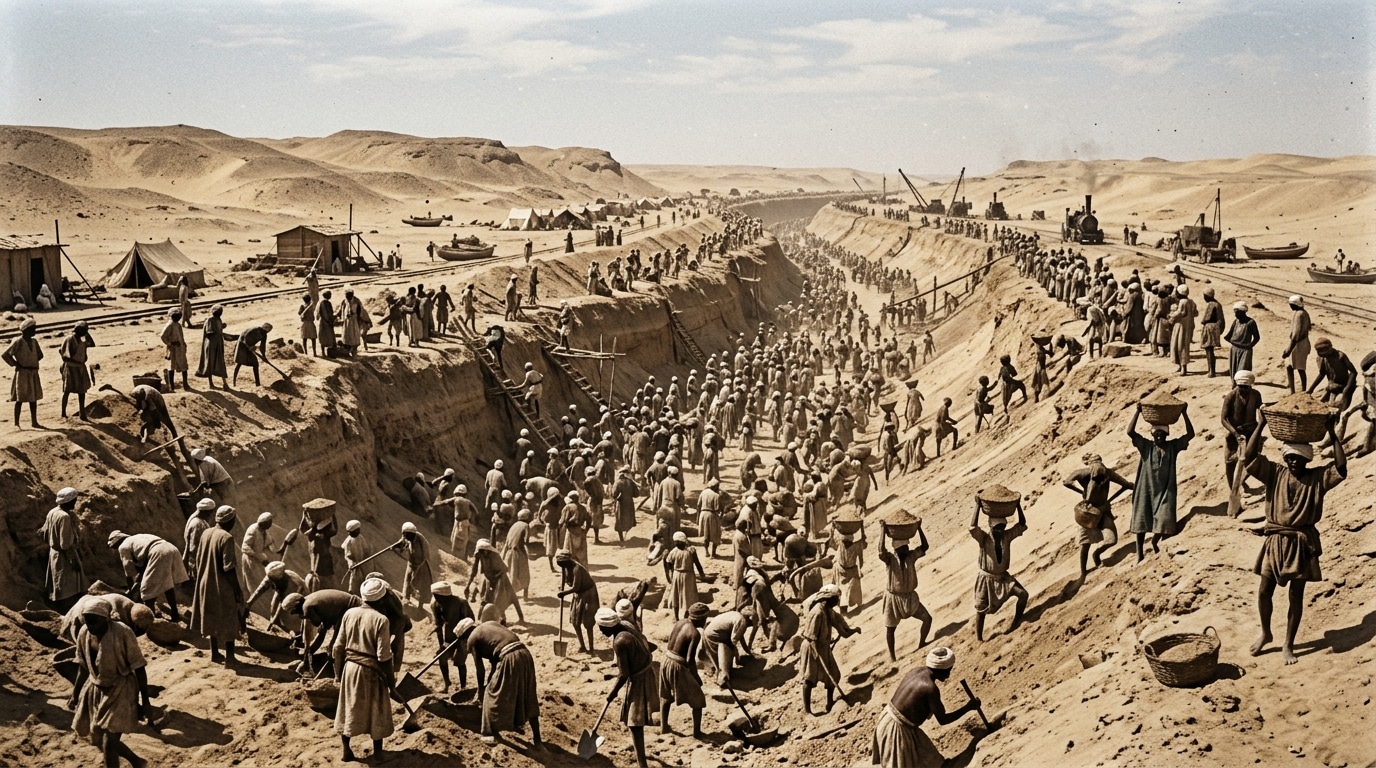
The viceroy proposed using the corvée, a traditional system that had until then mobilized peasants, the fellahs, for a month of maintenance along the Nile’s watercourses. Recast from its function, this practice became the instrument of a colossal undertaking. Tens of thousands of men were transported, by decree and at no cost to themselves, to dig the sand by hand under a blazing sun. Picture an endless human chain, bent over rudimentary shovels, gradually transforming a barren stretch into a navigable route capable of welcoming the world’s largest ships. The contrast between the project’s modernity and the archaic methods employed was striking.
Cholera, Thirst, and Accidents: The Real Human Toll That No One Can Quantify
Working conditions were extraordinarily brutal. Between 1859 and 1862, an estimated 400,000 fellahs were mobilized, and tens of thousands of them died. The causes of these deaths? Thirst in a desert without a reliable water source, cholera outbreaks that swept through the camps, and the accidents inherent to grueling manual labor. Soon, these conditions were condemned as bordering on slavery.
It is worth exercising caution about the numbers. The figure of 120,000 dead, long cited, was produced later by President Nasser, though precise archival records do not allow it to be confirmed. What is certain is that the toll was heavy. Paradoxically, the critique of the corvée did not come from Egyptian society itself. It was Great Britain that denounced the use of this forced labor, while the Ottoman Empire pressed Lesseps to halt the project. Under pressure, the fellahs were progressively replaced by foreign workers—Greeks, Italians, and Dalmatian laborers. A vast mechanization effort was launched, with steam dredges capable of digging much faster than any army of men.
The Financial Trap That Handed the Canal to London
Inaugurated in 1869, the canal quickly became a brilliant symbol of European imperialism. But Egypt emerged from the venture emptied of resources. The country had taken on massive debts to finance its share of the project, and the state’s coffers drained as interest mounted. What should have been a source of prosperity turned into a financial sinkhole.
Cornered, Egypt was forced to cede its shares in the canal to the British in 1875 to repay its crushing debt. In a matter of years, the nation that had supplied the labor and the blood to carve this major commercial artery lost control to a foreign power. The reversal was brutal, almost cruel: those who had dug it would never reap its benefits.
From Bankruptcy to Nationalization: What Suez Cost Egypt
The idea of linking the Red Sea to the Mediterranean was by no means novel. It traced back to ancient Egypt: as early as the reign of Sesostris III, around 2,000 years before our era, a canal system already connected the Red Sea to the Nile delta. Lesseps’ project thus belonged to a long historical arc, but with one crucial difference: this time control escaped the Egyptians.
For more than a century, the canal was a hotbed of constant tensions. It was only in 1956, with Nasser’s nationalization, that Egypt finally regained possession of this strategic corridor. Today, the enterprise continues to live on: it was even widened in 2015 to accommodate ships that are ever larger, a testament to its enduring importance in global commerce.
The Suez Canal remains a remarkable witness to the ambiguities of progress: an engineering marvel built on immense human sacrifice, then seized from those who made it possible. Watching the giant freighters glide across these tranquil waters today, one cannot help but wonder how many other great works in history carry beneath their gleaming surfaces a memory as silent as it is painful.
