
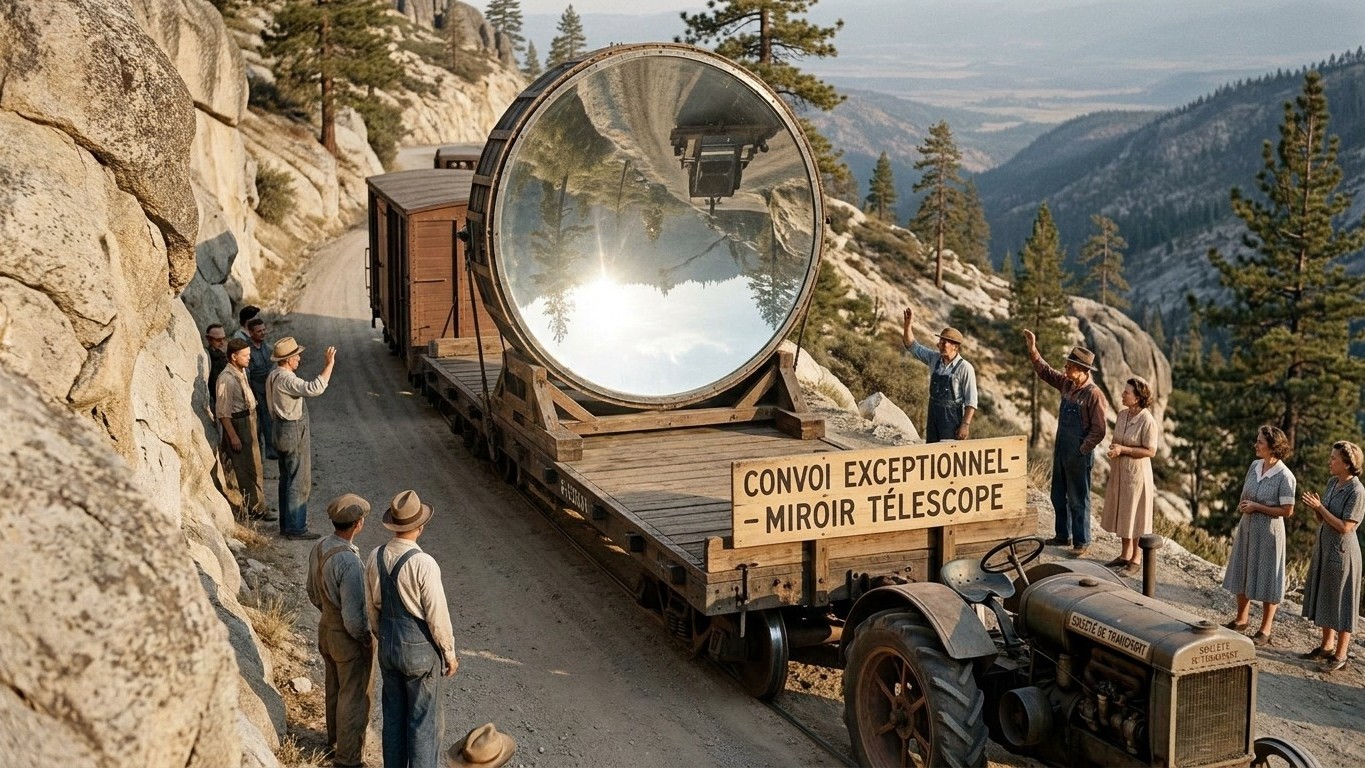
Fourteen thousand five hundred kilograms of optical glass, hoisted at the walking pace of a man, along a mountain-cut road built for this single load. In November 1947, this extraordinary convoy finally delivered to Palomar Mountain the disc that would render the Hale telescope the largest astronomical instrument in the world, thirteen years after it was cast in a workshop in New York State. Between the melting of the glass and its final installation, more than a decade of polishing, a world war, and two days of road travel under the gaze of a crowd that came to watch what looked like a traveling monument.
To Remember
- Why did it take thirteen years between the glass being poured and its installation?
- How to transform 20 tons of raw glass into an atomically precise mirror?
- What made this road transport more perilous than the years of polishing?
A glass that refuses to be born on the first try
The tale begins on a rough note. In March 1934, at the Corning Glass Works shops, a portion of the mold detached during the casting of the 200-inch disk, ruining the blank destined to become the future mirror. Instead of discarding it, engineer George McCauley chose to continue cooling this failed piece as an experiment, a decision that would give birth to an object now exhibited at the Corning Glass Museum. The second attempt, however, succeeded: on December 2, 1934, Corning Glass Works successfully cast the 200-inch disk that would become the Hale telescope’s mirror.
The glass chosen was no accident. It was Pyrex, a borosilicate designed to withstand thermal fluctuations, an absolute necessity for a mirror of this size that would spend its nights outdoors. Once cast, the disk must cool with extraordinary slowness: the second casting proved successful, and after a year of annealing the disk was finished and hauled by train to California. Twelve months to let the glass stabilize without cracking under its own internal stresses, an operation invisible but as risky as the road transport that would follow thirteen years later.
Thirteen years to polish a seventeen-foot disk
Arriving in California, the glass block began the longest phase of its life. In 1936, a train carried the specialized mirror to Caltech in Pasadena, where optical workshops undertook precision work that was almost unimaginable at the time. A special apparatus would spend eleven years shaping its surface into a convex parabolic form, with a tolerance of two millionths of an inch. Put plainly, that means carving a giant curve with a tolerance finer than the thickness of a bacterium.
The project did not progress smoothly. The pace slowed when the country entered World War II, optical workshops being requisitioned for military needs more urgent than a civil telescope. Work had to resume after the conflict to complete the polishing. In total, more than thirteen years of grinding and polishing would remove almost ten thousand pounds of glass, roughly four and a half tons hand-machined from a disk that weighed twenty tons when it left the mold. The final result: a fourteen-ton disk once the excess glass was removed, before applying a thin aluminum coating that made it a true mirror.
Two days of road travel at a tractor’s pace
Then came the most spectacular phase: moving this unique piece along 160 miles of country roads, without fracturing it. In November 1947, the Hale telescope’s mirror was hauled to its final destination atop Palomar Mountain, following a meandering route of 258 kilometers at an average speed of 15 kilometers per hour. The convoy did not merely use existing roads: bridges were reinforced, special routes were built and others repaired to ensure a journey without a single jolt for what was deemed the most valuable load ever transported. The trailer carrying the load weighed a total of sixty tons once the mirror was secured.
The convoy left Pasadena on a Sunday and took several days to reach the mountain. It departed on Sunday, November 16, 1947, and arrived at Palomar on Wednesday, November 19, after a grueling three days. Spectators lined the route. In Valley Center, a mandatory stop on the road to the mountain, residents braved the cold and the rain to watch, astonished, a forty-ton tractor slowly traverse the streets while pulling the two-hundred-inch mirror toward the new observatory. The town’s main street was renamed for the occasion, a tribute that remained for more than a decade before the signs disappeared, stolen one by one by improvised collectors.
It wasn’t the first time the region had seen an oversized convoy for this telescope. As early as 1938, massive pieces like the yoke bearing the instrument’s weight had already crossed the same town on a sixteen-wheeled semi-trailer, before World War II halted the project’s progress. The glass mirror, for its part, would take nearly twenty years to travel from the project’s announcement to its final arrival on the mountain, a pace that now seems almost serene compared with the bustle that accompanied each phase of its transport.
The Hale telescope went into service the following year and would remain the largest operational telescope in the world until 1993, contributing to the discovery of quasars and the first known brown dwarf. A lesser-known detail of this adventure: the 1947 convoy traveled under tight security, because threats had targeted the project; some religious groups viewed this skyward science as an affront to God. A century later, the Corning disk still sits on its mount at Palomar, the centerpiece of an instrument that astronomers still use today to study the Californian sky.
Sources : whatson.cmog.org | nyheritage.org
