
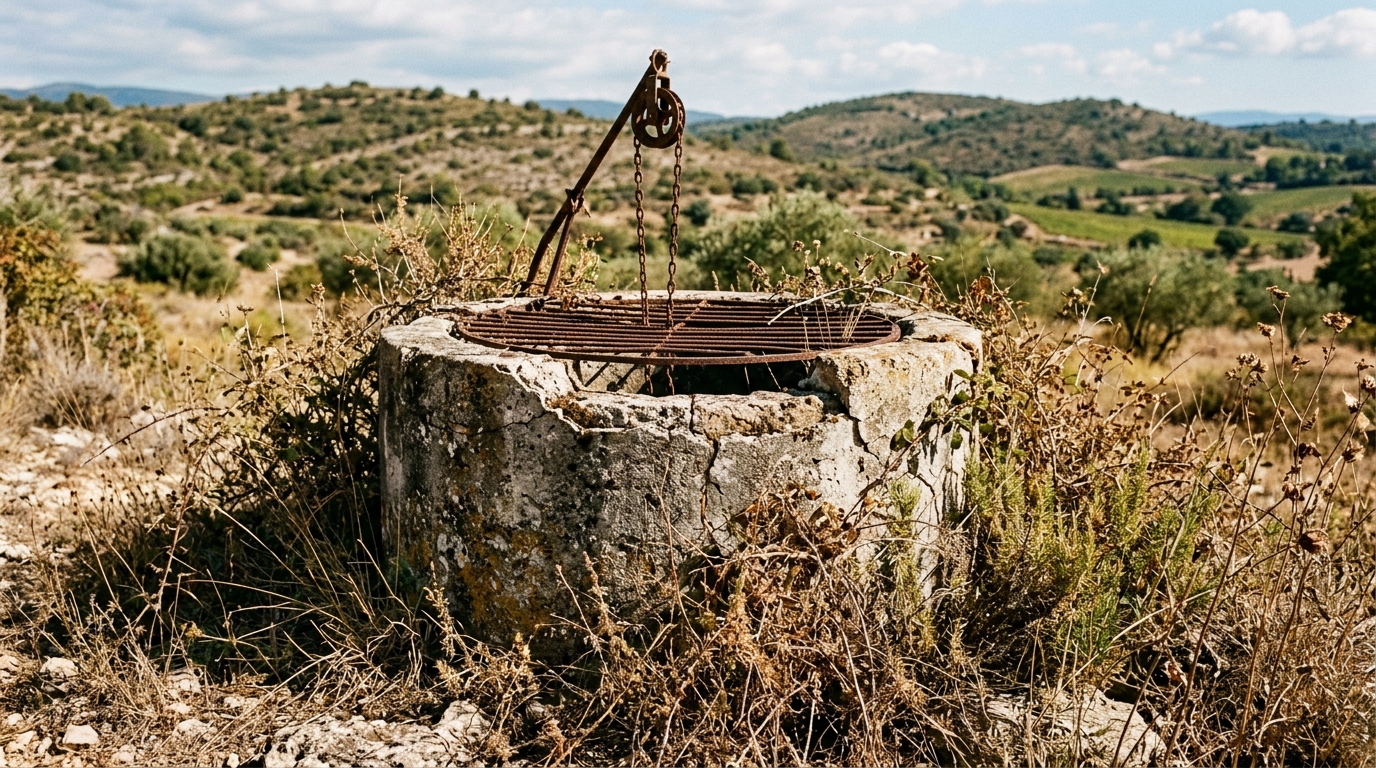
In Vaucluse, in the hills that overlook the Rhône Valley, eighteen wells twenty meters deep have slept for more than half a century without ever having been used to irrigate a single field. Drilled in 1971 with public funding, these structures were meant to transform local agriculture by bringing the water needed for crops. Yet, no farmer ever used them. This story, little known to the general public, perfectly illustrates these grand territorial development projects which, in the absence of foresight or dialogue with the field, end up forgotten, leaving behind concrete remnants and public funds spent.
- Eighteen wells, each twenty meters deep, were dug in 1971 with public funds to irrigate the crops of the Vaucluse.
- These wells were never connected to an irrigation network, lacking canals and pumps linked to the agricultural plots.
- The lack of coordination among the stakeholders and the existence of other water sources led farmers to abandon this system, still abandoned today.
- A mystery buried for more than 50 years in the Vaucluse hills
- Public funds spent without ever irrigating a single plot
- Why farmers shunned this ghost network
- What remains today of these 18 abandoned wells
A mystery buried for more than 50 years in the Vaucluse hills
In the early 1970s, France massively pursued the modernization of its agriculture. The Vaucluse, a land of vineyards, fruits and market gardening, did not escape this dynamic. It is within this context that a broad drilling program was launched in the department’s hills. The stated objective was clear: to secure the water supply for agricultural operations, which were especially dependent on the whims of the Mediterranean climate. Eighteen wells were then drilled, each reaching a depth of twenty meters, a major undertaking for the era, carried out with the technical means available at the time.
But right after the works ended, something began to stall. The wells, once completed, remained isolated in the landscape, as if suspended between two worlds: that of the ambitious project and that of the field’s reality. Even today, one can glimpse their discreet margins along a path, often overgrown by vegetation, quiet witnesses to a promise that was never fulfilled.
Public funds spent without ever irrigating a single plot
What makes this story particularly striking is the gulf between the investment made and the result obtained. Drilling eighteen wells, each twenty meters deep, represented a heavy project, mobilizing teams, specialized equipment, and substantial public funding for the era. Yet the revelation at the heart of this affair is simple: these wells were never connected to an irrigation network. In other words, the water they were meant to capture could never reach the fields it was supposed to water.
Without pipelines, without pumps connected to the agricultural plots, without additional infrastructure, these wells ended up as nothing more than deep, costly holes in the ground, completely useless for the intended use. It is a bit like building a railway station without ever laying the tracks that would lead trains to it: the structure exists, but it serves no purpose while the essential connection is missing.
Why farmers shunned this ghost network
Faced with such waste, the natural question is why. How could a project so ambitious end up in such a failure, with no operator taking advantage of it? Several explanations, often complementary, help to understand this disengagement. First, the lack of coordination among the different stakeholders in the project seems to have played a decisive role. Drilling wells is one thing, but building the entire network to transport the water to the farms is another, requiring additional financing and permissions that, it seems, never followed.
Next, one must also consider the local agricultural context. Some Vaucluse farmers already had other water sources, whether private boreholes, existing canals, or older irrigation systems. Faced with a public setup deemed unreliable, or whose practical utility had never been clearly demonstrated on the ground, many growers preferred to continue with their usual solutions rather than commit to an incomplete system. This gap between political intentions and the real needs of farmers ultimately doomed the project before it could prove its relevance.
What remains today of these 18 abandoned wells
More than fifty years after their construction, these eighteen wells continue to exist, scattered across the Vaucluse landscape, often unknown even to nearby residents. Some are now covered by vegetation, others remain visible but closed off by safety devices, reminding of the danger posed by a deep, unused well. They form something of an open-air museum of rural development, a silent testament to large public projects that did not always find their audience.
This ghost network has, to date, never been reactivated or truly repurposed. It persists as a local curiosity, sometimes mentioned by village elders, sometimes completely ignored by younger generations. In a context where water is becoming an increasingly central issue for agriculture, especially in the face of drought periods regularly affecting the Mediterranean region, these abandoned wells take on a particular resonance. They remind us that the mere existence of a resource is not enough: there must also be the infrastructure, coordination, and ground-level buy-in for a project to bear real fruit.
This Vaucluse tale, as discreet as it is instructive, invites us to rethink how large agricultural development projects are conceived. It raises especially a question that remains timely, as the stakes surrounding water and irrigation have never been more pressing: how many other works, funded with public money, sleep thus in oblivion, for lack of being thought through to the end?
