
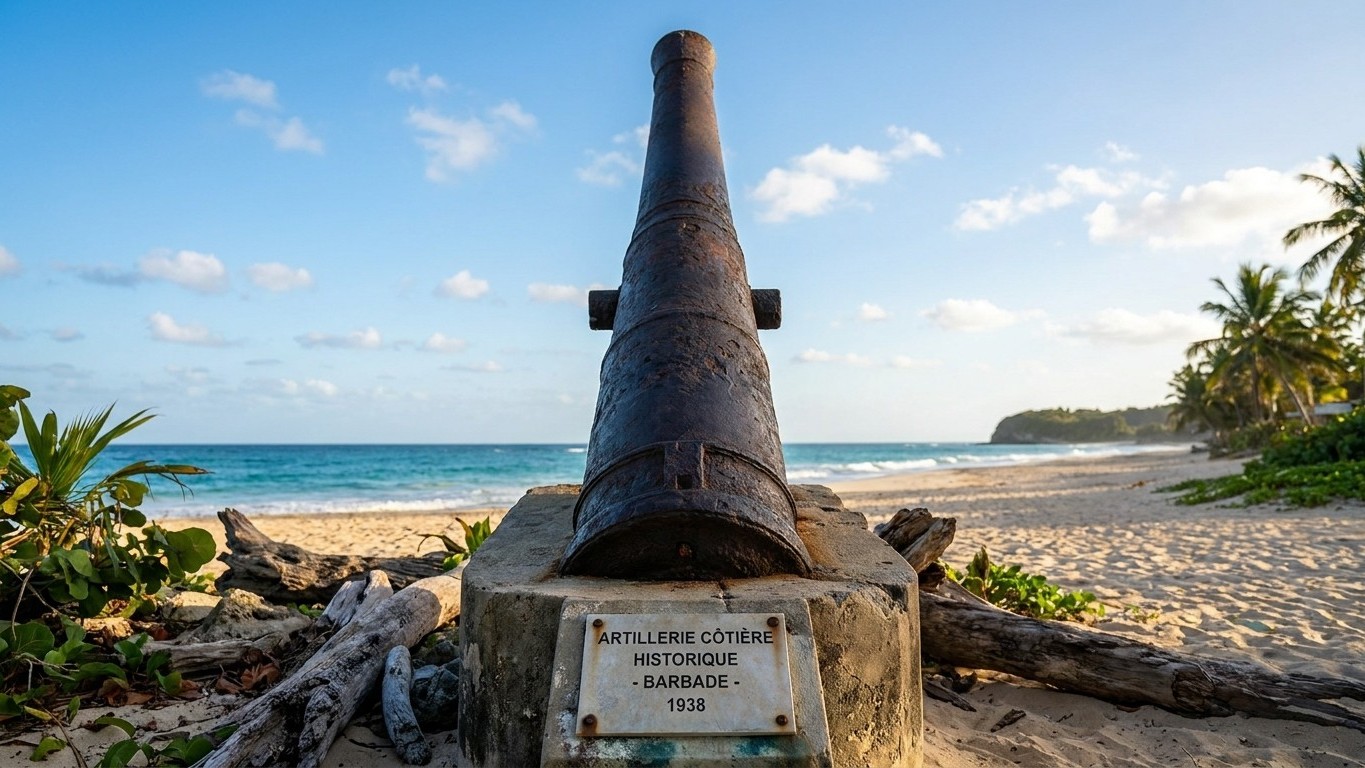
In November 1966, a shell fired from a cannon assembled from naval artillery tubes reached an altitude of 180 kilometers, a record that has never been equaled since. The man behind this extraordinary project is Gerald Bull, a Canadian aerospace engineer trained at the University of Toronto, and his idea could be expressed in a single sentence: send payloads into the upper atmosphere with gunpowder instead of costly and disposable rockets.
Key takeaways
- A 36-meter naval artillery tube erected vertically on a Caribbean beach
- A projectile launched at about 2,100 m/s with no onboard engine or fuel
- A record altitude of 180 km that continues to fascinate scientists six decades later
A naval gun planted facing the Atlantic
The story begins in 1961, when Bull won the go-ahead and funding to launch the HARP program, the High Altitude Research Project. Bull had secured a joint $10 million contract from the American and Canadian Defense Departments for this high-altitude research endeavor. The challenge was to find a tube capable of withstanding enormous pressures without bursting. The solution came from industrial improvisation: repurposing existing military hardware, specifically a 16-inch (406 mm) American naval gun weighing about 125 tons, used as a launcher. The original tube, intended for a battleship, measured 20 meters. It was extended to 36 meters and converted to a smooth bore to maximize the time during which the combustion gases pushed the projectile.
The choice of Barbados was no accident. Situated 13 degrees north of the equator, the island offered an excellent launch site, with thousands of kilometers of oceanic fall-out area above the Atlantic to ensure safe impact of the projectiles. Yet transporting the weapon to the site posed another challenge. The 16-inch tubes reached Foul Bay Beach in 1962 and were moved to the HARP site by a train running on specially laid tracks that were moved along the two-mile route. It was a nearly burlesque image: a battleship cannon traveling aboard a miniature train along a Caribbean beach, then standing upright like a metal obelisk.
1966, the year of the record that still stands
The initial tests on site, beginning in January 1963, were modest relative to the scope of the project: the first shot from the Barbados 16-inch gun occurred on January 20, 1963, with a 315 kg projectile reaching 3,000 meters in 58 seconds. A test mainly used to validate the principle, but it opened the pathway to rapid escalation. As the firing continued, Bull’s team refined the propulsion powder and lengthened the gun again, increasing the initial speed and thus the altitude.
The definitive record, however, was not set in Barbados but on a twin gun built to the same principle at the Yuma Proving Ground in Arizona. On November 18, 1966, a 16-inch cannon fired an 84 kg Martlet 2 projectile to an altitude of 180 km, a record that endures to this day. The projectile left the barrel at roughly 2,100 meters per second. What stands out is not only the altitude achieved but the method: no engine, no onboard fuel, just an extremely brutal initial push to overcome gravity for nearly two minutes of ballistic flight. To put it into perspective, 180 kilometers is around the altitude of some of the earliest crewed space capsules, reached here without a single gram of onboard propellant in the projectile.
A program scrapped in its prime
The paradox is cruel. The axe fell in 1967, even as the program had just broken its absolute altitude record a few months earlier. The reasons were not technical but financial and political. The Canadian government and the American military withdrew their funding due to internal pressures, the Vietnam War, and NASA’s preference for conventional rockets. In a context where every military dollar was scrutinized and space exploration was being pursued with Saturn rockets, an experimental cannon with no direct military application carried little weight against the priorities of the moment.
The outcome is as sad as it is fascinating. Overnight, a program that had mobilized hundreds of people and generated valuable scientific data about the upper atmosphere was halted, its facilities left in place for lack of funds to dismantle them. The giant tube remains standing there, on its support, a few hundred meters from the beach. It has rusted away on that isolated southeast Barbados beach, now part of a Barbados regiment base. A telling detail about the fate of this Cold War relic: the site even served, at times, as a paintball field—a paradox for an instrument that once aimed at the far reaches of the atmosphere.
Gerald Bull, for his part, never abandoned the idea of the space gun. He continued ballistic research for two decades, eventually applying his know-how to a project far more troubling—the Babylon supergun intended for Saddam Hussein’s regime in Iraq. On March 22, 1990, as he was returning home to Brussels, the engineer was shot multiple times in front of his apartment, in what appeared to be a targeted killing whose masterminds have never been formally identified. The rusted Barbados tube remains, in its own way, the last visible witness to a career that began by shattering a scientific record and ended in the shadows of intelligence services.
Sources: bajanthings.com | espionnage.over-blog.com | dyingwords.net
