
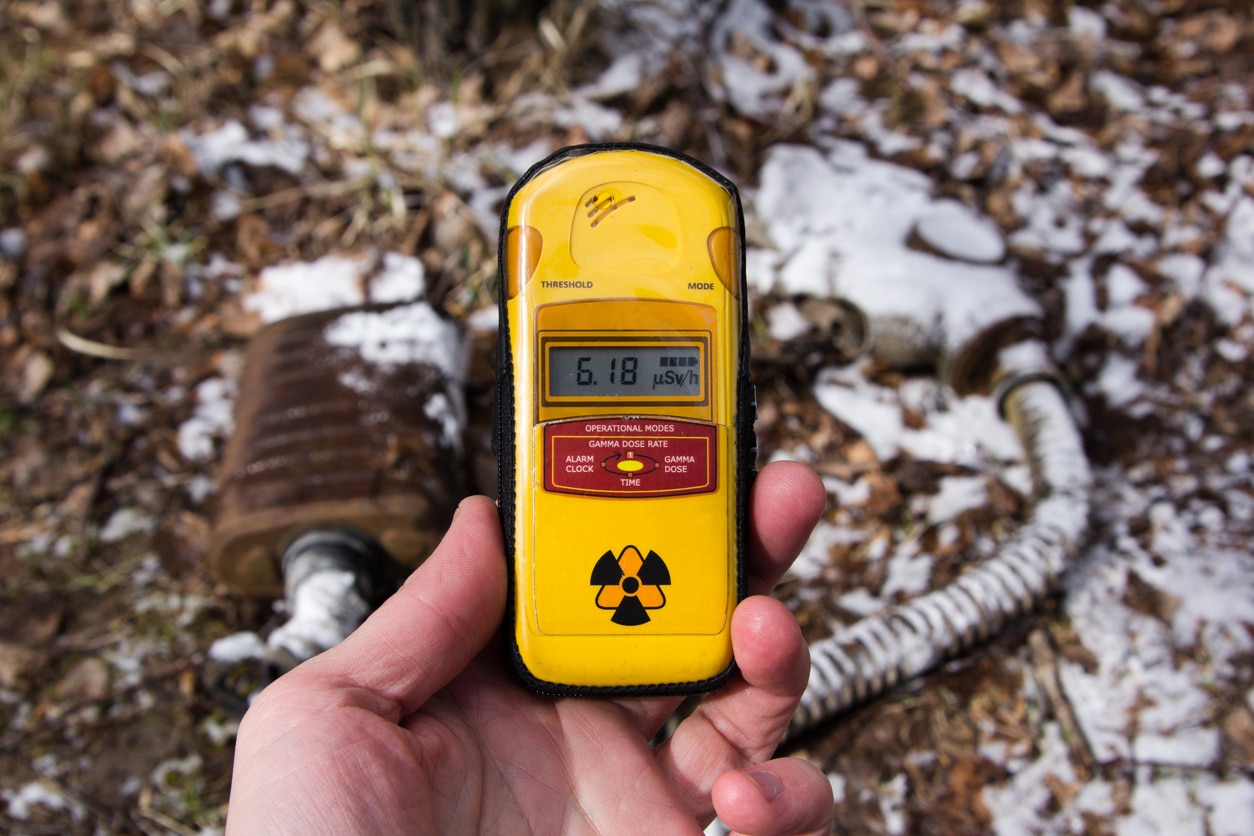
In Japan, researchers have developed a fairly surprising system that allows measuring radiation with a smartphone. It revolves around a special film that changes color under the influence of ionizing radiation, thereby enabling an estimation of radiation levels. While Geiger counters are generally not very affordable, the innovation from these Japanese scientists seems welcome.
Making Radioactivity Measurement Accessible to the Public at Large
First, let us recall that nuclear radiation comprises energies emanating from unstable atomic nuclei, in the form of alpha and beta particles, and gamma rays. These radiations can damage living cells and DNA, potentially leading to cancers and other heart diseases over the long term at low doses. However, a high dose can cause death after a sequence of severe symptoms.
It is entirely possible to measure the radioactivity of a zone at different levels, but the most common unit is the Becquerel (Bq), used to evaluate the activity of radiation. Also to mention are the Gray (Gy) for the energy absorbed by matter and the Sievert (Sv), for the biological risk on living beings and in particular the impact on humans. Different instruments and methods exist, but the most common is the Geiger counter. However, a quick Internet search reveals that such a device, if it is a quality product, can cost between 80 and 100 euros or even more for counters intended for research.
In order to make radioactivity measurement accessible to the broadest audience, researchers from Hiroshima University (Japan) have worked on an ingenious system. It was published in volume 191 of the journal Radiation Measurements, issued in February 2026.
Simpler and Cheaper but Imperfect
In practice, the system relies on a small box containing a radiochromic film, that is, a small sheet whose color darkens in the presence of radiation. While it is possible to observe this color change with the naked eye, at this stage it remains impossible to gauge the exact level of radioactivity. Thus, the box features a hole facing the film. The user can place their smartphone against the box and take a photo of the film, since the hole’s position also aligns with the device’s camera lens. A portable scanner and a dedicated app then analyze the image and estimate the radiation levels.
“This study demonstrated the feasibility of an economical in situ dosimetry method for relatively high doses (≥ 5 Gy), combining a small-sized radiochromic film, a smartphone and a portable scanner […] This simple, portable and inexpensive tool, requiring neither heavy instruments nor laboratory infrastructure, should be universally used by the general public for voluntary assessment of the dose received during nuclear or radiological emergency situations.”, one can read in the publication.
While the device is simple and slightly cheaper than entry-level Geiger counters (about 60 euros), the scientists consider that the offering can be improved. Indeed, efforts are anticipated to expand the applicable dose range and to develop practical calibration procedures. Finally, radiochromic films and portable scanners are available in limited quantities, but according to the researchers, it should be possible to distribute them beforehand to people potentially exposed to high doses — notably rescuers and medical staff — as well as to local authorities and other competent bodies.
