
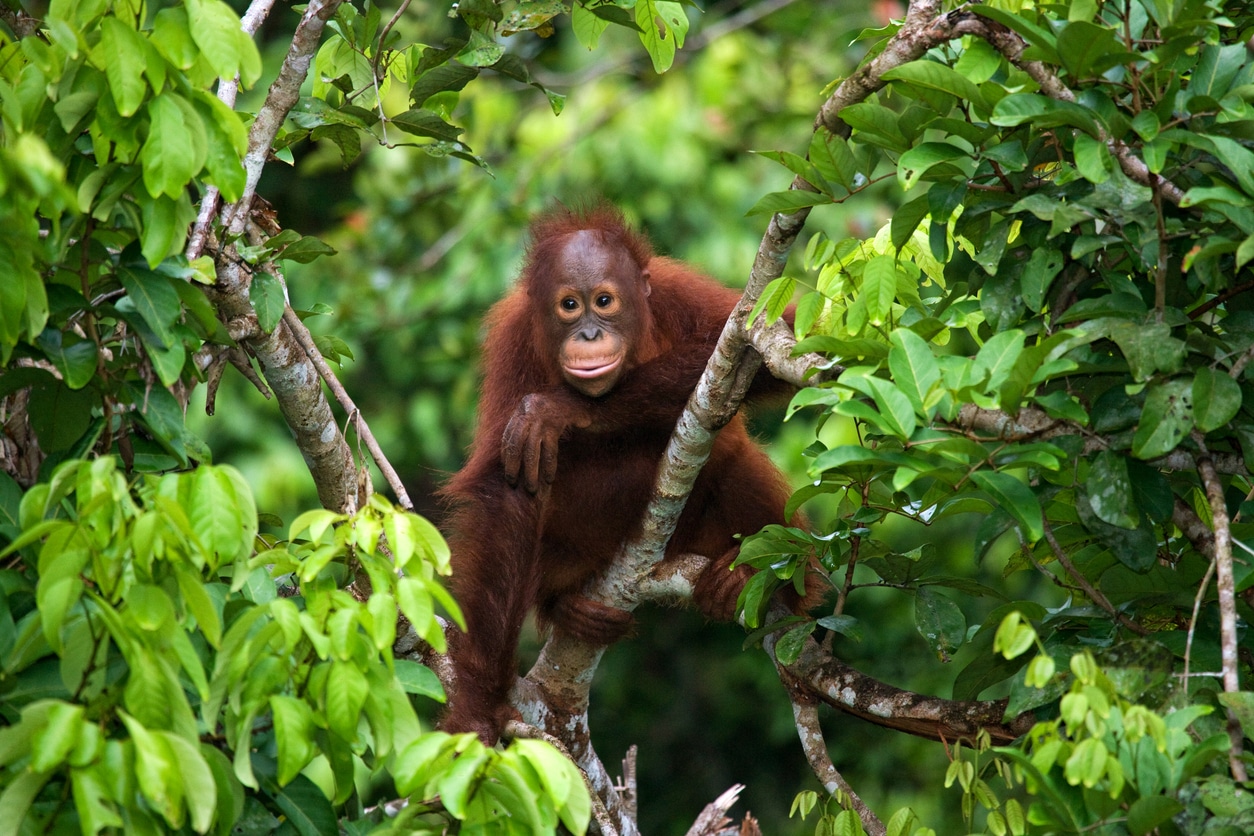
Recent observations by primatologists from the Max Planck Institute for Animal Behavior and Universitas Nasional Indonesia revealed a fascinating behavior in a wild male Sumatran orangutan. After sustaining a facial injury, the animal reportedly demonstrated a surprising behavior by using a plant to treat its wound, providing valuable insights into the origins of wound care in humans.
A Major First
The case in question concerns a male Sumatran orangutan named Rakus. He was observed in the Suaq Balimbing research area, within Gunung Leuser National Park, in Indonesia. Researchers noticed that Rakus had sustained a facial injury, probably during an altercation with another male orangutan. A remarkable behavior followed: Rakus selectively used the leaves of a vine called Akar Kuning to treat his wound.
Akar Kuning is a climbing plant used in traditional medicine for its medicinal properties, notably for treating injuries and various ailments. Chemical analyses of this plant revealed the presence of bioactive compounds such as furanoditerpenoids and protoberberine alkaloids that exhibit antibacterial, anti-inflammatory and antioxidant actions. These properties make Akar Kuning particularly effective at promoting wound healing.
The behavior observed in Rakus involved several steps. First, he chewed the stem and leaves of Akar Kuning to extract the plant’s sap. Then, he applied this sap directly to his wound, taking care to completely cover it with the chewed leaves. This process extended for more than 30 minutes, indicating a deliberate intention to treat his injury.
Subsequent observations by the researchers did not reveal any signs of infection in the wound. On the contrary, Rakus’s injury closed within five days and had fully healed in one month. This case constitutes the first documented example of active wound treatment by a wild animal using a biologically active plant.
A Trait Shared Among Great Primates
This fascinating discovery about wound-care behavior in Sumatra’s orangutans raises deep questions about its origin and evolution within the primate family. Researchers speculate that this behavior could be the result of a biological mechanism shared among members of this order of mammals.
This hypothesis rests on several crucial observations. First, the fact that similar behaviors have been documented in other great apes, notably chimpanzees in Africa, suggests an evolutionary continuity in the use of plants for medicinal purposes. This behavioral similarity across different primate species strengthens the idea of a biological mechanism inherited from a common ancestor.
Moreover, the fact that wound care has been documented in humans for thousands of years underscores its importance in the evolution of our own species. The earliest evidence of medical practices dates back to prehistoric periods, suggesting that our human ancestors also used plants to treat their injuries.
Again, this long history of wound care in humans provides further evidence that this behavior could have deep roots in our evolutionary heritage as primates.
This continuity in medicinal practices across different primate species thus suggests the existence of an innate ability to recognize and use medicinal substances to promote wound healing.
The details of the study are published in the journal Scientific Reports.
