
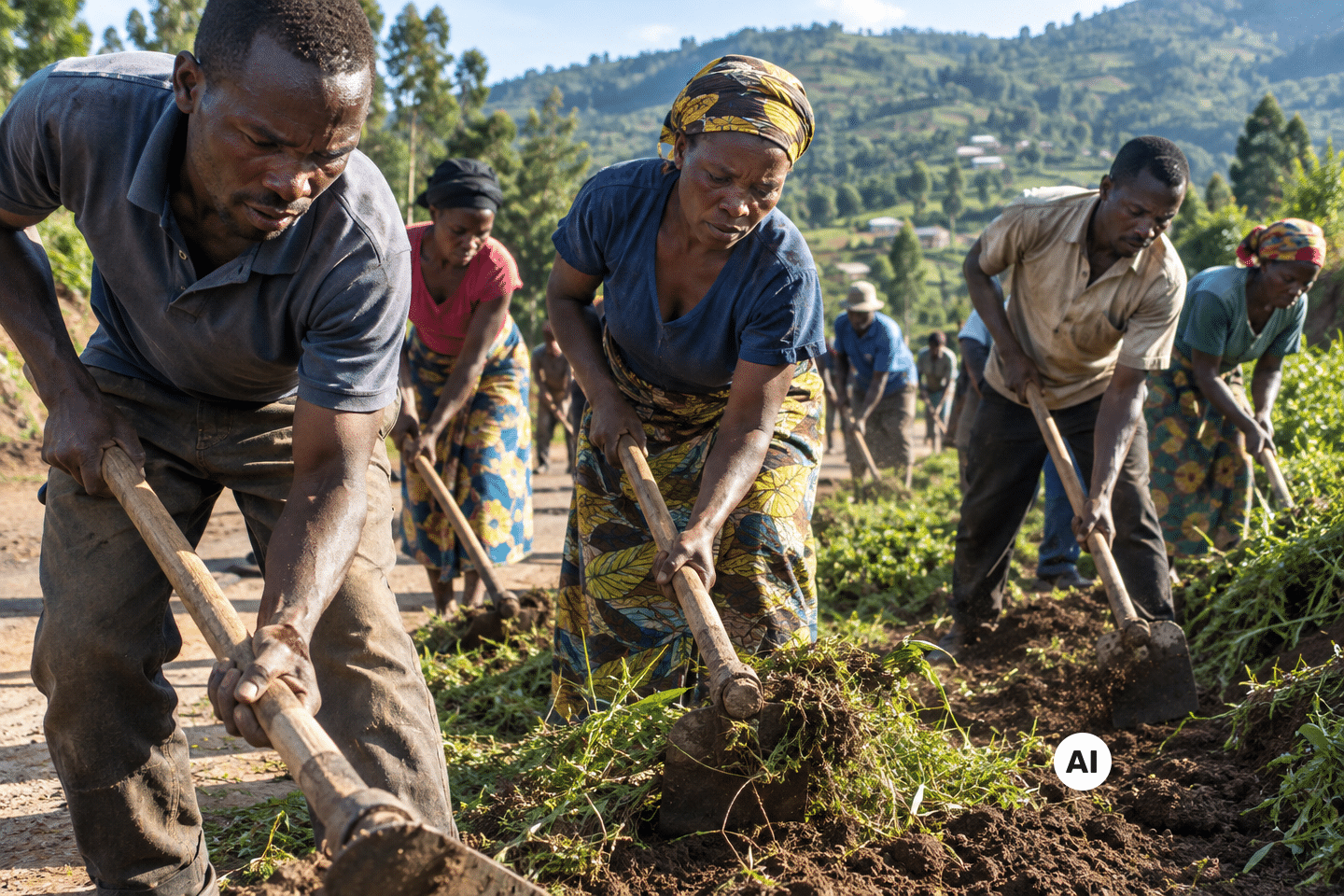
The last Saturday of every month, Rwanda comes to a halt. Shops shut, traffic is controlled, and millions of adults—from ordinary residents to ministers—gather in their neighborhoods to work together. This tradition, umuganda, was reinstated in 2009 and rests on an obligation, accompanied by a fine. It partly explains the country’s cleanliness, but also the way the Rwandan state manages its population.
A Saturday per Month, on a Legal Basis
The term stems from an old mutual-aid practice: lending a hand to a neighbor to harvest, repair a roof, or dig a trench. In its current form, umuganda was institutionalized in 2009. It takes place on the last Saturday of the month, in the morning, and concerns people aged 18 to 65, unless exemptions are granted, for instance on medical grounds. Expatriates are invited to participate.
Each neighborhood organizes its own project, often decided by local authorities according to current needs: cleaning ditches, clearing brush, road works, repairing homes, or planting trees. In Kigali, it is common to see the president and members of the government, which gives the event a strong symbolic dimension.
As the city has become quite clean, participants devote less time to litter-picking and more to tasks of communal utility. In a village described by the Belgian newspaper La Libre, the day’s assignment was to rebuild the partially collapsed house of a 63-year-old widow, using corrugated sheets provided by the sector authority.
A Duty, with a Fine on the Line
Umuganda is not voluntary work. Households must send at least one adult representative, and those who are absent without an excuse approved by local authorities risk sanction. The fine amounts to 5,000 Rwandan francs, roughly $3.50 at current exchange rates (nearly $6 a few years ago). While this may seem small, in a country where the average income hovers around $2 per day, the sum represents nearly two days’ earnings for many households.
During the morning, the police may also check travel to verify that people on the road have a valid reason for not being at the worksite. Social pressure also plays a role: everyone in the neighborhood knows one another, and an absence does not go unnoticed.
Supporters of the arrangement view it as a low-cost development lever. According to an assessment conducted by the Rwanda Governance Board, umuganda yielded roughly $127 million in value between 2007 and 2016, with a participation rate of 91.3% in 2015-2016. These figures come from an institutional study and should be read as such.
Between Local Development and Social Control
The results are visible: schools, roads, health centers, and bridges have been built or maintained in part thanks to this collective labor. The Bertelsmann Transformation Index (BTI 2026) confirms that local authorities contribute to the construction of health centers and clinics through this compulsory work. The 2025-2026 planting season, meanwhile, surpassed 68 million trees, according to Rwandan press, about 14% above the target of 60 million.
But the system has a downside. The same BTI report notes that residents openly voice their grievances, while political criticism is tolerated only if it does not contradict government policy, especially on national unity. Observers, such as NPR journalist Amy Yee, point out that not everyone buys into such a strict system.
Thus umuganda illustrates a governance choice: achieving tangible results quickly, at the price of an obligation that many accept and others endure.
Sources :
- How Rwanda tidied up its streets, and the rest of the country too – NPR (2018)
- In Rwanda, where good deeds are law – The Times of Israel (2017)
- Everyone to Work for Umuganda – La Libre (2014)
- BTI 2026 Country Report – Rwanda – Bertelsmann Stiftung
Article prepared with the help of AI · Our method
