
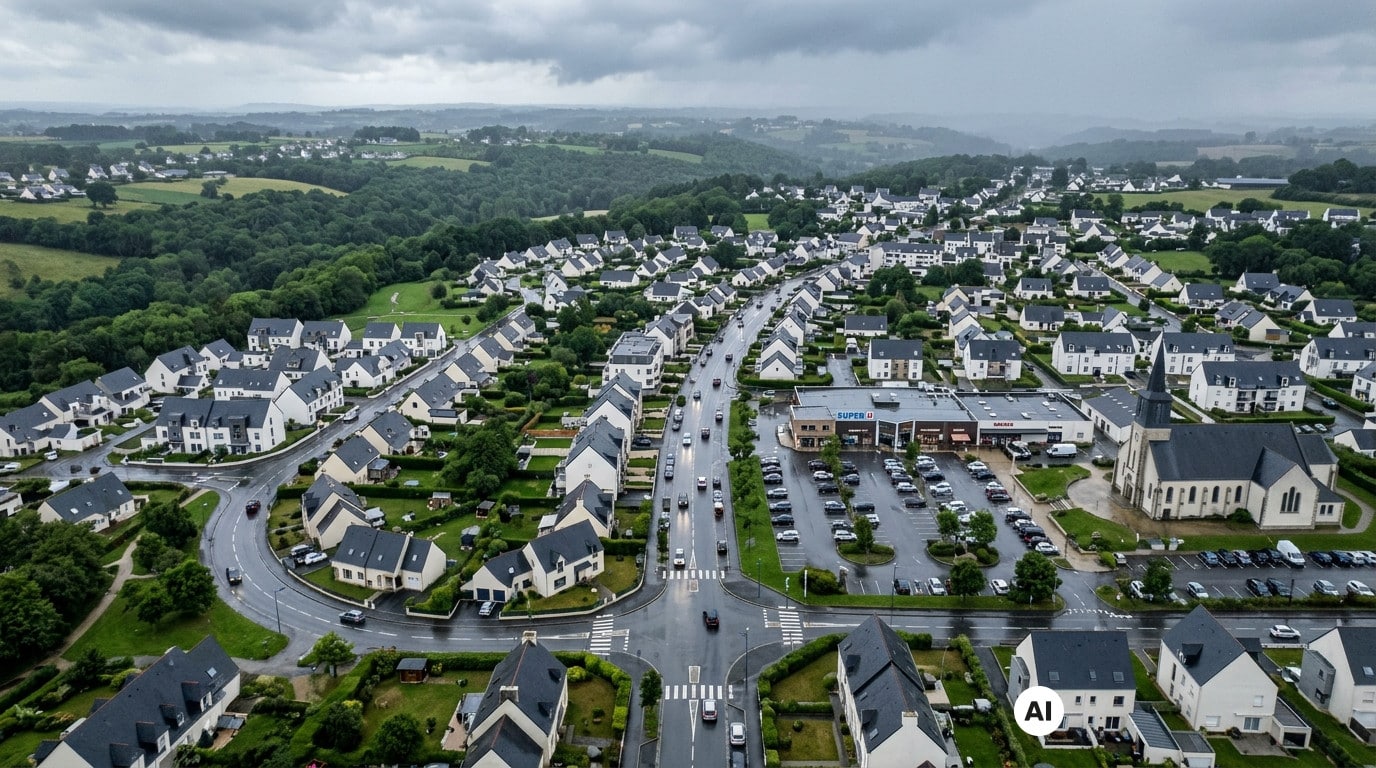
Despite these downpours, washing your car at home remains strictly forbidden in 64 departments. A situation that may seem absurd at first glance, almost unfair as water appears abundant outside. But behind this rule lies a process much slower and more complex than a mere shower. To understand why rain doesn’t change the situation, one must look at what happens beneath our feet, where water takes an extremely long time to drop back down.
What recent rains really say about the state of groundwater tables
When it rains for several consecutive days, the natural reflex is to think that the country’s water reserves are filling up rapidly. In reality, part of this water runs off on the surface, joins rivers, ditches, or wastewater networks, while another portion infiltrates and can reach the groundwater tables. These underground reservoirs, which supply a large portion of the drinking water distributed in France, recharge at a much slower pace, often over several weeks, or even months, depending on the nature of the soils and the depth of the affected aquifers.
In other words, heavy rain can give the impression that drought is over while, deep down, the levels remain fragile. It is precisely this data, the real groundwater level and not the current weather, that determines whether water restrictions are maintained or lifted. A soil that runs off more than it absorbs is therefore not enough to reassure authorities about the state of subterranean reserves.
How drought decrees work and why rain is not enough to lift them
Drought decrees are not triggered nor lifted on a whim after a few days of bad weather. They follow a precise logic, anchored to the evolution of groundwater levels observed over time. As long as these subterranean indicators have not risen in a significant and durable way, restrictions remain in effect, even if the sky is generous above ground.
It is this gap between visible weather and underground reality that explains why so many departments continue to apply strict measures despite recent rains. The prefectures, which rely on these data to adjust the alert level, prefer to wait for a real and prolonged recharge of the aquifers rather than lifting restrictions too quickly on the basis of a single rainy episode. In short, a weekend of rain never suffices to reverse a trend that has been in place for months.
Washing a car at home: what offenders realistically risk
In zones placed under reinforced alert, washing a vehicle at home or in public spaces is simply forbidden, except at equipped stations. This prohibition is not a mere recommendation that could be ignored without consequence: it carries a financial penalty that can rise up to 1,500 euros in the event of inspection and infraction.
This amount may surprise for a gesture as banal as scrubbing one’s car on a Sunday morning, but it reflects the authorities’ willingness to limit non-essential water uses during periods of resource strain. Car wash stations, too, are not spared from this ban.
Before you grab the sponge and bucket, it’s better to ask yourself the right questions:
- Is my department affected by an ongoing drought decree?
- What is the alert level applied in my area?
- Is home washing explicitly forbidden or simply limited to certain hours?
Check the restrictions in effect near you using VigiEau
Facing this mosaic of rules that vary from department to department and evolve over the weeks, there is a simple tool to navigate it: the VigiEau platform. By entering your municipality, you can know in a few seconds the local level of restriction in force, as well as the applicable uses, such as car washing.
This site is the go-to reference to consult before any action involving significant water use, especially in a context where the situation can change rapidly depending on groundwater levels. Better to take a quick look at VigiEau than to incur a hefty fine for a car wash that seemed innocuous.
Source : Guide de mise en œuvre des mesures de restriction des usages de l’eau en période de sécheresse (ecologie.gouv.fr)
Article prepared with the help of AI · Our method
