
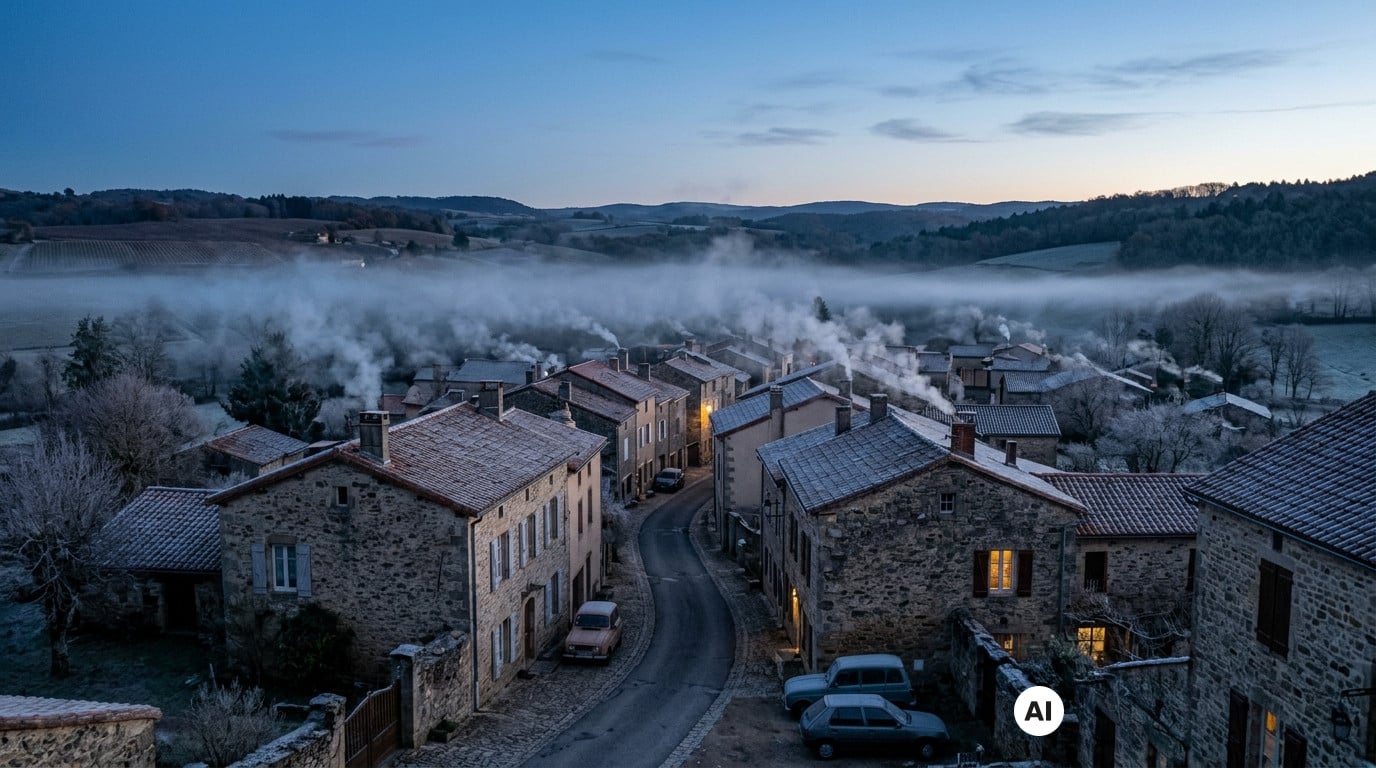
A freshly lit fireplace, the crackle of wood, and yet the smoke refuses to rise. It stalls just above the roof, stretches into a low haze, and eventually descends toward the street. This spectacle, which intrigues every year as winter approaches, is nothing supernatural. It even has a precise name in meteorology and recurs regularly on calm, clear nights, when the sky would seem to offer the best conditions for a proper blaze. Understanding what is at play in the atmosphere at that moment helps anticipate this phenomenon and avoid some of the familiar nuisances for wood-fire enthusiasts.
The smoke falls back to the ground instead of rising toward the sky
Under normal circumstances, the smoke from a chimney rises naturally, carried by the warm air that ascends and gradually disperses as it climbs higher. But on certain nights, this upward motion no longer occurs. The smoke exits the chimney, climbs a few tens of centimeters, then stalls and spreads horizontally, as if blocked by an invisible ceiling. It ends up descending toward the garden, the street, or the valley, forming a stubborn haze that can linger for several hours.
This phenomenon affects especially rural areas and valleys that are naturally more prone to air stagnation than open terrain. It is often in the early morning, when the cold is most pronounced, that this low-lying smoke becomes the most visible and bothersome for nearby residents.
The thermal inversion turns the atmosphere into an invisible lid
This blockage has a name: the thermal inversion. During clear, windless nights, the Earth’s surface rapidly loses heat by radiation and cools the air in contact with it, creating a layer of cold, heavy air that becomes trapped beneath a layer of warmer air higher up. Météo-France explains that this inverted configuration acts like a tight atmospheric lid preventing any ascent: the smoke from wood heating can no longer rise into the sky and is forced to accumulate in the lower layers of the atmosphere, just above the ground.
This phenomenon is particularly common in autumn and winter, when nights are long, the sky is clear, and the wind is absent. The ideal conditions for observing a striking thermal inversion are therefore paradoxically the conditions most conducive to the accumulation of smoke.
Why this phenomenon is such a concern for air quality
Beyond the persistent odor and visual nuisance, this accumulation of smoke at ground level poses a real health concern. The fine particles produced by burning wood, normally dispersed at altitude, remain concentrated in the air we breathe every day. Sensitive individuals, such as children, the elderly, or people suffering from respiratory disorders, are the first affected by this local spike in pollution.
To limit the risks, it is advised to avoid fires in fireplaces or stoves during the most marked inversion episodes, especially in already pollution-sensitive zones. A good practice also involves using well-dried wood and modern heating appliances, as incomplete combustion further increases the concentration of particles in the stagnant air. Conversely, waiting for the wind to rise or for the sky to become overcast often helps restore more favorable dispersion conditions.
Article prepared with the help of AI · Our method
