
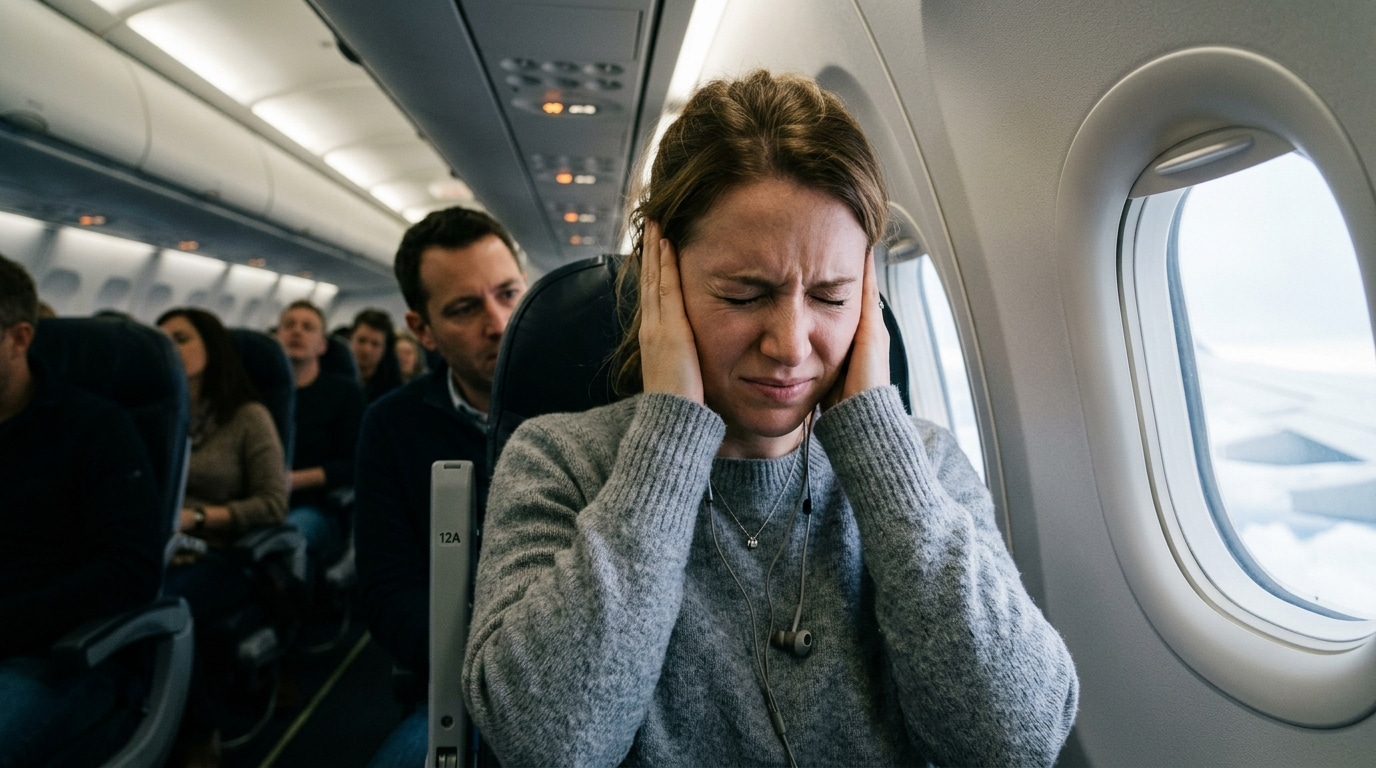
An earplug-like sensation, that cottony muffling that abruptly cuts you off from the world, as if someone had placed an invisible cushion on your eardrums. On an airplane, we almost always attribute it to altitude, to the pressure rising as the aircraft tears through the clouds. It’s logical, it’s intuitive, and yet it’s false. The real culprit is not outside, in the vastness of the sky, but inside your own skull. It hides in a tiny duct, barely bigger than a matchstick, tucked behind your nose. And if you dive into the lines that follow, in the heat of summer when vacation departures are in full swing, you’ll never look at your plugged ears the same way again.
The real culprit isn’t the plane, it’s a matchstick-sized tube
Put the jets and turbulence out of mind for a moment. The central character of this story goes by the name of the Eustachian tube. This small channel connects your middle ear to the back of your nose and throat, in a region known as the nasopharynx. Imagine a discreet valve, a backup passage between two rooms. Its role is simple yet vital: to balance the air pressure on both sides of the eardrum.
When at rest, this tube stays dutifully closed. It isn’t a fault, quite the opposite: by remaining closed, it prevents microbes and secretions from the nose and throat from traveling up to the middle ear. It is a real line of defense. The problem arises when the pressure around you changes: the door must then open to let air circulate. And when it delays in doing so, discomfort appears.
Why your ears pop on the rise but hurt on the descent
You’ve probably noticed: during takeoff, the ears make that small dry sound, those pops that are almost pleasant. Upon landing, however, it’s another story. The pain can become frankly unpleasant, even throbbing. Why this difference in treatment?
It’s all a matter of the direction in which air flows. During ascent, the air trapped in your middle ear tries to escape outward, and it finds the exit quite easily. The Eustachian tube then acts as a valve that lets the excess air go. But during descent, external pressure increases abruptly, and the tube doesn’t always have time to perform its venting duty. Air has a much harder time getting in than getting out.
Result: a real vacuum forms in the middle ear. This vacuum pulls the tympanic membrane inward, like an invisible hand that would suction the skin of a drum. This is precisely what triggers that sensation of fullness, those stubborn blockages, and sometimes ear pain. The same phenomenon also haunts divers: among divers, exposure to pressure changes is so frequent that a large majority have already experienced such a disturbance at the level of the middle ear.
Swallowing, yawning, chewing: the moves that reopen the stuck door
Good news: you hold the key to this obstinate little door, and it costs nothing. The most effective reflexes are disarmingly simple. Swallowing and yawning are your best allies. These movements engage the muscles that govern the opening of the Eustachian tube, allowing air to circulate freely once again on both sides of the eardrum.
Here are some concrete gestures to keep in mind during your next flight:
- Swallow regularly, especially during descent
- Deliberately yawn, even if it feels a bit forced
- Chew a piece of gum to multiply the swallows
- Suck on a candy, which explains the famous onboard distribution
- Take a few sips of water when the discomfort sets in
The principle is always the same: each swallow reopens the door and lets the air restore the balance. That is why airlines sometimes hand out candies before landing. It isn’t indulgence; it’s applied physiology.
What to remember before your next takeoff
Note, however, that not everyone is treated the same. Some people suffer from an Eustachian tube dysfunction, a faulty operation of this tube that struggles to open properly. This issue affects a non-negligible portion of adults, around 4.6%, and this share rises with age to nearly 8% among people 65 and older. If you’re congested, the swollen mucosa makes opening even harder, which explains why flying with a bad cold is often a nightmare.
In short, this blockage you take for a simple altitude-related inevitability actually stems from a pressure imbalance, and its remedy hides in a gesture as banal as a yawn. The next time your ears feel plugged, whether on a plane, in the mountains, or even in a fast elevator, you’ll know not to curse the sky, but to wake this little valve sleeping behind your nose. And you—have you ever thought about all the other everyday reflexes your body performs without you having the slightest idea?
