
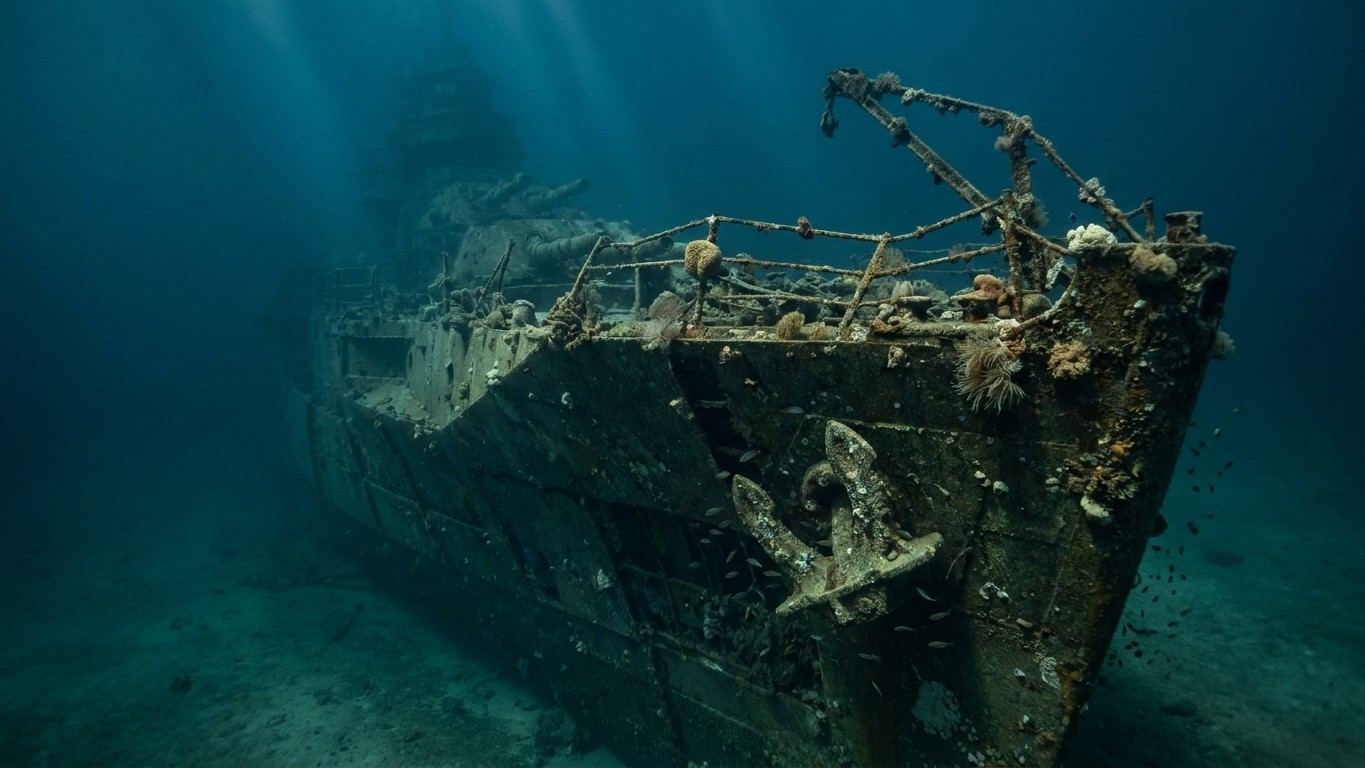
Seven wrecks still lie at the bottom of Scapa Flow, in the Orkney Islands, north of Scotland. They bear little resemblance to World War I battleships: gaping hulls, toppled turrets, corals and anemones colonize the guns. And yet, a few grams of their steel are now worth far more than their weight in scrap, because they end up in dark matter detectors, Geiger counters, and some of the world’s most sensitive medical devices.
Key takeaways
- Why all steel manufactured after 1945 carries the invisible traces of the Cold War
- How sunken ships from a century ago became the raw material for a secret scientific quest
- What lies beneath these frigid waters could vanish much faster than we think
A botched scuttling that created an unforeseen treasure
The story begins on June 21, 1919. The German High Seas Fleet, interned at Scapa Flow since the Armistice, waited for the Allies to decide its fate during the Versailles negotiations. Vice Admiral Ludwig von Reuter, the German commander, believed the ships would soon be seized as war spoils and ordered the fleet to be scuttled. The British guard ships, caught completely off guard, scrambled to respond in haste. Their guard vessels managed to foil the scuttling of a handful of German ships, but 52 of the 74 ships sank to the bottom of Scapa Flow. Nine German sailors died that day, the last casualties of the Great War.
In the following decades, most of the wrecks were salvaged and sent to the scrapyard: too profitable to leave so much metal lying underwater. But seven ships, too deep or too costly to recover, remained on the seabed. It is there that the fate of this steel shifted completely. These surviving wrecks now attract divers and form a source of “low-background steel,” steel with a very low radioactive background.
Why modern steel has become “tainted”
Nothing to do with ordinary chemical pollution. The problem is nuclear, and it affects absolutely all steel manufactured after 1945. With the Trinity test, the bombings of Hiroshima and Nagasaki in 1945, and then the early cold-war nuclear weapons tests, ambient radiation levels rose worldwide, and modern steel is contaminated by radionuclides because its production uses atmospheric air. Specifically, the furnaces draw in the surrounding air to transform iron into steel, an air laden with radioactive particles suspended since the atomic tests.
The principal culprit is cobalt-60. Its half-life is a little over five years, and after several decades, even the initial contamination has practically disappeared in steel produced before the first atomic explosion. That is the core issue. A device designed to detect minute traces of radioactivity simply cannot be built from a material that itself emits background noise. Geiger counters, which measure radiation levels, are a prime example: built from contaminated steel, the instrument would pick up its own radioactivity. It’s like asking a microphone to stay silent while catching the faintest murmur at the far end of a crowded room.
From German submarines to dark matter detectors
The link between a World War I wreck and the most advanced particle physics may seem unlikely. It isn’t. The LUX-ZEPLIN dark matter detector, installed at the Sanford Underground Research Facility, uses more than 10 tons of low-radioactivity stainless steel in the neutron shields surrounding its liquid xenon time projection chamber. Without this type of material, it would be impossible to distinguish a real exotic-particle signal from the simple radioactive crackling of the structure itself.
The use is not limited to hunting for dark matter. Hull plates from SMS Kronprinz Wilhelm were reused in 1974 to construct a whole-body counting room in a Scottish hospital. Some rumors, never fully confirmed, even speak of steel from SMS Markgraf used in the radiation detectors on the first American satellite, Explorer 1. More documented: 65 tons of steel drawn from the USS Indiana, scrapped in 1962, served as shielding in a veterans’ hospital in Illinois, and 210 more tons enabled the construction of a shielded chamber for in vivo radiation measurements at a medical center in Utah. Each time, the principle remains the same: to create a radioactive-background silence around an ultra-sensitive measuring instrument.
Wrecks now under strict protection
This quiet trade has not always been legal, and it is becoming less so. Two divers were fined £18,000 each after looting several ships, including the battleships SMS Markgraf and SMS Kronprinz Wilhelm, designated as protected historic monuments since their 1919 sinking. The Scottish government has recently tightened the regime: designation as a Historic Marine Protected Area now makes removing objects from these sites a criminal offense. Cutting a plate from a German battleship to sell it to a physics laboratory is no longer a gray area; it is a crime.
Yet demand itself is waning. Since the 1963 Partial Test Ban Treaty, atmospheric contamination has gradually declined, and modern steelmaking techniques have become cleaner, so that some newer detectors can now use ordinary steel with only minor adjustments. The steel from Scapa Flow is no longer the irreplaceable resource it once was. It remains, beneath the icy waters of the Orkneys, one of the few tangible witnesses to a pre-fission world, a silent stock that science continues to draw from the depths when it seeks a perfect radioactive silence.
Sources: fr.wikipedia.org | fr-academic.com
