
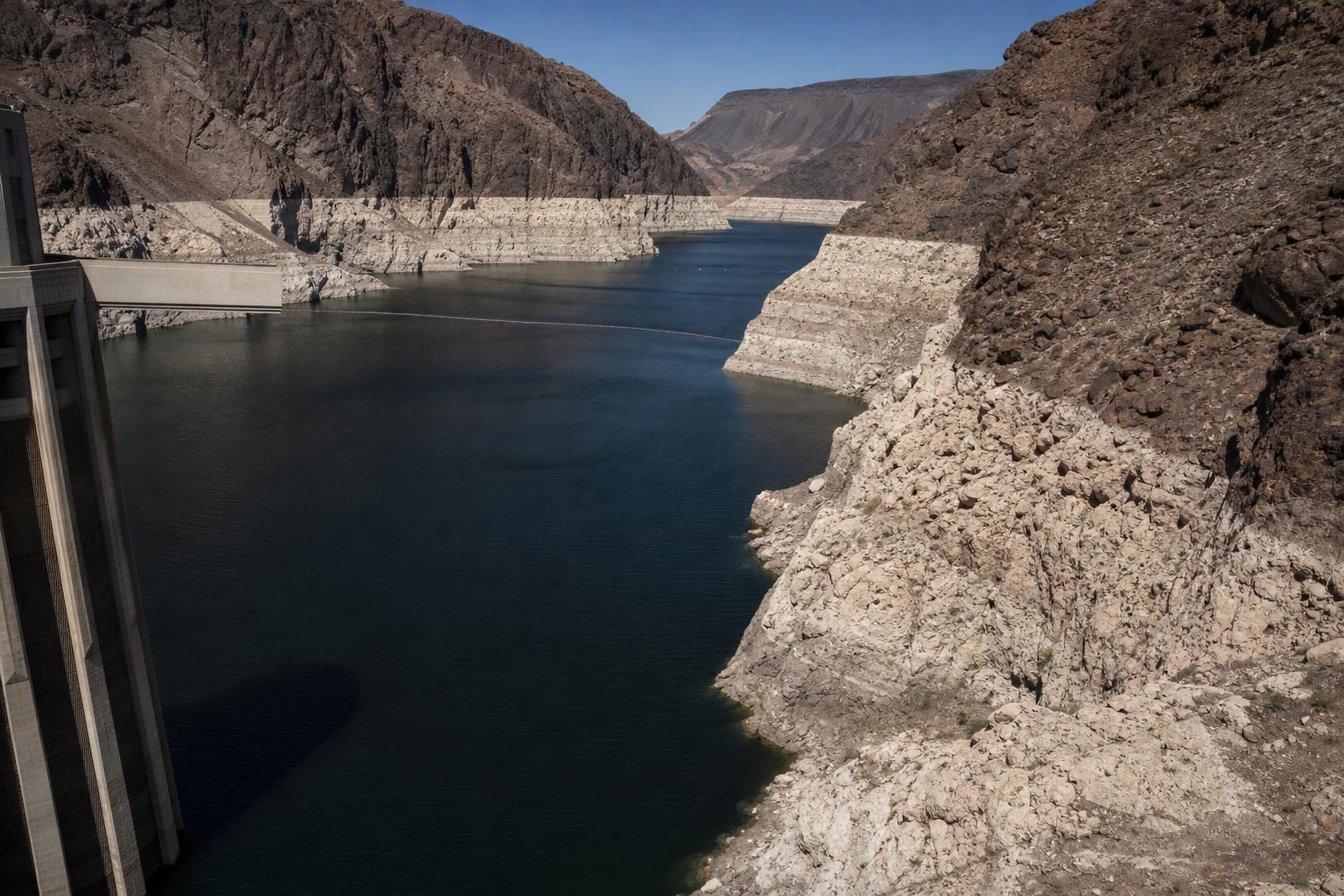
The American Southwest lives on a fragile promise: that a river born in snow and stone will keep flowing to the desert. If the surface of Lake Mead fell to the fateful elevation known as dead pool, that promise would snap. At that point, gravity loses its leverage. Water can no longer pass through Hoover Dam by simple force of height. The supply that anchors cities, farms, and industries would face an abrupt, physical limit. “You can’t release what the dam can’t reach,” as one engineer likes to say. The clock would tick loudly for 25 million people.
What “dead pool” really means
At dead pool, the reservoir sits so low that its outlets are effectively above the waterline. The structure can’t push water downstream using gravity. Unlike routine shortage tiers, this isn’t a matter of negotiated cuts. It’s hydraulics. Pumps can’t be flipped on at Hoover Dam; there is no secret backup switch. Below that line, downstream deliveries would shrivel, not because of policy, but because of physics. “It’s the moment when infrastructure says no,” and that “no” echoes across the basin.
Power would blink out before the water
Hydropower depends on head—the vertical drop that spins the turbines. Long before dead pool, Lake Mead can slip below the minimum power pool. Output declines, then winks to zero. That loss doesn’t just darken landmarks on the Strip. It ripples through the Western grid, replacing flexible, carbon-free generation with costlier, often dirtier alternatives. Grid managers can patch, but they pay, and so do consumers who feel it in rates.
Cities and farms on the line
When gravity can’t move water past the wall, downstream users face immediate interruptions. Urban districts in Arizona and California would scramble to meet basic demand. Many would still have some stored supplies, groundwater, and emergency interties, but they would not replace what the river can’t deliver. Las Vegas stands as a partial exception: its low-lake-level pumping station can draw from Mead even near dead pool. Yet that helps Las Vegas, not the vast conveyance system that depends on Hoover releases.
Agriculture in the Imperial and Yuma valleys consumes the lion’s share of Lower Basin allocations. Fields that feed the nation—lettuce, alfalfa, vegetables—would go fallow at massive scale. Rural jobs would vanish. Food prices would wobble as supply chains look for wetter, or simply possible, places to grow.
The river’s living web would fray
Take away flow, and a river’s ecology buckles. Side channels go stagnant. Riparian forests wither. Warm, shallow pools invite harmful algae. Native fish already under stress face another turn of the screw. Downstream to the border, treaty deliveries to Mexico would be at risk in a way paper compromises can’t solve. “A dry channel is a different world,” as field biologists often warn.
Law meets the hard stop of physics
The “Law of the River”—a century of compacts, statutes, and decrees—was built for shortage, not for zero. Priority rights matter until a pipe meets air. Senior users don’t drink priority labels; they drink water. In a dead-pool scenario, triage turns from legal to logistical in hours, not years.
- Hydropower halts; downstream releases cease; agriculture fallows; urban demand faces hard rationing; the U.S.–Mexico treaty endures unprecedented strain.
Can we engineer around it?
Some will ask: why not pump around the dam? In theory, a massive bypass could lift water over concrete. In practice, that means years of design, billions in cost, uncertain permits, and planetary-scale crane work. Retrofitting new, deeper outlets is similarly slow and fraught. Desalination can help at the margins, but big plants take time, power, and politics. Reuse, stormwater capture, and aggressive conservation scale faster, but they are already the region’s daily bread.
The fastest lever remains cutting demand. Paid fallowing programs can idle water-thirsty fields temporarily. Cities can keep ripping out ornamental turf, tightening leaks, and recycling every legally and technologically reachable drop. “Every gallon saved upstream is a gallon you don’t have to invent downstream,” as planners like to say.
What it takes to avoid the brink
Avoiding this edge means matching reality, not memories. The basin has entered a hotter, drier regime, where the same snow yields less runoff. Evaporation rises; soils drink first; rivers get the leftovers. To stay above crisis, the Lower Basin likely needs durable, multi-million-acre-foot reductions, shared across sectors with money, monitoring, and measurable results. That points to:
- Binding, enforceable demand cuts backed by federal and state funding, transparent accounting, and programs that reward verified savings rather than paper promises.
Upstream, coordinated releases can buy time, but they can’t conjure water. Balancing Lake Powell and Lake Mead remains crucial, yet both need a bigger, steadier cushion. Think less about heroic one-offs and more about a permanent diet for a river living in a new climate.
If the reservoir ever sinks to dead pool, there will be no graceful pivot. It would be a blunt, physics-driven reset. The better story is still available: cut demand now, build resilience where we live, and keep the river above the point where gravity gives up. “Hope is not a plan,” but prudent, shared sacrifice still is—and the window to make it work is open, for now.
