
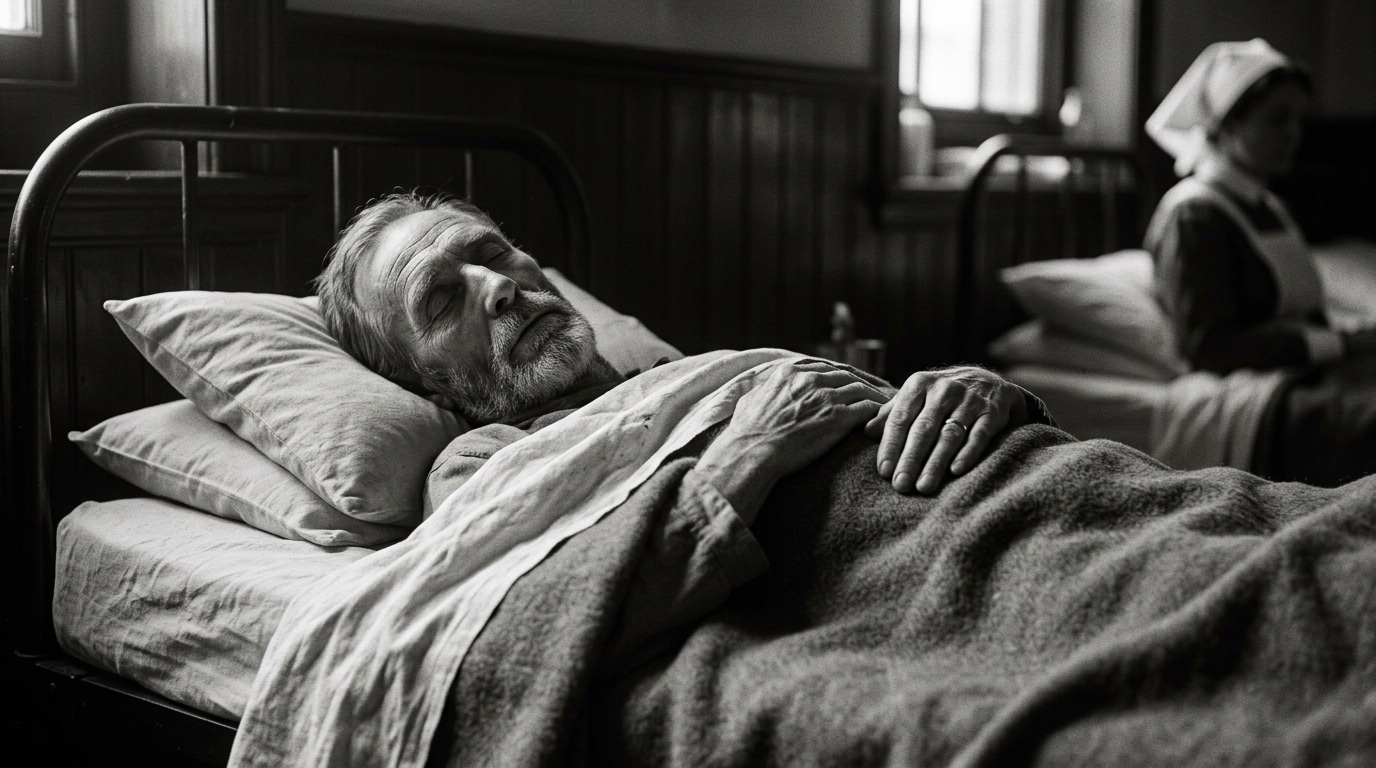
What if one of the greatest medical mysteries of the last century had been almost entirely erased from our collective memory? While the Spanish Flu occupies a vast place in historical narratives, another pandemic, far quieter, struck Europe and the world at roughly the same time. It did not trigger raging fevers or deadly coughing fits, but something even more troubling: a sleep from which many never woke. People assumed these patients were simply exhausted, victims of the fatigue of a war that seemed endless. The reality was quite different, and a century later, scientists have still not cracked its mystery.
A phantom epidemic in the shadow of the Spanish Flu
Everything begins in the midst of World War I. While cannons roared and the so-called Spanish Flu prepared to sweep away millions of lives, two doctors observed an odd affliction almost simultaneously. In France, the Bordeaux-born René Cruchet, then mobilized at the Bar-le-Duc neuropsychiatric center, filed a note describing around forty cases of a mysterious “subacute encephalomyelitis.” A few days later, in Vienna, the Austro-Hungarian neurologist Constantin von Economo characterized this disease, naming it lethargic encephalitis.
The calendar’s coincidence meant that this epidemic overlapped with the Spanish Flu pandemic. The result: its toll, estimated between 500,000 and a million deaths, remains terribly unclear. The massive mortality caused by the flu seemed to absorb, dilute, and erase the traces of this other catastrophe. It is a bit like a quiet fire burning next to a gigantic blaze: hardly noticed, and yet it claims its own victims.
Symptoms that defy medical logic
What made this disease so perplexing was its course in two distinct phases. The first resembled a banal flu: fever, fatigue, general malaise. Then came an abnormal, pervasive sleep, sometimes accompanied by states of confusion akin to dementia. Some patients slipped into a sleep from which they never emerged. Hence the chilling nickname of the European “sleeping sickness”.
For those who survived, the story did not end there. A second phase could set in, often associated with a severe Parkinsonian syndrome. The victims found themselves frozen, as if petrified, deprived of speech and movement. Imagine beings transformed into living statues, conscious yet imprisoned in their own bodies. More troubling still, the patients were frequently children and young adults, and many showed heavy psychiatric disturbances: hallucinatory delusions, violent behaviors, disinhibition, or seizures. Neurological sequelae, when they appeared, were disabling and permanent.
An elusive culprit: the viral lead still escaping researchers
From its earliest descriptions, von Economo leaned toward an infectious origin. The coincidence with the Spanish Flu made the virus hypothesis particularly appealing. And yet, a crucial detail complicated everything: the disease did not seem contagious in the conventional sense. It did not transmit to the relatives of the patients, nor to the caregivers who worked with them daily.
This absence of transmission has long muddied the trail. How could an epidemic affecting hundreds of thousands strike without person-to-person spread? A century of research has not settled the matter. Some propose an immune system reaction to an infection, others a still-unknown viral pathway. The truth is that the culprit remains unfound, leaving scientists facing an enigma as fascinating as it is maddening.
What these “sleepers” of 1917 still teach us today
Remarkably, this disease disappeared almost as mysteriously as it had appeared. In its epidemic form, it faded by the late 1920s. The world quickly forgot it, even though it had inspired more than 9,000 scientific articles between 1917 and 1939. It remains today regarded as one of the greatest medical mysteries of the twentieth century.
Its interest extends far beyond pure historical curiosity. Studying these “sleepers” helps us better understand the complex links between infections, the nervous system, and neurodegenerative diseases. Each new pandemic rekindles worry: what if unexpected neurological complications could also go unnoticed amid the noise of a major health crisis? This lesson from the past invites vigilance against what hides in the shadows of great catastrophes.
Lethargic encephalitis reminds us how medicine sometimes advances by trial and error, confronted with mysteries that resist time. These thousands of sleepers from another century continue to challenge us: how many other enigmas of this kind lie hidden in the folds of history? Perhaps the key to this disease, one day, will help us better understand how our brain functions. In the meantime, these living statues of 1917 remain the silent testimony of an epidemic we almost forgot.
