
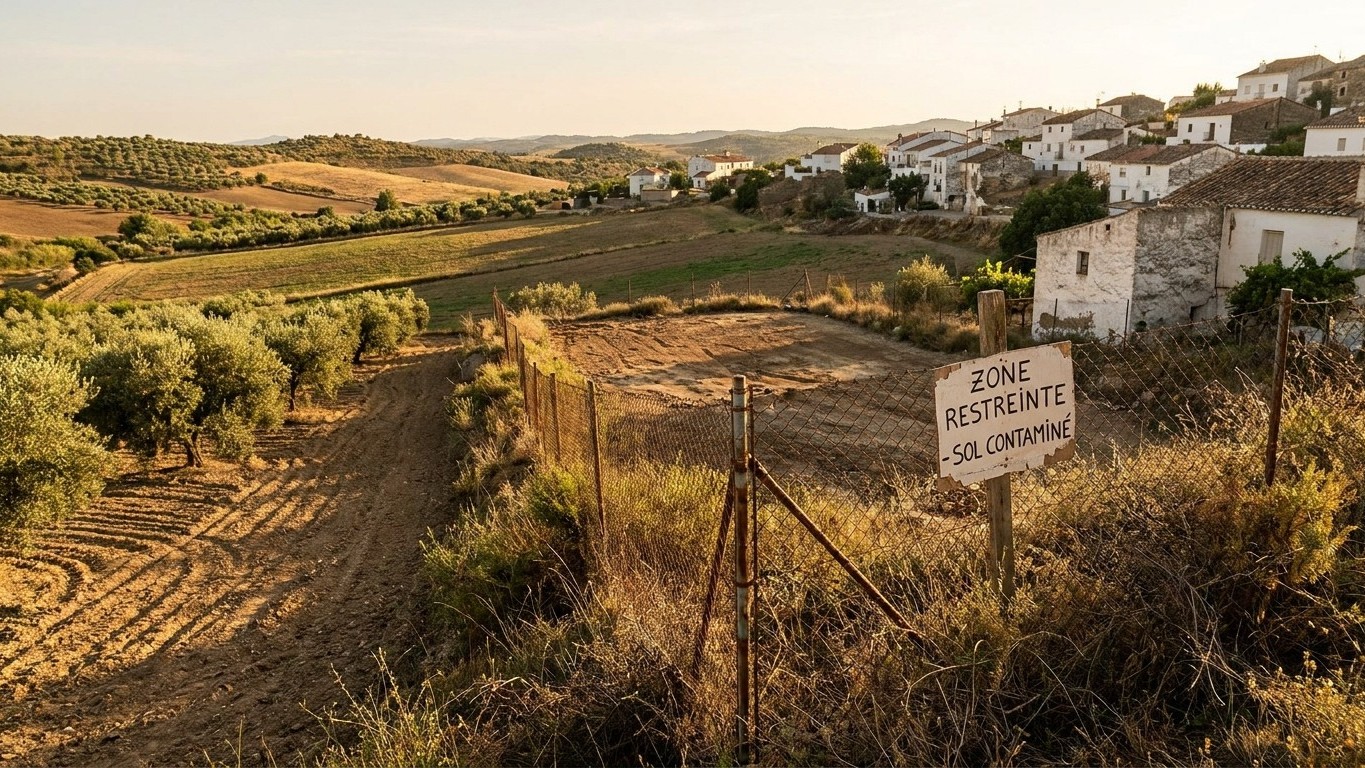
Forty hectares of Andalusian land, ringed by rusted fences for six decades: this is what remains, still today, of the worst nuclear accident ever to strike European soil. Contrary to the common belief that Palomares had been fully decontaminated by 1966, a portion of the territory of the small village of Almería remains off-limits, under the supervision of CIEMAT, the Spanish public agency responsible for energy and environmental research.
Key takeaways
- A clean-up pledge in 1966 that masks a far different reality
- How secret pits revealed the truth forty years later
- Why a 2015 agreement remained without effect
Nine kilos of plutonium dispersed in a few seconds
On January 17, 1966, an American B-52 bomber collided in mid-air with a KC-135 refueling aircraft over the Sierra Almagrera. The bombs were dropped on January 17, 1966, when a B-52 bomber and a refueling aircraft collided during a routine aerial refueling operation, killing seven of the eleven crew members. None of the four thermonuclear devices exploded in a nuclear sense, but the plutonium-filled detonators of two of them were triggered, dispersing about 3 kilograms of highly radioactive plutonium-239 across the landscape around the town. Other estimates talk of nine kilograms of isotopes spread as aerosols. Palomares, an agricultural village with a population a little over 700, would forever bear the mark, with a dispersion over an area of about 226 hectares comprising wild vegetation, cultivated land and urban zones.
The U.S. military acted swiftly to limit visible damage. The American Department of Defense remediated the site within weeks after the accident, with the contaminated soil placed in drums and shipped to the Savannah River Site of the DOE, where it was initially buried. To reassure tourists and salvage the summer season, the Francoist government even organized a famous public relations operation: American ambassador Angier Biddle Duke invited several Spanish ministers, including Manuel Fraga, to bathe in the sea in front of the world’s cameras, to demonstrate the absence of radioactive danger. The official message was clear: everything is clean. The reality, however, was quite different.
Secret pits discovered forty years later
For decades, the official version held. Then voices began to speak up, and excavations revealed a very different story. While the American and Spanish governments had officially declared the cleanup site finished, it later became clear that this was not the case, as researchers, journalists and activists persisted in uncovering two trenches of radioactive debris buried, revealing that around 40 hectares of land remained contaminated with plutonium. It was only in 2006 that serious radioprotection measures were taken. It was in 2006 that the first radioprotection measures were adopted, with the fencing off of 40 hectares.
These fenced-off zones, dubbed zones 2, 3, 6 and 2-bis in administrative jargon, are not mere empty plots. Despite official acknowledgment of the problem, the land remains confined behind rusted fences delimiting exclusion zones, roughly 40 hectares spread across several sectors. And the danger is not frozen in time: while diplomacy stalls, the physical reality of the problem worsens, as americium, a decay byproduct of plutonium, increases in presence over the years and keeps the radiological risk alive. A dizzying figure: according to CIEMAT measurements, the residual concentration of radionuclides in Zone 6, which covers part of the Sierra Almagrera, jumped by 400% compared with Zones 2 and 3.
A 2015 agreement that remained a dead letter
Almería, nevertheless, did not lack diplomatic promises. In October 2015, Madrid and Washington signed a grandiose declaration of intent. Under this agreement, signed by Minister José Manuel García-Margallo and Secretary of State John Kerry, the two countries pledged to negotiate a binding agreement to continue the restoration and the evacuation of the Palomares site to a location suitable for the United States. The problem is that this text never carried legal binding force. The fundamental issue remains the same as in 2015: the agreements have no mandatory legal bite, and this pact, which spoke of “repairing a mistake,” remained a dead letter after Donald Trump came to power.
Washington does not deny its responsibility. A Government Accountability Office (GAO) report from February 2024 explicitly acknowledged that U.S. aid is “vital” to solving the problem. But recognizing a problem and solving it are two different things. The document acknowledged that the Spanish state does not have the facilities to store permanently the very long-lived transuranic wastes, plutonium-239 and americium-241; the only viable option is their transfer to the Nevada desert. Result: ten years after the signing, not a gram of soil has moved. What had been closed off in 1966 by a show of closure reappears in 2026 as an open Cold War wound, a labyrinth of “radioactive diplomacy” that has failed to move any of the 50,000 cubic meters of contaminated soil that remain in Spain.
The patience of the residents has limits
Facing diplomatic inertia, local residents and environmental groups eventually turned to the courts. The Audiencia Nacional admitted in January 2025 the administrative-judicial appeal by Ecologistas en Acción against the Ministry for Ecological Transition. The association’s lawyer does not mince words about how residents have been treated for decades: administrations “deceived the population by saying everything was clean so that they could resume agricultural activities, breathe the plutonium, then analyze at CIEMAT how their health evolved,” denounces José Ignacio Domínguez. The association now demands that, in the absence of an agreement with Washington, the government set a unilateral deadline to decontaminate the area and temporarily store the residues in a safe location.
On the ground, frustration blends with weariness. The pedanía mayor of the village sums up the situation with a mix of fatalism and firmness: “this is not a contaminated village, it’s only a few plots,” she insists, adding that the only wish remains that “the decontamination of the fenced lands be carried out, as we have been asking for for 60 years.” The former mayor goes further, warning of the urgency: he cautions that a moment will come when the fence will no longer be sufficient to contain the risk, because americium degrades and emits another type of radiation likely to escape outward.
The dossier took an almost absurd turn in recent months. At the end of 2025, the environmental approval to build 1,600 homes in the PA-4 sector, adjacent to the contaminated areas, revived warnings about the risk of remobilizing radioactive particles during earthworks. A real estate project advancing just metres from a site classified as a nuclear exclusion zone, while courts still decide the fate of the decontamination project itself: in July 2026, an Ecologistas en Acción lawyer studied an appeal to block irrigation canal works started by CIEMAT inside one of the fenced zones, deemed incompatible with the ban on activity on those lands. Sixty years after the dropping of the four bombs, Palomares has still not managed to move past an accident that international diplomacy seems to have already closed.
Sources: fr.wikipedia.org | actualidadalmanzora.es
