
Around a hundred rocket engines, forgotten in a Siberian warehouse for twenty years, eventually powered an American rocket toward the International Space Station. Then one of them exploded six seconds after liftoff. This tale, as improbable as it is authentic, shows how the Cold War continues to shape modern astronautics long after the fall of the Wall.
Key takeaways
- About 150 Soviet rocket engines disappear mysteriously after the cancellation of the N1 lunar program in 1974
- The Americans locate this forgotten treasure in Siberia and buy it for a fraction of its real cost
- A spectacular blast in 2014 exposes a forty-year-old industrial secret
La fusée qui devait emmener l’URSS sur la Lune
Everything began with the N1 program, the Soviet answer to the American Saturn V. Conceived in the late 1960s by the Kuznetsov design bureau, the NK-33 engines were meant to lift the Soviet lunar launch vehicle off the ground, a behemoth intended to rival the Apollo missions. The NK-33 and its variant NK-43 are rocket engines delivering about 150 tons of thrust, designed and built in the 1960s and early 1970s by the Soviet company Kuznetsov, intended to power the heavy-lift N-1 rocket developed as part of the Soviet piloted lunar program.
On paper, the device represents a technical tour de force. The NK-33 boasted the highest thrust-to-weight ratio of all existing rocket engines while maintaining a very good specific impulse, making it, in many respects, the most capable liquid oxygen/kerosene engine ever created. But theory alone could not withstand the brutal vibrations of a first stage packed with thirty engines. The N-1 launcher originally used NK-15 engines for its first stage, and after four consecutive launch failures with no successes, the project was halted. It was 1974. The Moon race was lost, and Moscow drew a definitive line under its crewed lunar ambitions.
Logically, such a fiasco should have ended in the scrap heap. But someone, somewhere in the Soviet apparatus, had the foresight not to destroy the hardware. A stock of already manufactured engines, about 150 units by the most common estimates, was set aside and stored in a warehouse near Samara. They remained there for twenty years, in near-total anonymity, while the world forgot even the existence of the N1 program, classified as a defense secret until the end of the USSR.
Un rachat providentiel dans le chaos post-soviétique
The collapse of the USSR in 1991 rearranged everything, including industry. Large swaths of the Soviet militaro-space complex sought cash, and the West detected a technological windfall. It is in this context that the American company Aerojet took control of the Samara stock starting in 1995. Aerojet Rocketdyne bought about 40 NK-33 engines in the mid-1990s and “Americanized” them with multiple modifications, notably a gimbal-based steering mechanism. Other sources suggest an even larger figure, with the total stock reaching up to 200 units produced during the Soviet era.
The price paid remains fuzzy in detail, but estimates hover around $1.1 million per unit, a pittance compared with the cost of developing a comparable engine from scratch. The Americans were not mistaken: “they were actually built in Russia about 40 years ago and stored in plastic bags after the lunar program was cancelled,” summarizes astronomer Jonathan McDowell of the Harvard-Smithsonian Center for Astrophysics, in an interview with NPR. Ironically, these Soviet engineering jewels slept for twenty years in plastic, like spare parts forgotten in the back of a garage.
Renamed AJ26, the engines underwent a modernization program. They were equipped with modern avionics by their American importer, the manufacturer Aerojet. The first intended application was the Atlas V rocket. But the partnership never fully took off, and the engines sat for a few more years before finding their true second wind, under a slightly different designation depending on the commercial variants, AJ26-58 or AJ26-62.
Antares, ou la renaissance sous bannière étoilée
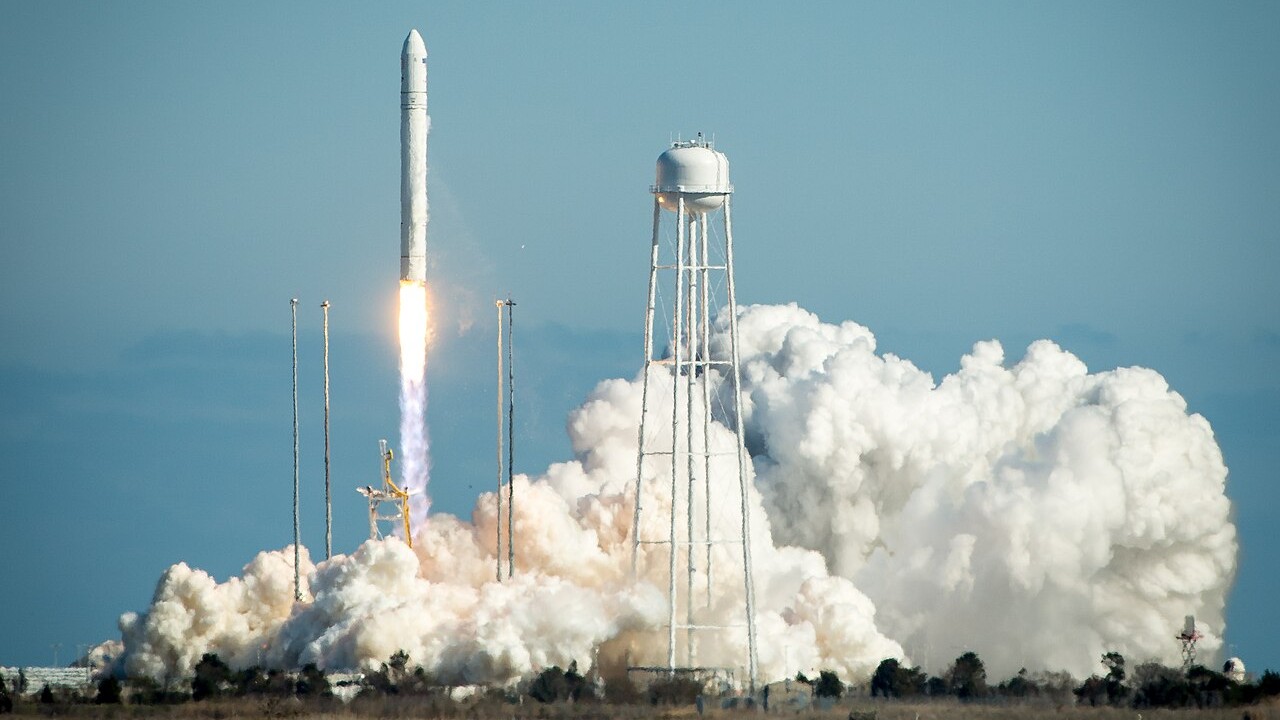
It was ultimately Orbital Sciences that gave them a second life, by integrating the NK-33-derived engines into the first stage of its Antares launcher, developed to resupply the International Space Station under NASA’s commercial contracts. The first stage uses, for the first time, the Russian NK-33 rocket engine, developed in the late 1960s for the Soviet lunar N-1 launcher, two instances of this engine driving the stage. Seen from the outside, the scene is striking: a launcher bearing the American flag taking off from Virginian soil, with the core technology of a project buried in the USSR for forty years at its heart.
For several flights, everything went smoothly. Then came October 28, 2014. The Antares rocket lifted off from Wallops Island, Virginia, carrying the Cygnus freight capsule toward the ISS. Fifteen seconds after ignition, disaster struck: an explosion ripped through the first stage, and the rocket crashed near its launchpad. The NASA independent review team concluded that there had been an explosion in the liquid-oxygen turbopump of one of the two AJ-26 engines, designated E15, in the first stage, roughly 15 seconds after liftoff.
The thorough investigation pointed to a precise defect. The investigation by Orbital ATK and NASA found a fault in the bore of the turbine housing bearing, not compliant with basic design requirements, a defect introduced during the machining of the bearing-bore housing before engine acceptance testing. A poorly machined part, sitting there since the engine’s manufacture decades earlier in the USSR or during its American remanufacture. A microscopic detail capable of toppling months of preparation in seconds.
The issue does not stop at a technical finding. Aerojet and Orbital ATK had insufficient knowledge of the NK-33’s design and its operational history from which the AJ-26 descended. A revealing admission: buying a Soviet engine also means inheriting a technical mystery that even Cold War heirs sometimes struggle to fully decipher. NASA states this plainly in its recommendations, demanding greater transparency about the industrial history of engines purchased abroad.
Orbital learned from the accident by definitively abandoning the venerable NK-33 in favor of newer Russian engines for later Antares versions. A question extends beyond the Soviet case: how many other Cold War technologies, forgotten in hangars or in boxes of archives, still await a second chance in today’s space industry?
Sources: slate.fr | americaspace.com
