
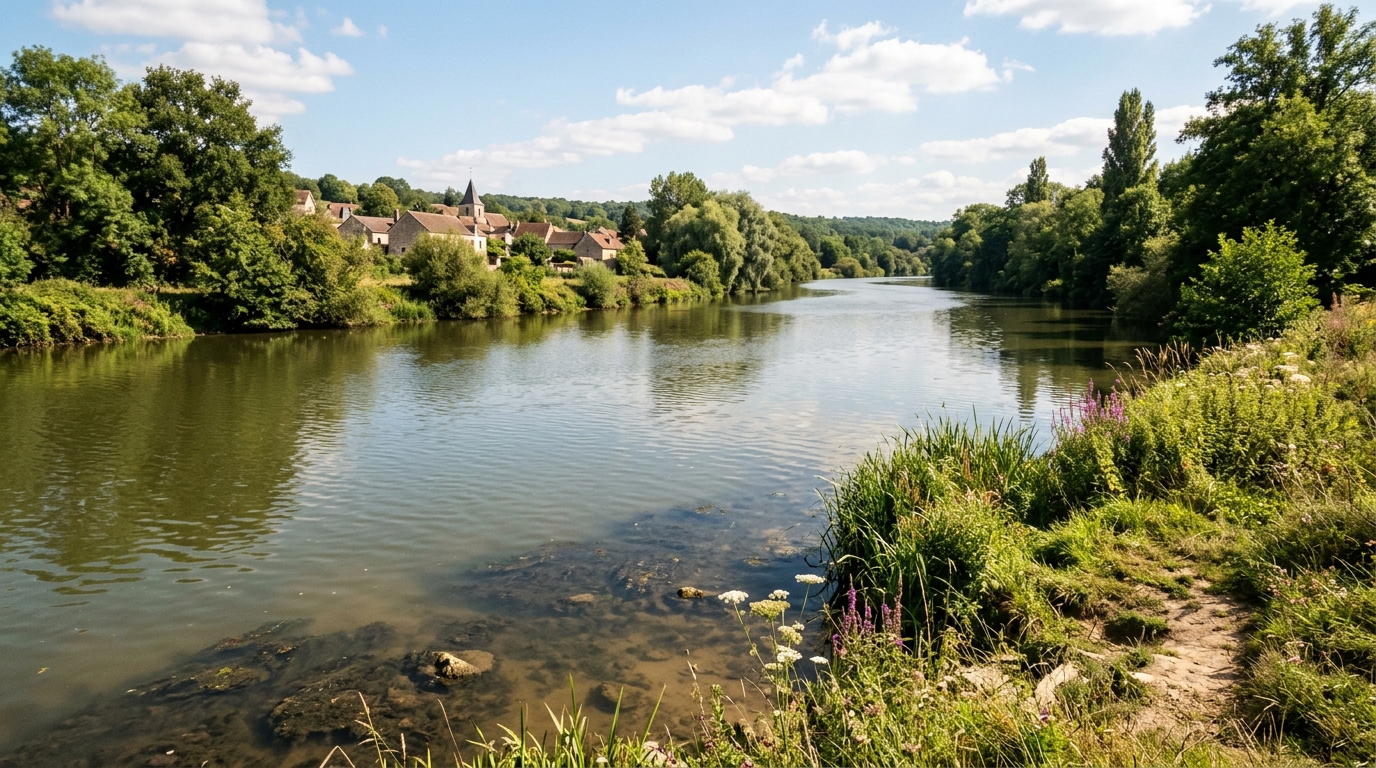
And what if the rivers where we swim in summer kept in memory pollutions nearly forty years old? The question may seem almost absurd, as we tend to believe that an official ban is enough to erase a problem. Yet beneath the calm surface of many French waterways, a chemical pollution dating from the last century continues quietly to contaminate. PCBs, those industrial compounds banned since 1987, have never truly left our rivers: they have simply hidden, tucked away in the mud, patiently waiting for the next flood event to resurface. A story that speaks volumes about the persistence of certain pollutants, far beyond the laws that forbid them.
Indestructible Molecules That Span Decades
Polychlorinated biphenyls, more commonly known by their acronym PCB, long served as valuable allies to French industry. Used extensively in electrical transformers and various industrial equipment up into the 1980s, these chemical compounds bore a quality that would become their worst flaw: an almost indestructible chemical stability. Their outright ban in France in 1987 should have marked the end of this pollution. It did not.
Because PCBs have a formidable characteristic: they are insoluble in water. Rather than dissolving and disappearing, these molecules have patiently accumulated in the sediments and silt located downstream of historic discharge points. Direct industrial discharges, clandestine dumping of old transformers, illegal riverbank dumps: the origins of this contamination are precisely identified. The result is a toxic legacy buried in the bed of our rivers, invisible yet real, that traverses decades without undergoing significant degradation.
When Floods Become a Chemical Time Bomb
As long as the sediments remain motionless at the bottom of the water, PCBs stay relatively confined. But nature is not static, and this is precisely where the problem takes a worrying turn. During major floods, these phenomena regularly observed after heavy rainfall or snowmelt, the river bed literally reconfigures. The strong currents scour the bottoms, re-suspend sediments accumulated over decades, and can transport these contaminated sediments over long distances.
This dynamic is exactly what has been studied by analyzing PCB contamination in sediments along four major French river corridors, over a remarkably long period spanning from 1945 to 2018. This work highlights a central mechanism: fine sediments play a decisive role in this process. Their small size and large surface area make them especially effective carriers for hydrophobic organic contaminants like PCBs. Thus, each major flood acts as a reveal, redistributing a pollution that had long seemed under control.
The Fish That Concentrates Forty Years of Industrial Pollution
Once remobilized, these chemical compounds do not stay inert for long. Extremely little biodegradable, they progressively integrate into the aquatic food chain. Filter-feeding organisms, then small fish, then the larger predators: at each step, PCBs become more concentrated, especially in the fats of fish. This phenomenon, known as bioaccumulation, explains why certain river species exhibit contamination levels well above those of the surrounding environment.
This chronic contamination is not without consequences for the overall balance of aquatic ecosystems. The chemical contaminants present in excess in the sediments can alter the biological quality elements of waterways, thereby jeopardizing the attainment of the well-known good ecological status that environmental policies aim to generalize. In response to this, health authorities have not stood idly by. Since 2008, a targeted monitoring strategy has been implemented, with regular sampling of river fish intended to prevent any risk of consuming specimens that do not meet the sanitary thresholds in force.
What makes these protocols particularly interesting is that they directly integrate the risk of remobilization by floods mentioned earlier. The scientific measurements are thus carried out at dates close enough to ensure that no flood event can intervene between two samplings. A precaution that shows how seriously this hydrological dynamic is now taken by control agencies.
Why Nobody Has Ever Drained These Poisoned Rivers
In the face of the scale of this enduring pollution, a natural question arises: why not simply remove these contaminated sediments once and for all? The answer lies in the very complexity of the problem. PCBs are not localized to a single, easily identifiable spot: they are dispersed over kilometers, sometimes tens of kilometers, along the river corridors, depending on the history of discharges and the multiple flood episodes that have progressively redistributed them over decades.
Dredging the entire bed of a river would be a colossal, costly, and potentially counterproductive undertaking: stirring these sediments without caution would risk reintroducing the PCBs into circulation on a massive scale. Therefore a pragmatic approach was chosen: rather than tackling the entire problem at its source, which today seems technically out of reach, authorities decided to monitor the consequences, by regularly checking the quality of fish destined for consumption. A risk-management approach that, forty years after the ban, illustrates the difficulty of completely erasing the traces of industrial pollution once it has durably infiltrated ecosystems.
This history of PCBs in our rivers underscores a truth that can be uncomfortable: banning a substance does not always erase its effects. Sediments, these silent archives at the bottom of waterways, continue to tell a past pollution that refuses to disappear completely. At a moment when new industrial molecules are appearing in our environment, this lesson deserves to be remembered, as it questions our collective ability to anticipate the long-term consequences of our current chemical choices.
